Hadjianfar Mehdi, Semnani Dariush, Varshosaz Jaleh, Mohammadi Sajad, Rezazadeh Tehrani Sayed Pedram
Department of Textile Engineering, Isfahan University of Technology, Isfahan, Iran.
Department of Pharmaceutics School of Pharmacy and Pharmaceutical Sciences, Isfahan University of Medical Sciences, Isfahan, Iran.
Adv Pharm Bull. 2022 May;12(3):568-582. doi: 10.34172/apb.2022.060. Epub 2021 Sep 29.
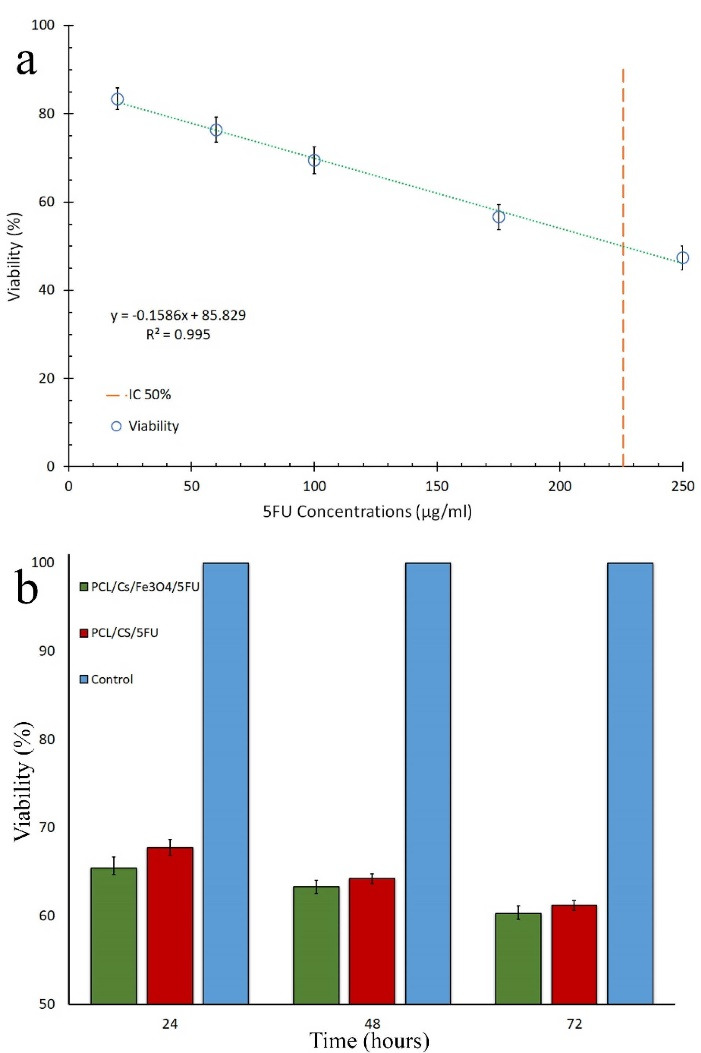
5-Fluorouracil (5FU) and FeO nanoparticles were encapsulated in core-shell polycaprolactone (PCL)/chitosan (CS) nanofibers as a multi-mode anticancer system to study drug release sustainability. The structure of the core-shell drug delivery system was also optimized according to drug release behavior by artificial intelligence. The core-shell nanofibers were electrospun by a coaxial syringe. Artificial neural network (ANN) was used for function approximation to estimate release parameters. A genetic algorithm was then used for optimizing the structure. Chemical assay of the optimized sample was performed by Fourier transform infrared spectroscopy (FTIR), X-ray diffraction (XRD), and energy-dispersive X-ray spectroscopy (EDX). vibration sample magnetometer (VSM) test was conducted to measure the real amount of loaded magnetic nanoparticles. HepG2 cell cytotoxicity was studied and the results for the optimized samples with and without FeO after 72 hours were reported. Feeding ratio of sheath to core and the amount of CS, FeO, and 5FU had a statistical effect on nanofibers diameters, which were 300-450 nm. The drug loading efficiency of these nanofibers was 65-86%. ANN estimated the release parameters with an error of 10%. The temperature increased about 5.6°C in the alternative magnetic field (AMF) of 216 kA.m300 kHz and 4.8°C in the AMF of 154 kA.m400 kHz after 20 minutes. HepG2 cell cytotoxicity for the optimized samples with and without FeO after 72 hours were 39.7% and 38.8%, respectively. Since this core-shell drug release system was more sustainable compared to the blend structure despite the low half-life of 5FU, it is suggested to utilize it as post-surgical implants for various cancer treatments such as liver or colorectal cancer in the future. This system is capable of providing chemotherapy and hyperthermia simultaneously.
5-氟尿嘧啶(5FU)和FeO纳米颗粒被包裹在核壳聚己内酯(PCL)/壳聚糖(CS)纳米纤维中,作为一种多模式抗癌系统,用于研究药物释放的可持续性。核壳药物递送系统的结构也通过人工智能根据药物释放行为进行了优化。核壳纳米纤维通过同轴注射器进行电纺丝。人工神经网络(ANN)用于函数逼近以估计释放参数。然后使用遗传算法优化结构。通过傅里叶变换红外光谱(FTIR)、X射线衍射(XRD)和能量色散X射线光谱(EDX)对优化后的样品进行化学分析。进行振动样品磁强计(VSM)测试以测量负载磁性纳米颗粒的实际量。研究了HepG2细胞的细胞毒性,并报告了72小时后含FeO和不含FeO的优化样品的结果。壳层与核层的进料比以及CS、FeO和5FU的量对直径为300-450nm的纳米纤维有统计学影响。这些纳米纤维的载药效率为65-86%。ANN估计释放参数的误差为10%。20分钟后,在216kA·m300kHz的交变磁场(AMF)中温度升高约5.6°C,在154kA·m400kHz的AMF中温度升高4.8°C。72小时后,含FeO和不含FeO的优化样品对HepG2细胞的细胞毒性分别为39.7%和38.8%。由于尽管5FU半衰期较短,但这种核壳药物释放系统与共混结构相比更具可持续性,因此建议将来将其用作各种癌症治疗(如肝癌或结直肠癌)的术后植入物。该系统能够同时提供化疗和热疗。