Hamed Samira M, Hussein Amira F A, Al-Agamy Mohamed H, Radwan Hesham H, Zafer Mai M
Department of Microbiology and Immunology, Faculty of Pharmacy, October University for Modern Sciences and Arts (MSA), Giza, Egypt.
Department of Clinical and Chemical Pathology, Faculty of Medicine, Cairo University, Cairo, Egypt.
Front Microbiol. 2022 Jul 22;13:878912. doi: 10.3389/fmicb.2022.878912. eCollection 2022.
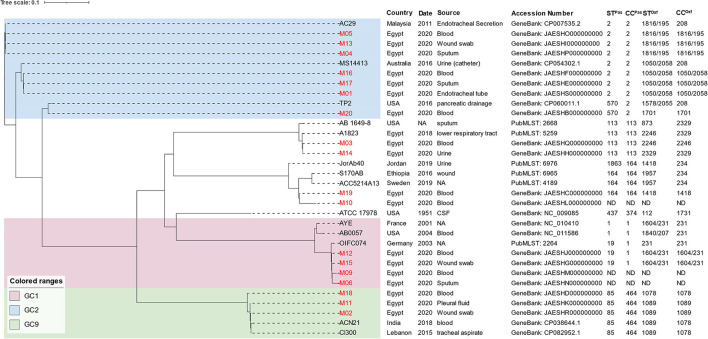
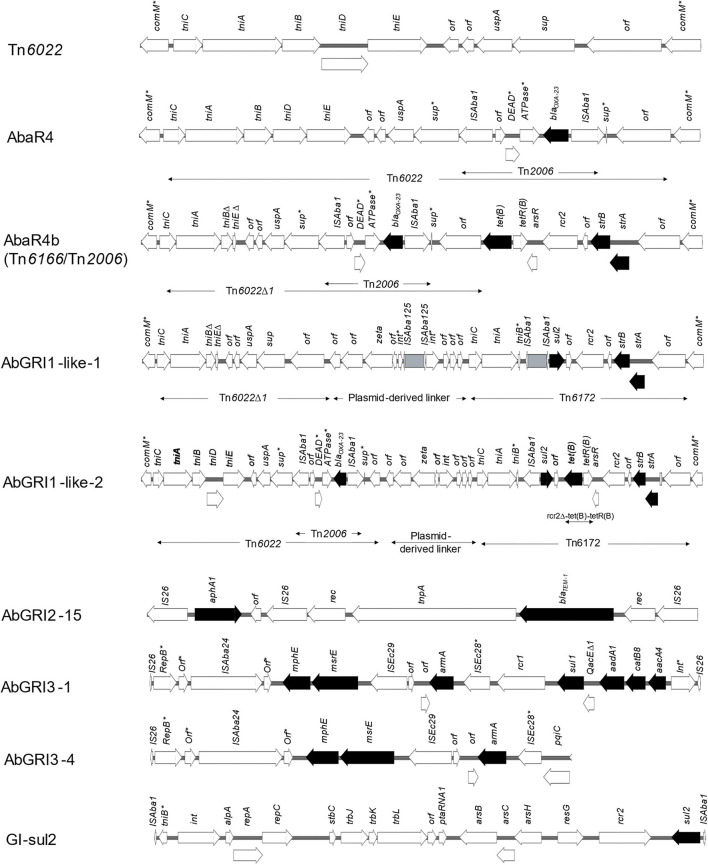
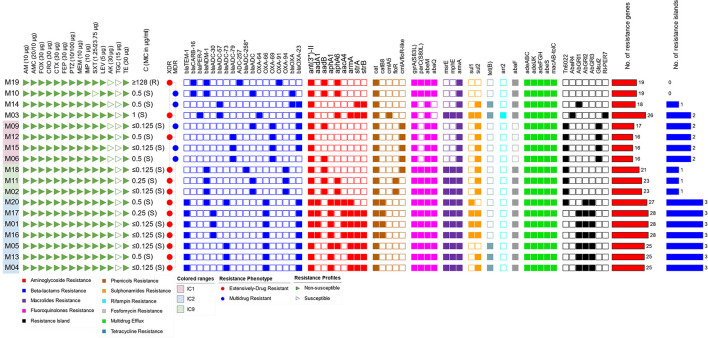
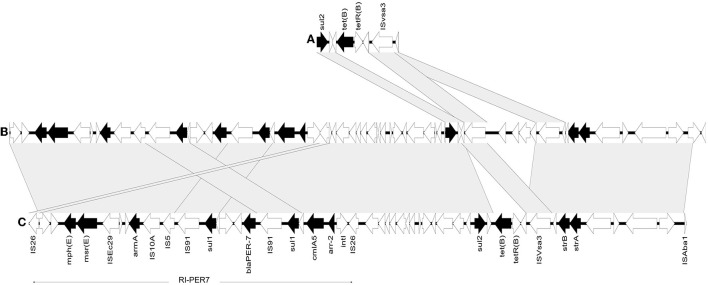
In (), a wide repertoire of resistance genes is often carried within genomic resistance islands (RIs), particularly in high-risk global clones (GCs). As the first in Egypt, the current study aimed at exploring the diversity and genetic configuration of RIs in the clinical isolates of . For this purpose, draft genomes of 18 isolates were generated by Illumina sequencing. Disk diffusion susceptibility profiling revealed multidrug resistance (MDR) and extensive drug resistance (XDR) phenotypes in 27.7 and 72.2%, respectively. The highest susceptibility was noted for tigecycline (100.0%) followed by colistin (94.4%), for which an MIC of 0.25 μg/ml was recorded by the broth microdilution assay. Sequence typing (ST) showed that the majority of the isolates belonged to high-risk global clones (GC1, GC2, and GC9). A novel Oxford sequence type (ST2329) that also formed a novel clonal complex was submitted to the PubMLST database. A novel variant ( ) was also identified in strain M18 (ST85/1089). In addition to a wide array of resistance determinants, whole-genome sequencing (WGS) disclosed at least nine configurations of genomic RIs distributed over 16/18 isolates. GC2 isolates accumulated the largest number of RIs (three RIs/isolate) followed by those that belong to GC1 (two RIs/isolate). In addition to Tn (44.4%), the gene was interrupted by AbaR4 (5.5%) and three variants of A. b genomic resistance island 1(AbGRI)-type RIs (44.4%), including AbaR4b (16.6%) and two novel configurations of AbGRI1-like RIs (22.2%). Three of which (AbaR4, AbaR4b, and AbGRI1-like-2) carried within Tn. With less abundance (38.8%), IS-bound RIs were detected exclusively in GC2 isolates. These included a short version of AbGRI2 (AbGRI2-15) carrying the genes and and two variants of AbGRI3 RIs carrying up to seven resistance genes []. Confined to GC1 (22.2%), sulfonamide resistance was acquired by an IS bracketed GIsul2 RI. An additional RI (RI-PER-7) was also identified on a plasmid carried by strain M03. Among others, RI-PER-7 carried the resistance genes and . Here, we provided a closer view of the diversity and genetic organization of RIs carried by a previously unexplored population of .
在()中,广泛的抗性基因库通常存在于基因组抗性岛(RIs)内,特别是在高风险全球克隆(GCs)中。作为埃及的首例研究,当前研究旨在探索()临床分离株中RIs的多样性和基因结构。为此,通过Illumina测序生成了18株分离株的草图基因组。纸片扩散药敏试验显示,分别有27.7%和72.2%的菌株呈现多重耐药(MDR)和广泛耐药(XDR)表型。替加环素的敏感性最高(100.0%),其次是黏菌素(94.4%),肉汤微量稀释法测得其MIC为0.25μg/ml。序列分型(ST)表明,大多数分离株属于高风险全球克隆(GC1、GC2和GC9)。一种新的牛津序列型(ST2329),它还形成了一个新的克隆复合体,已提交至PubMLST数据库。在菌株M18(ST85/1089)中还鉴定出一种新的()变体()。除了大量的抗性决定簇外,全基因组测序(WGS)还揭示了分布在16/18株分离株中的至少九种基因组RIs结构。GC2分离株积累的RIs数量最多(每株3个RIs),其次是属于GC1的分离株(每株2个RIs)。除了Tn(44.4%)外,()基因被AbaR4(5.5%)和三种A. b基因组抗性岛1(AbGRI)型RIs变体(44.4%)中断,包括AbaR4b(16.6%)和两种新型AbGRI1样RIs结构(22.2%)。其中三种(AbaR4、AbaR4b和AbGRI1样-2)在Tn内携带()。丰度较低(38.8%)的IS结合RIs仅在GC2分离株中检测到。这些包括携带()基因和()的短版本AbGRI2(AbGRI2-15)以及携带多达七个抗性基因的两种AbGRI3 RIs变体[ ]。局限于GC1(22.2%),通过一个被IS包围的GIsul2 RI获得了磺胺抗性。在菌株M03携带的质粒上还鉴定出另一个RI(RI-PER-7)。其中,RI-PER-7携带抗性基因()和()。在此,我们更深入地观察了以前未被探索的()群体所携带的RIs的多样性和基因组织。