Bogdanova Olena V, Bogdanov Volodymyr B, Pizano Adrien, Bouvard Manuel, Cazalets Jean-Rene, Mellen Nicholas, Amestoy Anouck
CNRS, Aquitaine Institute for Cognitive and Integrative Neuroscience, INCIA, UMR 5287, Université de Bordeaux, Bordeaux, France.
Laboratoire EA 4136 - Handicap Activité Cognition Santé HACS, Collège Science de la Sante, Institut Universitaire des Sciences de la Réadaptation, Université de Bordeaux, Bordeaux, France.
Front Psychiatry. 2022 Jul 22;13:910824. doi: 10.3389/fpsyt.2022.910824. eCollection 2022.
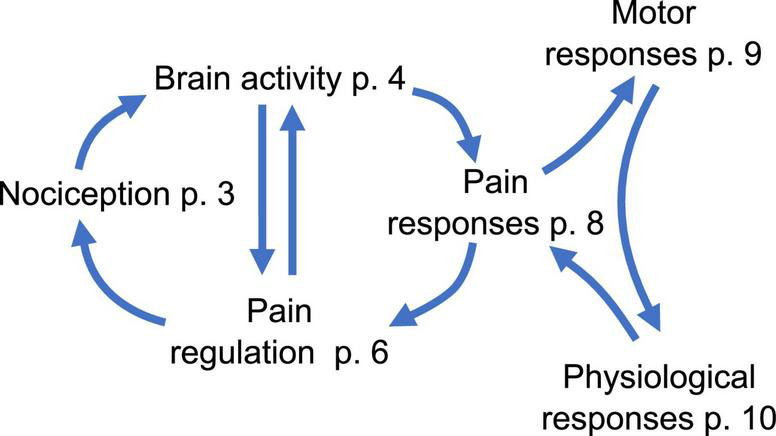
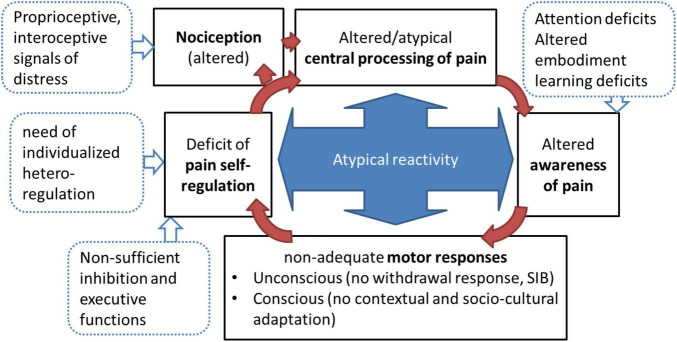
Autism spectrum disorder (ASD) is a neurodevelopmental disorder, which affects 1 in 44 children and may cause severe disabilities. Besides socio-communicational difficulties and repetitive behaviors, ASD also presents as atypical sensorimotor function and pain reactivity. While chronic pain is a frequent co-morbidity in autism, pain management in this population is often insufficient because of difficulties in pain evaluation, worsening their prognosis and perhaps driving higher mortality rates. Previous observations have tended to oversimplify the experience of pain in autism as being insensitive to painful stimuli. Various findings in the past 15 years have challenged and complicated this dogma. However, a relatively small number of studies investigates the physiological correlates of pain reactivity in ASD. We explore the possibility that atypical pain perception in people with ASD is mediated by alterations in pain perception, transmission, expression and modulation, and through interactions between these processes. These complex interactions may account for the great variability and sometimes contradictory findings from the studies. A growing body of evidence is challenging the idea of alterations in pain processing in ASD due to a single factor, and calls for an integrative view. We propose a model of the pain cycle that includes the interplay between the molecular and neurophysiological pathways of pain processing and it conscious appraisal that may interfere with pain reactivity and coping in autism. The role of social factors in pain-induced response is also discussed. Pain assessment in clinical care is mostly based on subjective rather than objective measures. This review clarifies the strong need for a consistent methodology, and describes innovative tools to cope with the heterogeneity of pain expression in ASD, enabling individualized assessment. Multiple measures, including self-reporting, informant reporting, clinician-assessed, and purely physiological metrics may provide more consistent results. An integrative view on the regulation of the pain cycle offers a more robust framework to characterize the experience of pain in autism.
自闭症谱系障碍(ASD)是一种神经发育障碍,每44名儿童中就有1人受其影响,可能导致严重残疾。除了社交沟通困难和重复行为外,ASD还表现为非典型的感觉运动功能和疼痛反应性。虽然慢性疼痛在自闭症中是一种常见的共病,但由于疼痛评估困难,该人群的疼痛管理往往不足,这会使他们的预后恶化,甚至可能导致更高的死亡率。以往的观察往往将自闭症患者的疼痛体验过于简单化,认为他们对疼痛刺激不敏感。过去15年的各种研究结果对这一教条提出了挑战,并使其变得复杂。然而,相对较少的研究调查了ASD中疼痛反应性的生理相关性。我们探讨了ASD患者非典型疼痛感知可能是由疼痛感知、传递、表达和调节的改变以及这些过程之间的相互作用介导的可能性。这些复杂的相互作用可能解释了研究中存在的巨大变异性以及有时相互矛盾的结果。越来越多的证据对ASD中疼痛处理改变是由单一因素导致的观点提出了挑战,并呼吁采用综合观点。我们提出了一个疼痛循环模型,该模型包括疼痛处理的分子和神经生理途径之间的相互作用以及可能干扰自闭症患者疼痛反应性和应对能力的意识评估。还讨论了社会因素在疼痛诱发反应中的作用。临床护理中的疼痛评估大多基于主观而非客观测量。本综述阐明了对一致方法的强烈需求,并描述了应对ASD中疼痛表达异质性的创新工具,以实现个性化评估。多种测量方法,包括自我报告、信息提供者报告、临床医生评估和纯生理指标,可能会提供更一致的结果。对疼痛循环调节的综合观点为描述自闭症患者的疼痛体验提供了一个更强大的框架。