Kasahara Satoshi, Yoshimoto Takahiko, Oka Hiroyuki, Sato Naoko, Morita Taito, Niwa Shin-Ichi, Uchida Kanji, Matsudaira Ko
Department of Anesthesiology and Pain Relief Center, The University of Tokyo Hospital, 7-3-1 Hongo, Bunkyo-ku, Tokyo, 113-8655, Japan.
Department of Pain Medicine, Fukushima Medical University School of Medicine, Fukushima, Japan.
Sci Rep. 2025 Apr 16;15(1):13165. doi: 10.1038/s41598-025-95864-4.
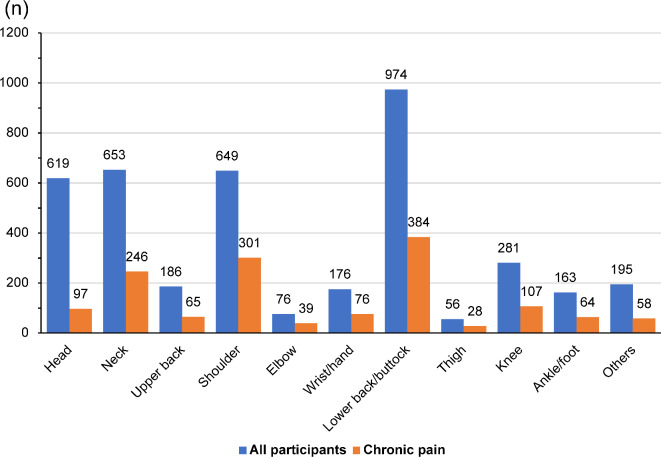
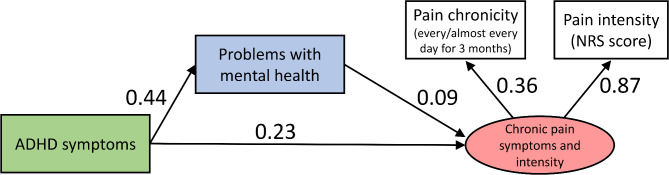
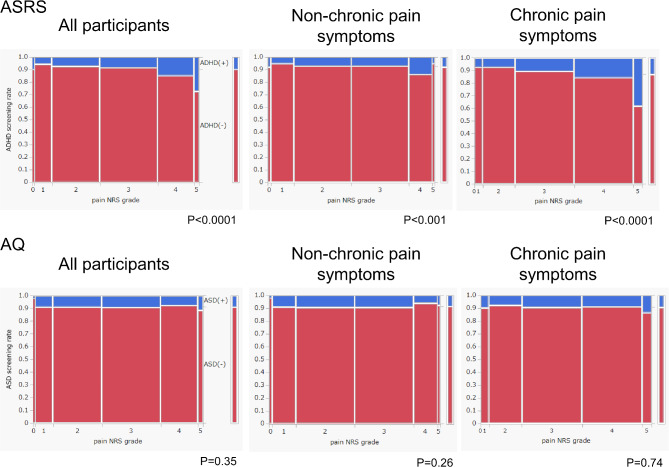
This cross-sectional epidemiological internet survey assessed whether attention deficit/hyperactivity disorder (ADHD) and autism spectrum disorder (ASD) symptoms are associated with pain chronicity and intensity and explored the relationship between developmental disorder symptoms and pain. Participants were 4028 adults aged 20-64 years who experienced pain, assessed using an 11-point numerical rating scale (NRS), in any body part in the previous 4 weeks. ADHD and ASD symptoms were assessed using the Adult ADHD Self-Report Scale (ASRS) and autism spectrum quotient, respectively. Problems with mental health (PMH) were assessed using the shortened Profile of Mood States. Pathway analyses were performed to examine the association between ADHD symptoms and pain. The chronic pain symptoms (CP) group (N = 1465) scored higher than the non-CP group (N = 2563) for all ASRS variables. ASRS positivity was associated with CP symptoms and increased with increasing NRS score; the CP group showed particularly high positivity (38.3%) with extreme pain. ADHD symptoms were more strongly associated with CP symptoms and intensity than was PMH (0.26 vs. 0.09). ADHD symptoms, but not ASD symptoms, were associated with CP symptoms. ADHD medications reportedly improve coexisting CP; therefore, ADHD screening and treatment may be important for patients with CP, especially those with extreme pain.
这项横断面流行病学网络调查评估了注意力缺陷/多动障碍(ADHD)和自闭症谱系障碍(ASD)症状是否与慢性疼痛及其强度相关,并探讨了发育障碍症状与疼痛之间的关系。参与者为4028名年龄在20 - 64岁之间、在过去4周内身体任何部位经历过疼痛的成年人,疼痛程度使用11点数字评分量表(NRS)进行评估。ADHD和ASD症状分别使用成人ADHD自我报告量表(ASRS)和自闭症谱系商数进行评估。心理健康问题(PMH)使用简化版情绪状态剖面图进行评估。进行路径分析以检验ADHD症状与疼痛之间的关联。慢性疼痛症状(CP)组(N = 1465)在所有ASRS变量上的得分均高于非CP组(N = 2563)。ASRS阳性与CP症状相关,且随着NRS评分的增加而增加;CP组在极端疼痛时显示出特别高的阳性率(38.3%)。与PMH相比,ADHD症状与CP症状及强度的关联更强(0.26对0.09)。ADHD症状而非ASD症状与CP症状相关。据报道,ADHD药物可改善并存的CP;因此,对CP患者,尤其是那些有极端疼痛的患者进行ADHD筛查和治疗可能很重要。