Liu Xinran, Wang Chengshi, Feng Yu, Shen Chaoyong, He Tao, Wang Zhu, Ma Linjie, Du Zhenggui
Clinical Research Center for Breast Diseases, West China Hospital, Sichuan University, Chengdu, China.
Sichuan Cancer Hospital and Institute, Sichuan Cancer Center, School of Medicine, University of Electronic Science and Technology of China, Chengdu, China.
Gland Surg. 2022 Jul;11(7):1224-1239. doi: 10.21037/gs-22-330.
Since numerous retrospective studies and prospective trials have shown divergent results, whether the surgical excision of the primary tumor results in survival benefits for stage IV breast cancer patients is inconclusive. Consequently, we need a prediction model of prognosis, judge the efficiency of breast surgery, and identify the advanced breast cancer patients who would benefit from surgery.
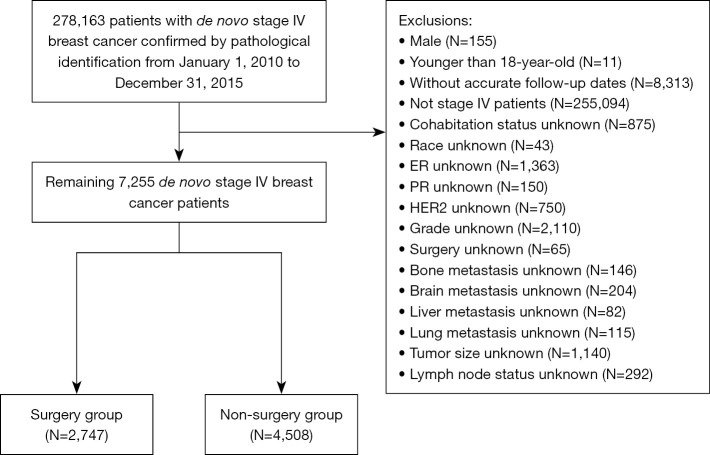
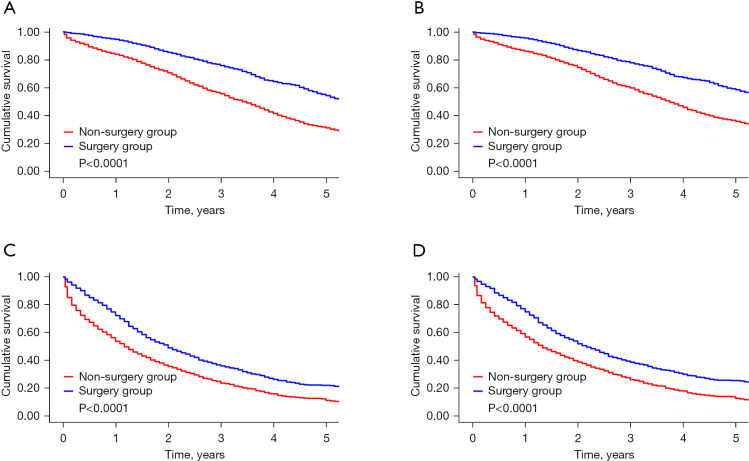
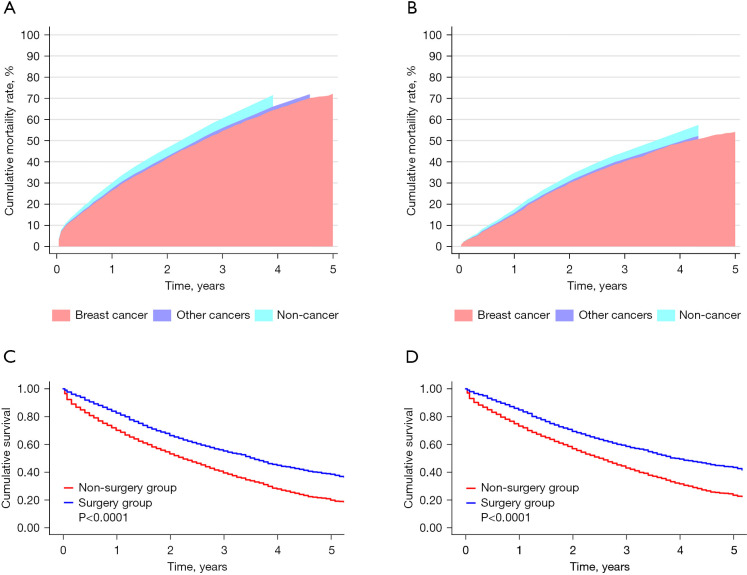
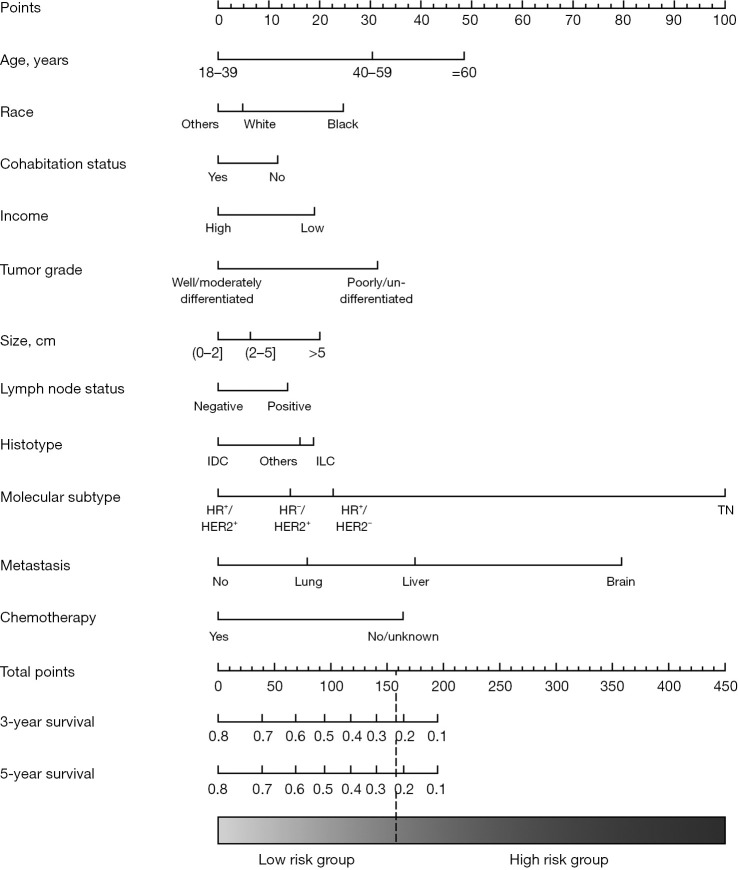
We analyzed the data of 2,747 metastatic breast cancer patients (the surgery group) and 4,508 patients (the non-surgery group) from the Surveillance, Epidemiology, and End Results (SEER) database during 2010-2015. Propensity score matching (PSM) was used to attain a balance between the covariates of both groups. We then assessed the potential risk factors for the breast cancer-specific survival (BCSS) of patients in the non-surgery group by Cox regression and constructed a nomogram to predict BCSS. All the patients were classified into different risk groups based on the median risk score obtained from the nomogram. The hazard ratios of BCSS and overall survival (OS) of patients in the two groups were calculated.
After PSM, 2,288 patients severally in the two groups (the surgery group and the non-surgery group) were enrolled in the study. A nomogram incorporating 13 potential risk factors (i.e., age, race, cohabitation status, income, tumor grade, histotype, tumor size, lymph node status, molecular subtype, metastasis to brain, liver, lung, and chemotherapy) was constructed using the data of patients in the non-surgery group. The C statistics for the internal (patients in the non-surgery group) and external (patients in the surgery group) validation of the nomogram were 0.70 [95% confidence interval (CI), 0.69-0.71] and 0.73 (95% CI, 0.72-0.74), respectively. In the low-risk group, patients in the surgery group had lower risks of breast cancer-specific mortality (BCSM) (hazard ratio =0.53; 95% CI, 0.47-0.59; P for interaction =0.014) and overall mortality (OM) (hazard ratio =0.52; 95% CI, 0.46-0.58; P for interaction =0.002) than those in the non-surgery group.
Breast surgery might improve the survival of metastatic breast cancer patients in the low-risk group. The established nomogram could provide a reference for clinicians in enabling personalized treatment among advanced breast cancer patients.
由于众多回顾性研究和前瞻性试验结果不一,对于IV期乳腺癌患者而言,原发性肿瘤手术切除是否能带来生存获益尚无定论。因此,我们需要一个预后预测模型,以判断乳腺癌手术的效果,并识别出能从手术中获益的晚期乳腺癌患者。
我们分析了监测、流行病学和最终结果(SEER)数据库中2010 - 2015年间2747例转移性乳腺癌患者(手术组)和4508例患者(非手术组)的数据。采用倾向评分匹配(PSM)使两组协变量达到平衡。然后,我们通过Cox回归评估非手术组患者乳腺癌特异性生存(BCSS)的潜在危险因素,并构建列线图以预测BCSS。根据列线图获得的中位风险评分将所有患者分为不同风险组。计算两组患者BCSS和总生存(OS)的风险比。
PSM后,两组(手术组和非手术组)各有2288例患者纳入研究。利用非手术组患者的数据构建了一个包含13个潜在危险因素(即年龄、种族、同居状态、收入、肿瘤分级、组织学类型、肿瘤大小、淋巴结状态、分子亚型、脑转移、肝转移、肺转移和化疗)的列线图。该列线图内部(非手术组患者)和外部(手术组患者)验证的C统计量分别为0.70 [95%置信区间(CI),0.69 - 0.71]和0.73(95% CI,0.72 - 0.74)。在低风险组中,手术组患者的乳腺癌特异性死亡率(BCSM)(风险比 = 0.53;95% CI,0.47 - 0.59;交互作用P值 = 0.014)和总死亡率(OM)(风险比 = 0.52;95% CI,0.46 - 0.58;交互作用P值 = 0.002)低于非手术组。
乳腺癌手术可能改善低风险组转移性乳腺癌患者的生存。所建立的列线图可为临床医生在晚期乳腺癌患者中进行个体化治疗提供参考。