Menon Dhruv, Ranganathan Raghavan
Department of Materials Engineering, Indian Institute of Technology Gandhinagar, Gandhinagar 382355, India.
ACS Omega. 2022 Jul 24;7(30):25958-25973. doi: 10.1021/acsomega.2c03264. eCollection 2022 Aug 2.
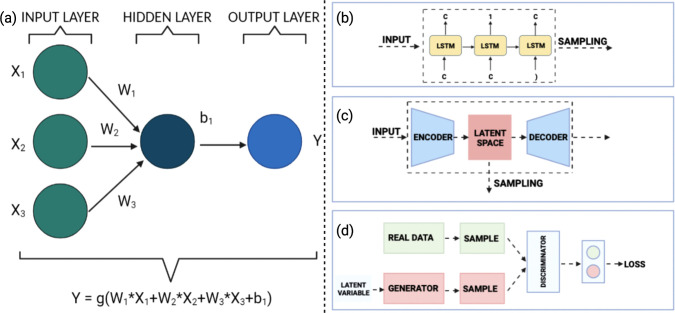
Despite its potential to transform society, materials research suffers from a major drawback: its long research timeline. Recently, machine-learning techniques have emerged as a viable solution to this drawback and have shown accuracies comparable to other computational techniques like density functional theory (DFT) at a fraction of the computational time. One particular class of machine-learning models, known as "generative models", is of particular interest owing to its ability to approximate high-dimensional probability distribution functions, which in turn can be used to generate novel data such as molecular structures by sampling these approximated probability distribution functions. This review article aims to provide an in-depth understanding of the underlying mathematical principles of popular generative models such as recurrent neural networks, variational autoencoders, and generative adversarial networks and discuss their state-of-the-art applications in the domains of biomaterials and organic drug-like materials, energy materials, and structural materials. Here, we discuss a broad range of applications of these models spanning from the discovery of drugs that treat cancer to finding the first room-temperature superconductor and from the discovery and optimization of battery and photovoltaic materials to the optimization of high-entropy alloys. We conclude by presenting a brief outlook of the major challenges that lie ahead for the mainstream usage of these models for materials research.
尽管材料研究具有改变社会的潜力,但它存在一个主要缺点:研究周期长。最近,机器学习技术已成为解决这一缺点的可行方案,并且在计算时间仅为其他计算技术(如密度泛函理论,DFT)一小部分的情况下,已显示出与它们相当的准确性。一类特别的机器学习模型,即“生成模型”,因其能够逼近高维概率分布函数而备受关注,进而可以通过对这些逼近的概率分布函数进行采样来生成新的数据,如分子结构。这篇综述文章旨在深入理解流行的生成模型(如递归神经网络、变分自编码器和生成对抗网络)的潜在数学原理,并讨论它们在生物材料和类有机药物材料、能源材料以及结构材料领域的最新应用。在此,我们讨论这些模型的广泛应用,从治疗癌症药物的发现到首个室温超导体的寻找,从电池和光伏材料的发现与优化到高熵合金的优化。最后,我们简要展望了这些模型在材料研究主流应用中面临的主要挑战。