Department of Systematic Theology, Friedrich-Alexander-Universität Erlangen-Nürnberg, Erlangen, Germany.
Front Public Health. 2022 Jul 22;10:859831. doi: 10.3389/fpubh.2022.859831. eCollection 2022.
In the context of the COVID-19 pandemic, there is much discussion about contact tracing apps, their use to contain the spread of the virus as well as the ethical, legal, and social aspects of their development, implementation, acceptance, and use. In these discussions, authors frequently mention "solidarity" when making key points in arguments. At the same time, authors rarely specify how they understand "solidarity". This lack of specification about how they understand "solidarity" can lead to misunderstandings in discussions.
To prevent such misunderstandings, it is important to specify how one understands "solidarity" when mentioning it in the discussions on contact tracing apps. Therefore, the aim of this paper is to elaborate how "solidarity" is understood in the context of contact tracing apps, i.e., how different authors understand "solidarity" when using it in discussions about these apps.
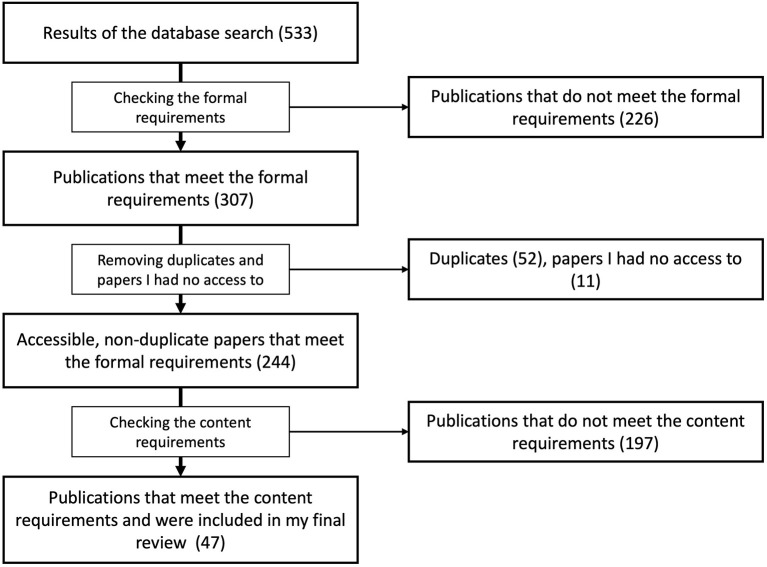
In order to find out how different authors understand "solidarity" when discussing contact tracing apps, I conduct a literature review. I collect papers from several databases, inductively work out central differences and similarities between the different uses of "solidarity", and use them to code and analyze relevant passages.
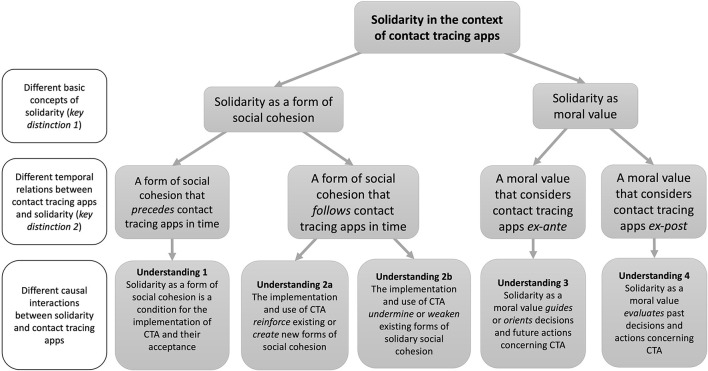
In the final sample, five different understandings of "solidarity" in the context of contact tracing apps can be identified. These understandings differ in how different authors (1) imagine the basic concept of solidarity, i.e., what "solidarity" refers to, (2) how they temporally relate solidarity to contact tracing apps, and (3) how they perceive the causal interactions between solidarity and contact tracing apps, i.e., the different ways in which solidarity and contact tracing apps influence each other.
The five understandings of "solidarity" in the context of contact tracing apps presented here can serve as guidance for how "solidarity" can be understood in discussions-thus contributing to a better mutual understanding and preventing communicative misunderstandings.
在 COVID-19 大流行背景下,人们对接触者追踪应用程序展开了大量讨论,包括使用此类应用程序来控制病毒传播,以及开发、实施、接受和使用此类应用程序所涉及的伦理、法律和社会问题。在这些讨论中,作者在提出观点时经常提到“团结”一词。与此同时,作者很少具体说明他们对“团结”的理解。这种在讨论中提及“团结”时缺乏具体说明的做法可能会导致误解。
为了避免这种误解,在讨论接触者追踪应用程序时提及“团结”一词时,明确说明如何理解“团结”非常重要。因此,本文的目的是详细阐述在接触者追踪应用程序的背景下如何理解“团结”,即不同作者在讨论这些应用程序时使用“团结”一词时对“团结”的理解。
为了了解不同作者在讨论接触者追踪应用程序时如何理解“团结”,我进行了文献回顾。我从多个数据库中收集了论文,归纳出不同作者在使用“团结”一词时的核心差异和相似之处,并使用这些差异和相似之处对相关段落进行编码和分析。
在最终的样本中,可以确定在接触者追踪应用程序的背景下有五种不同的“团结”理解。这些理解在以下三个方面存在差异:不同作者(1)如何想象团结的基本概念,即“团结”所指为何;(2)如何将团结与接触者追踪应用程序在时间上联系起来;(3)如何看待团结与接触者追踪应用程序之间的因果相互作用,即团结和接触者追踪应用程序如何相互影响。
本文提出的接触者追踪应用程序背景下的五种“团结”理解,可以作为理解讨论中“团结”的指导,从而促进更好的相互理解,防止沟通误解。