King's College London, UK.
Graduate Institute of International and Development Studies, Switzerland.
Health (London). 2023 Jul;27(4):625-644. doi: 10.1177/13634593211060768. Epub 2021 Nov 23.
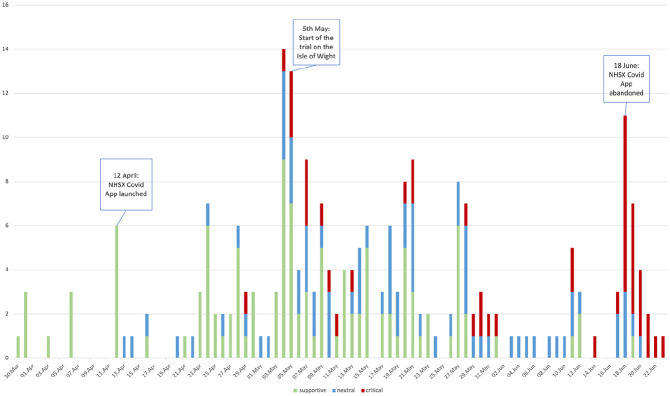
The UK's National Health Service (NHS) COVID-19 contact tracing app was announced to the British public on 12th April 2020. The UK government endorsed the app as a public health intervention that would improve public health, protect the NHS and 'save lives'. On 5th May 2020 the technology was released for trial on the Isle of Wight. However, the trial was halted in June 2020, reportedly due to technological issues. The app was later remodelled and launched to the public in September 2020. The rapid development, trial and discontinuation of the app over a short period of a few months meant that the mobilisation and effect of the discourses associated with the app could be traced relatively easily. In this paper we aimed to explore how these discourses were constructed in the media, and their effect on actors - in particular, those who developed and those who trialled the app. Promissory discourses were prevalent, the trajectory of which aligned with theories developed in the sociology of expectations. We describe this trajectory, and then interpret its implications in terms of infectious disease public health practices and responsibilities.
英国国民保健制度(NHS)的 COVID-19 接触者追踪应用程序于 2020 年 4 月 12 日向英国公众宣布。英国政府认可该应用程序是一项公共卫生干预措施,将改善公共卫生、保护国民保健制度并“拯救生命”。2020 年 5 月 5 日,该技术在怀特岛进行了试用。然而,据报道,由于技术问题,该试验于 2020 年 6 月停止。该应用程序后来经过重新设计,并于 2020 年 9 月向公众推出。该应用程序在短短几个月的时间内经历了快速开发、试验和停用,这意味着与该应用程序相关的论述的动员和影响可以相对容易地追踪。在本文中,我们旨在探讨这些论述是如何在媒体中构建的,以及它们对参与者的影响——特别是那些开发和试用该应用程序的人。有希望的论述是普遍存在的,其轨迹与期望社会学中发展的理论相一致。我们描述了这一轨迹,然后从传染病公共卫生实践和责任的角度来解释其含义。