Yuan Zihao, Jiang Shuai, Qin Kunpeng, Sun Li
CAS and Shandong Province Key Laboratory of Experimental Marine Biology, Institute of Oceanology, CAS Center for Ocean Mega-Science, Chinese Academy of Sciences, Qingdao, China.
Laboratory for Marine Biology and Biotechnology, Pilot National Laboratory for Marine Science and Technology, Qingdao, China.
Front Cell Dev Biol. 2022 Jul 22;10:952015. doi: 10.3389/fcell.2022.952015. eCollection 2022.
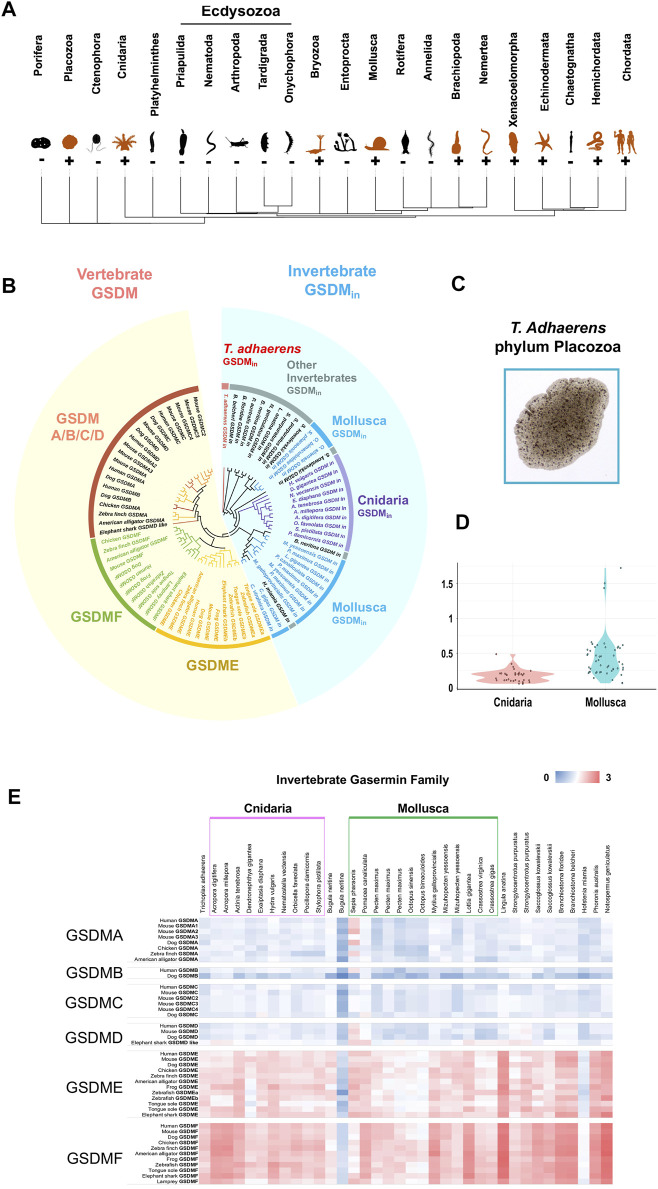
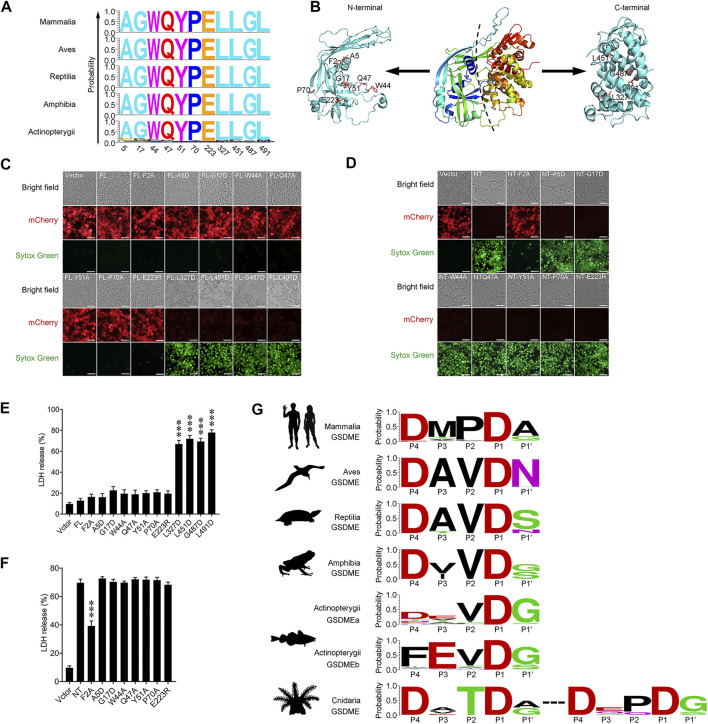
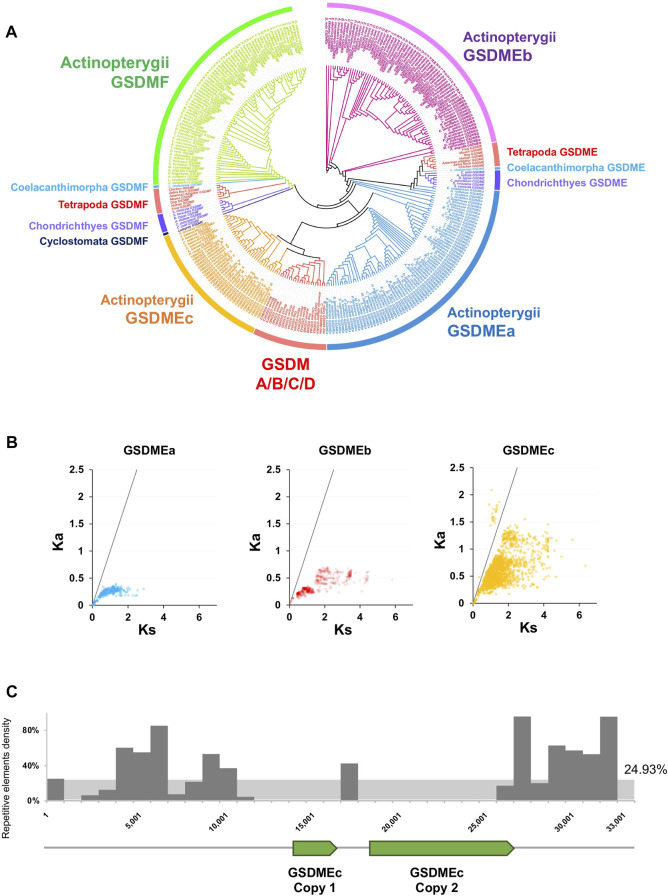
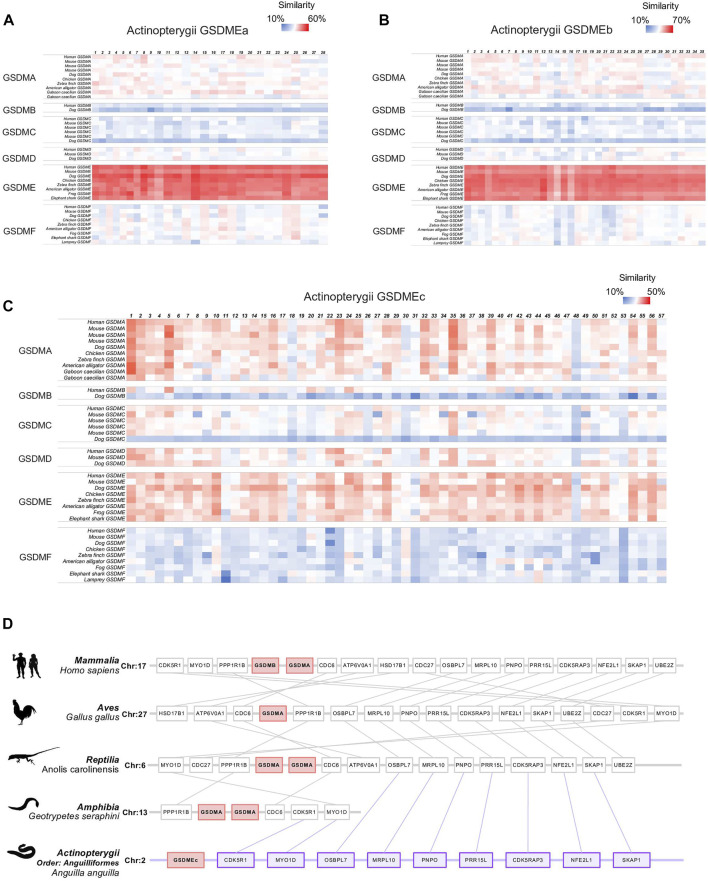
Gasdermin (GSDM) is a family of pore-forming proteins that induce pyroptosis. To date, the origin and evolution of GSDM in Metazoa remain elusive. Here, we found that GSDM emerged early in Placozoa but is absent in a large number of invertebrates. In the lower vertebrate, fish, three types of GSDME, i.e., GSDMEa, GSDMEb, and a previously unreported type (designated GSDMEc), were idenitied. Evolutionarily, the three GSDMEs are distinctly separated: GSDMEa is closely related to tetrapod GSDME; GSDMEb exists exclusively in fish; GSDMEc forms the lineage root of tetrapod GSDMA/B/C/D. GSDMEc shares conserved genomic features with and is probably the prototype of GSDMA, which we found existing in all tetrapod classes. GSDMEc displays fast evolutionary dynamics, likely as a result of genomic transposition. A cross-metazoan analysis of GSDME revealed that GSDMEa shares a conserved caspase recognition motif with the GSDME of tetrapods and cnidarians, whereas GSDMEb has a unique caspase recognition motif similar to that of mammalian GSDMD, and GSDMEc exhibits no apparent caspase recognition motif. Through functional test, four highly conserved residues in vertebrate GSDME proved to be essential to auto-inhibition. Together our results provide new insights into the origin, evolution, and function of metazoan GSDMs.
Gasdermin(GSDM)是一类可诱导细胞焦亡的成孔蛋白家族。迄今为止,后生动物中GSDM的起源和进化仍不清楚。在此,我们发现GSDM在扁盘动物中出现得较早,但在大量无脊椎动物中不存在。在低等脊椎动物鱼类中,鉴定出了三种类型的GSDME,即GSDMEa、GSDMEb和一种先前未报道的类型(命名为GSDMEc)。在进化上,这三种GSDME明显分开:GSDMEa与四足动物的GSDME密切相关;GSDMEb仅存在于鱼类中;GSDMEc构成了四足动物GSDMA/B/C/D的谱系根源。GSDMEc与GSDMA具有保守的基因组特征,可能是GSDMA的原型,我们发现其存在于所有四足动物类别中。GSDMEc表现出快速的进化动力学,可能是基因组转座的结果。对GSDME进行的跨后生动物分析表明,GSDMEa与四足动物和刺胞动物的GSDME共享一个保守的半胱天冬酶识别基序,而GSDMEb具有与哺乳动物GSDMD相似的独特半胱天冬酶识别基序,并且GSDMEc没有明显的半胱天冬酶识别基序。通过功能测试,脊椎动物GSDME中的四个高度保守的残基被证明对自我抑制至关重要。我们的研究结果共同为后生动物GSDM的起源、进化和功能提供了新的见解。