Zukunftskolleg, University of Konstanz, Konstanz, 78464 Germany.
Department of Biology, University of Konstanz, Konstanz, 78464 Germany.
Proc Natl Acad Sci U S A. 2022 Aug 16;119(33):e2204754119. doi: 10.1073/pnas.2204754119. Epub 2022 Aug 8.
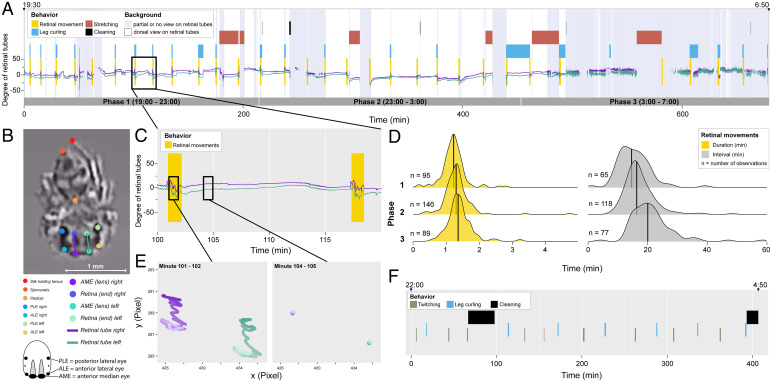
Sleep and sleep-like states are present across the animal kingdom, with recent studies convincingly demonstrating sleep-like states in arthropods, nematodes, and even cnidarians. However, the existence of different sleep phases across taxa is as yet unclear. In particular, the study of rapid eye movement (REM) sleep is still largely centered on terrestrial vertebrates, particularly mammals and birds. The most salient indicator of REM sleep is the movement of eyes during this phase. Movable eyes, however, have evolved only in a limited number of lineages-an adaptation notably absent in insects and most terrestrial arthropods-restricting cross-species comparisons. Jumping spiders, however, possess movable retinal tubes to redirect gaze, and in newly emerged spiderlings, these movements can be directly observed through their temporarily translucent exoskeleton. Here, we report evidence for an REM sleep-like state in a terrestrial invertebrate: periodic bouts of retinal movements coupled with limb twitching and stereotyped leg curling behaviors during nocturnal resting in a jumping spider. Observed retinal movement bouts were consistent, including regular durations and intervals, with both increasing over the course of the night. That these characteristic REM sleep-like behaviors exist in a highly visual, long-diverged lineage further challenges our understanding of this sleep state. Comparisons across such long-diverged lineages likely hold important questions and answers about the visual brain as well as the origin, evolution, and function of REM sleep.
睡眠和类似睡眠的状态存在于整个动物王国中,最近的研究令人信服地证明了节肢动物、线虫,甚至刺胞动物都存在类似睡眠的状态。然而,不同分类群之间存在不同的睡眠阶段尚不清楚。特别是快速眼球运动(REM)睡眠的研究仍然主要集中在陆地脊椎动物,特别是哺乳动物和鸟类上。REM 睡眠的最显著标志是在这个阶段眼睛的运动。然而,可移动的眼睛仅在有限数量的谱系中进化而来——这一适应在昆虫和大多数陆地节肢动物中明显缺失,限制了跨物种的比较。跳蛛拥有可移动的视网膜管来重新定向视线,而在新孵化的幼蛛中,这些运动可以通过它们暂时透明的外骨骼直接观察到。在这里,我们报告了一种在陆地无脊椎动物中存在 REM 睡眠样状态的证据:在夜间休息时,周期性的视网膜运动伴随着四肢抽搐和刻板的腿部卷曲行为。观察到的视网膜运动发作是一致的,包括有规律的持续时间和间隔,两者在夜间都有所增加。这些特征性的 REM 睡眠样行为存在于一个高度视觉化、长期分化的谱系中,这进一步挑战了我们对这种睡眠状态的理解。在如此长期分化的谱系中进行比较,可能会对视觉大脑以及 REM 睡眠的起源、进化和功能提出重要的问题和答案。