Computational Neuroethology Unit, Okinawa Institute of Science and Technology (OIST) Graduate University, Okinawa, Japan.
Marine Animal Research Support Team, Okinawa Institute of Science and Technology Graduate University, Okinawa, Japan.
Nature. 2023 Jul;619(7968):129-134. doi: 10.1038/s41586-023-06203-4. Epub 2023 Jun 28.
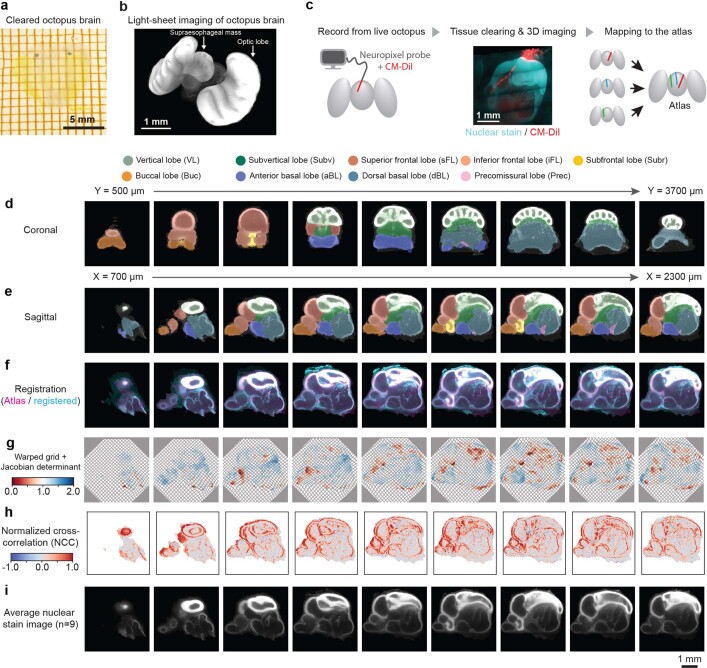
While sleeping, many vertebrate groups alternate between at least two sleep stages: rapid eye movement and slow wave sleep, in part characterized by wake-like and synchronous brain activity, respectively. Here we delineate neural and behavioural correlates of two stages of sleep in octopuses, marine invertebrates that evolutionarily diverged from vertebrates roughly 550 million years ago (ref. ) and have independently evolved large brains and behavioural sophistication. 'Quiet' sleep in octopuses is rhythmically interrupted by approximately 60-s bouts of pronounced body movements and rapid changes in skin patterning and texture. We show that these bouts are homeostatically regulated, rapidly reversible and come with increased arousal threshold, representing a distinct 'active' sleep stage. Computational analysis of active sleep skin patterning reveals diverse dynamics through a set of patterns conserved across octopuses and strongly resembling those seen while awake. High-density electrophysiological recordings from the central brain reveal that the local field potential (LFP) activity during active sleep resembles that of waking. LFP activity differs across brain regions, with the strongest activity during active sleep seen in the superior frontal and vertical lobes, anatomically connected regions associated with learning and memory function. During quiet sleep, these regions are relatively silent but generate LFP oscillations resembling mammalian sleep spindles in frequency and duration. The range of similarities with vertebrates indicates that aspects of two-stage sleep in octopuses may represent convergent features of complex cognition.
在睡眠过程中,许多脊椎动物群体至少会交替经历两种睡眠阶段:快速眼动睡眠和慢波睡眠,其分别部分以类似于清醒的同步脑活动为特征。在这里,我们描述了章鱼(一种与脊椎动物大约在 5.5 亿年前分化的海洋无脊椎动物)的两种睡眠阶段的神经和行为相关性,章鱼独立进化出了大型大脑和复杂的行为。章鱼的“安静”睡眠会被大约 60 秒的身体运动和皮肤图案及质地的快速变化所周期性打断。我们表明,这些睡眠阶段是受体内平衡调节的,能迅速逆转,并伴有觉醒阈值的增加,代表了一个独特的“活跃”睡眠阶段。通过一组在章鱼中保守且强烈类似于清醒状态的模式,对活跃睡眠皮肤图案进行的计算分析揭示了多样化的动力学。高密度脑电记录从中枢大脑揭示,活跃睡眠期间的局部场电位(LFP)活动类似于清醒状态下的活动。LFP 活动在不同脑区有所不同,在与学习和记忆功能相关的额上和垂直叶中,活跃睡眠时的 LFP 活动最强。在安静睡眠期间,这些区域相对安静,但产生的 LFP 振荡在频率和持续时间上类似于哺乳动物的睡眠纺锤波。与脊椎动物的相似性表明,章鱼的两阶段睡眠的某些方面可能代表了复杂认知的趋同特征。