Future Urbanity & Sustainable Environment (FUSE) Lab, Division of Landscape Architecture, Department of Architecture, Faculty of Architecture, The University of Hong Kong, Hong Kong SAR, China.
Urban Systems Institute, The University of Hong Kong, Hong Kong SAR, China.
Nat Commun. 2022 Aug 8;13(1):4636. doi: 10.1038/s41467-022-32258-4.
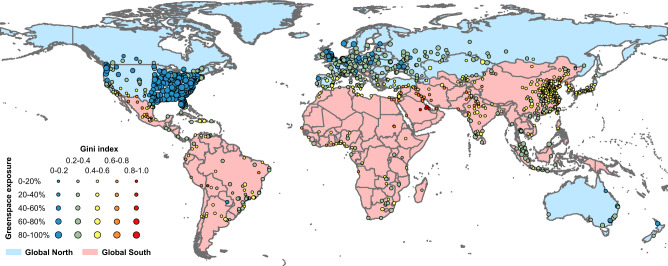
The United Nations specified the need for "providing universal access to greenspace for urban residents" in the 11th Sustainable Development Goal. Yet, how far we are from this goal remains unclear. Here, we develop a methodology incorporating fine-resolution population and greenspace mappings and use the results for 2020 to elucidate global differences in human exposure to greenspace. We identify a contrasting difference of greenspace exposure between Global South and North cities. Global South cities experience only one third of the greenspace exposure level of Global North cities. Greenspace exposure inequality (Gini: 0.47) in Global South cities is nearly twice that of Global North cities (Gini: 0.27). We quantify that 22% of the spatial disparity is associated with greenspace provision, and 53% is associated with joint effects of greenspace provision and spatial configuration. These findings highlight the need for prioritizing greening policies to mitigate environmental disparity and achieve sustainable development goals.
联合国在第 11 个可持续发展目标中明确指出“为城市居民提供普遍可及的绿地”的必要性。然而,我们离这个目标还有多远尚不清楚。在这里,我们开发了一种结合精细分辨率人口和绿地映射的方法,并使用 2020 年的结果来说明人类接触绿地的全球差异。我们发现,全球南、北城市之间的绿地暴露存在显著差异。全球南方城市的绿地暴露水平仅为全球北方城市的三分之一。全球南方城市的绿地暴露不平等程度(基尼系数:0.47)接近全球北方城市(基尼系数:0.27)的两倍。我们量化了 22%的空间差异与绿地供应有关,而 53%与绿地供应和空间配置的联合效应有关。这些发现强调了需要优先考虑绿化政策,以减轻环境差距,实现可持续发展目标。