Bhattarai Saurav, Bokati Laxman, Sharma Sanjib, Talchabhadel Rocky
Department of Civil and Environmental Engineering, Jackson State University, Jackson, MS, USA.
School of Sustainable Engineering and the Built Environment, Arizona State University, Tempe, AZ, USA.
Sci Rep. 2025 Mar 27;15(1):10643. doi: 10.1038/s41598-025-95097-5.
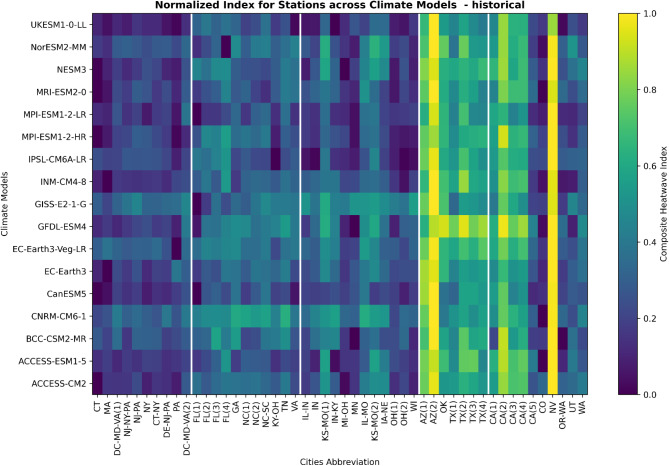
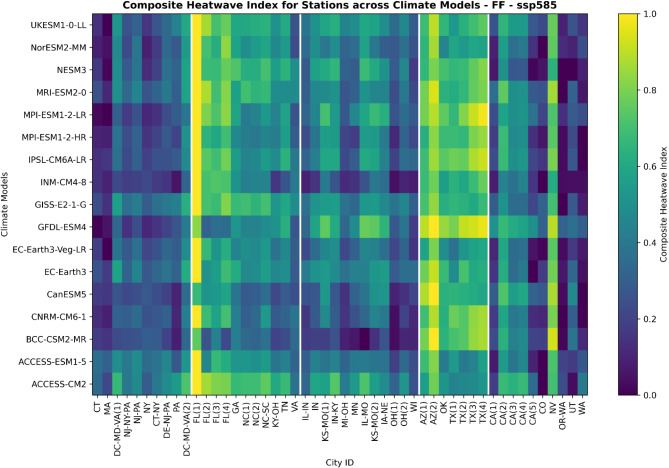
Heatwaves are one of the deadliest meteorological hazards, posing a substantial risk to human health, environment, and the economy. The frequency and intensity of heatwaves have substantially escalated throughout the United States (US), as evidenced by a noticeable contrast between the average occurrence of two heatwaves per year during the 1960s and the surge to six per year during the 2010s. The primary objective of this study is to assess the impacts of past heatwave events in major US cities, project future scenarios, and analyze the relationship between heatwaves and their associated health and environmental consequences. First, we investigate the spatio-temporal variations in the intensity, frequency, and duration of past heatwaves, along with anticipated changes under various shared socioeconomic pathways till the end of 2100. Secondly, we examine the adverse heatwave impacts on human health and well-being, considering both current demographics and future projections. Our results highlight significant projected increases in heatwave frequency, intensity, and duration across all US regions, with the most dramatic escalations under high-emission scenarios. By the late twenty-first century, cities could experience up to 2-4 times the frequency and duration of heatwave days annually compared to the baseline period (1985-2014), with night-time heatwave durations potentially covering over half the year in some regions. Furthermore, analysis using composite heatwave indices reveals severe heat stresses, particularly in southwestern cities like Las Vegas and Yuma, and southern cities like Miami, indicating a rising trend of heatwave susceptibility due to both climatic and demographic shifts. This study contributes to the growing body of research advocating proactive measures to address the escalating threat of heatwaves. By integrating projected climate indices and demographic shift, it provides a nuanced assessment of urban heatwave vulnerability, with a specific focus on densely populated cities and high-risk regions.
热浪是最致命的气象灾害之一,对人类健康、环境和经济构成重大风险。在美国,热浪的频率和强度大幅上升,20世纪60年代每年平均发生两次热浪,到2010年代激增至每年六次,这一显著对比就是明证。本研究的主要目的是评估美国主要城市过去热浪事件的影响,预测未来情景,并分析热浪与其相关的健康和环境后果之间的关系。首先,我们调查过去热浪在强度、频率和持续时间方面的时空变化,以及到2100年底在各种共享社会经济路径下的预期变化。其次,我们考虑当前人口统计数据和未来预测,研究热浪对人类健康和福祉的不利影响。我们的结果突出显示,预计美国所有地区的热浪频率、强度和持续时间将显著增加,在高排放情景下增幅最为显著。到21世纪后期,与基线期(1985 - 2014年)相比,城市每年可能经历热浪天数的频率和持续时间增加2至4倍,在某些地区夜间热浪持续时间可能长达半年以上。此外,使用综合热浪指数的分析显示,特别是在拉斯维加斯和尤马等西南部城市以及迈阿密等南部城市存在严重的热应激,这表明由于气候和人口结构变化,热浪易感性呈上升趋势。本研究为倡导采取积极措施应对不断升级的热浪威胁的研究做出了贡献。通过整合预计的气候指数和人口结构变化,它对城市热浪脆弱性进行了细致入微的评估,特别关注人口密集城市和高风险地区。