Shionogi & Co., Ltd., 1-8 Doshomachi 3-Chome, Chuo-ku, Osaka, Osaka 541-0045, Japan; AdvanSentinel Inc., 1-8 Doshomachi 3-Chome, Chuo-ku, Osaka, Osaka 541-0045, Japan.
Division of Clinical Genome Research, The Institute of Medical Science, The University of Tokyo, 4-6-1 Shirokanedai, Minato-ku, Tokyo 108-8639, Japan.
Sci Total Environ. 2022 Nov 25;849:157869. doi: 10.1016/j.scitotenv.2022.157869. Epub 2022 Aug 6.
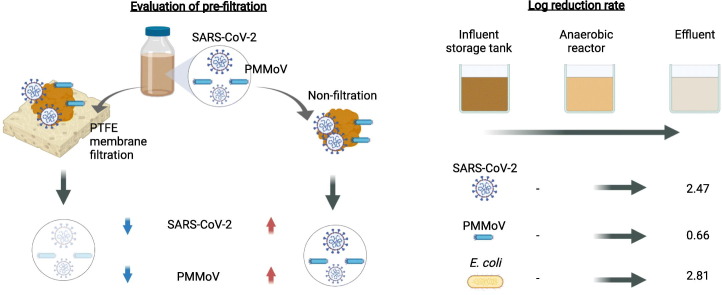
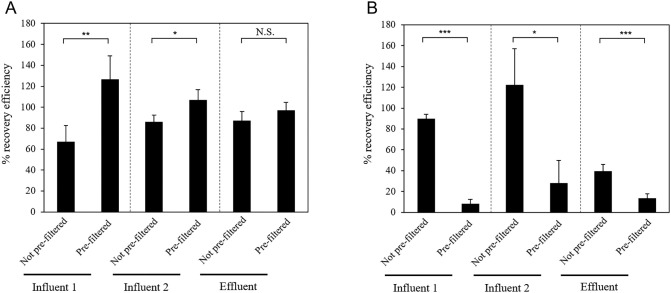
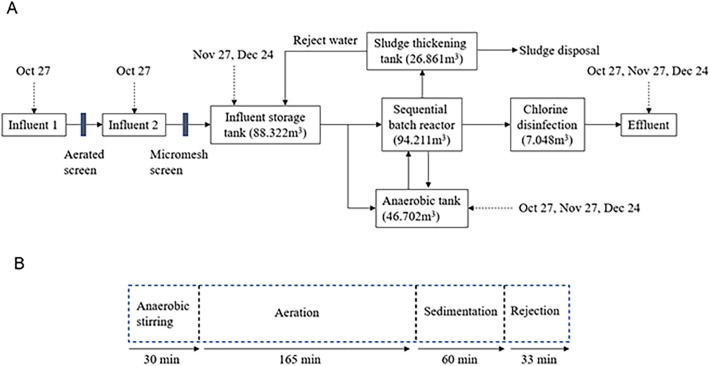
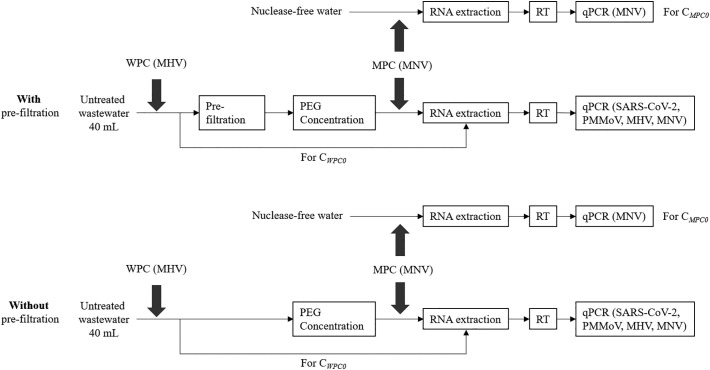
Severe acute respiratory syndrome coronavirus 2 (SARS-CoV-2) is known to be present in sewage, and wastewater-based epidemiology has attracted much attention. However, the physical partitioning of SARS-CoV-2 in wastewater and the removal efficiency of treatment systems require further investigation. This study aimed to investigate the detectability and physical partitioning of SARS-CoV-2 in wastewater and assess its removal in a large-scale septic tank employing anaerobic, anoxic, and oxic processes in a sequential batch reactor, which was installed in a coronavirus disease 2019 (COVID-19) quarantine facility. The amount of SARS-CoV-2 RNA in wastewater was determined with polyethylene glycol (PEG) precipitation followed by quantitative polymerase chain reaction (qPCR), and the association of SARS-CoV-2 with wastewater solids was evaluated by the effect of filtration prior to PEG precipitation (pre-filtration). The amount of SARS-CoV-2 RNA detected from pre-filtered samples was substantially lower than that of samples without pre-filtration. These results suggest that most SARS-CoV-2 particles in wastewater are associated with the suspended solids excluded by pre-filtration. The removal efficiency of SARS-CoV-2 in the septic tank was evaluated based on the SARS-CoV-2 RNA concentrations in untreated and treated wastewater, which was determined by the detection method optimized in this study. Escherichia coli and pepper mild mottle virus (PMMoV) were also quantified to validate the wastewater treatment system's performance. The mean log reduction values of SARS-CoV-2, E. coli, and PMMoV were 2.47 (range, 2.25-2.68), 2.81 (range, 2.45-3.18), and 0.66 (range, 0.61-0.70), respectively, demonstrating that SARS-CoV-2 removal by the wastewater treatment system was comparable to or better than the removal of fecal indicators. These results suggest that SARS-CoV-2 can be readily removed by the septic tank. This is the first study to determine the removal efficiency of SARS-CoV-2 in a facility-level sequencing batch activated sludge system.
严重急性呼吸系统综合征冠状病毒 2(SARS-CoV-2)已知存在于污水中,基于污水的流行病学已引起广泛关注。然而,SARS-CoV-2 在污水中的物理分配以及处理系统的去除效率仍需要进一步研究。本研究旨在调查 SARS-CoV-2 在污水中的可检测性和物理分配,并评估其在采用厌氧、缺氧和好氧工艺的序批式反应器中大型化粪池中的去除效果,该序批式反应器安装在 2019 年冠状病毒病(COVID-19)隔离设施中。采用聚乙二醇(PEG)沉淀结合定量聚合酶链反应(qPCR)测定污水中 SARS-CoV-2 RNA 的含量,并通过 PEG 沉淀前过滤(预过滤)评估 SARS-CoV-2 与污水固体的关联。预过滤样品中检测到的 SARS-CoV-2 RNA 量明显低于未预过滤样品中的量。这些结果表明,污水中大多数 SARS-CoV-2 颗粒与预过滤排除的悬浮固体有关。根据本研究优化的检测方法,通过测定未经处理和处理污水中的 SARS-CoV-2 RNA 浓度来评估化粪池中 SARS-CoV-2 的去除效率。还定量测定了大肠杆菌和辣椒轻斑驳病毒(PMMoV)以验证废水处理系统的性能。SARS-CoV-2、大肠杆菌和 PMMoV 的平均对数减少值分别为 2.47(范围,2.25-2.68)、2.81(范围,2.45-3.18)和 0.66(范围,0.61-0.70),表明 SARS-CoV-2 由废水处理系统去除的效果可与粪便指标的去除效果相媲美或优于。这些结果表明,SARS-CoV-2 可以很容易地被化粪池去除。这是首次在设施级序批式活性污泥系统中确定 SARS-CoV-2 去除效率的研究。