Department of Animal and Food Sciences, University of Delaware, Newark, DE, United States; Center for Environmental and Wastewater-based Epidemiological Research, University of Delaware, Newark, DE, United States.
Department of Animal and Food Sciences, University of Delaware, Newark, DE, United States.
Sci Total Environ. 2022 Jul 15;830:154619. doi: 10.1016/j.scitotenv.2022.154619. Epub 2022 Mar 16.
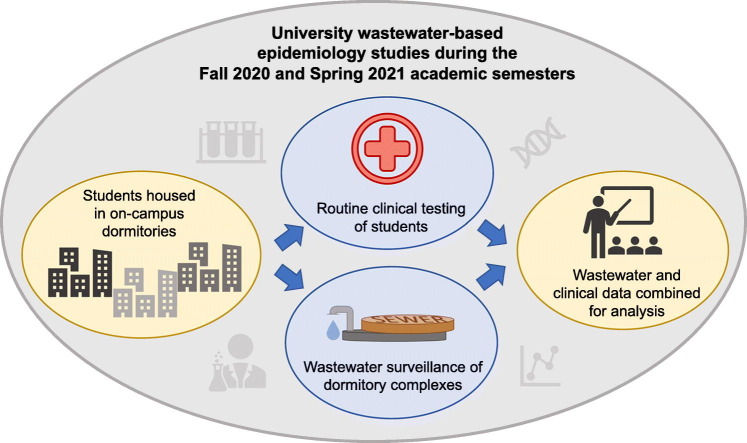
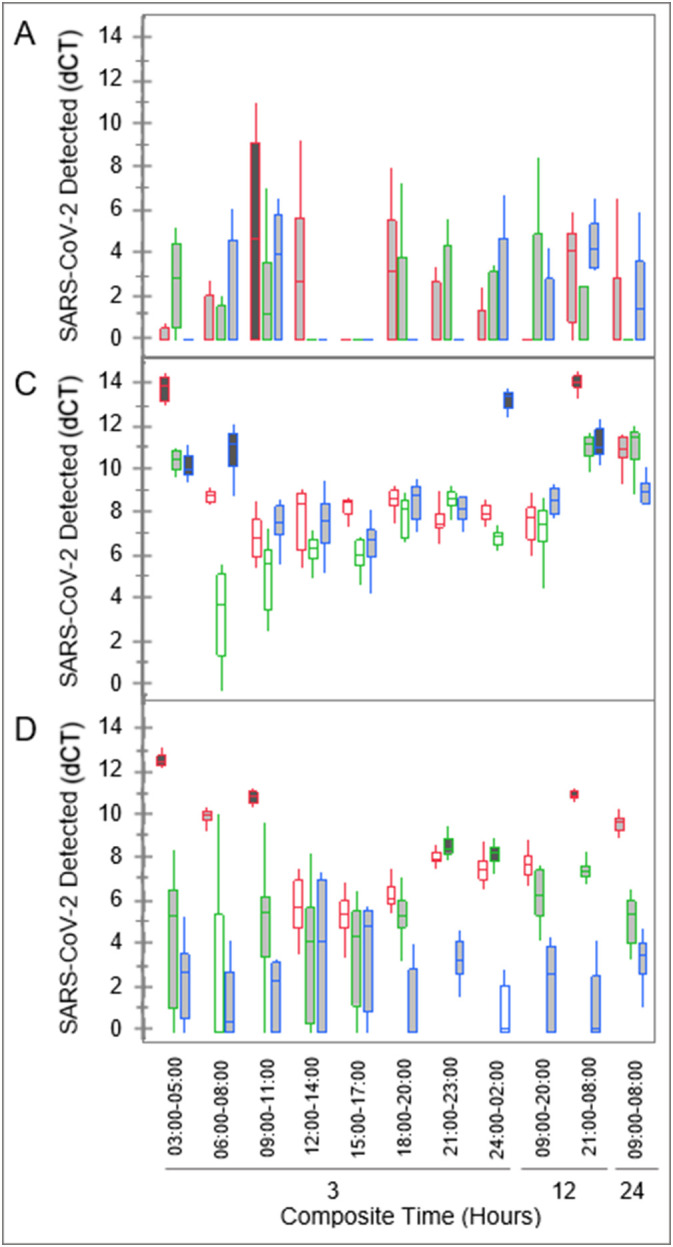
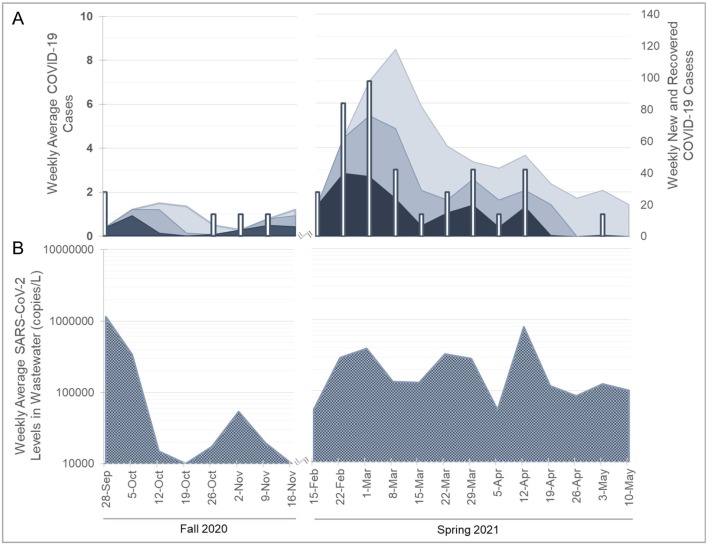
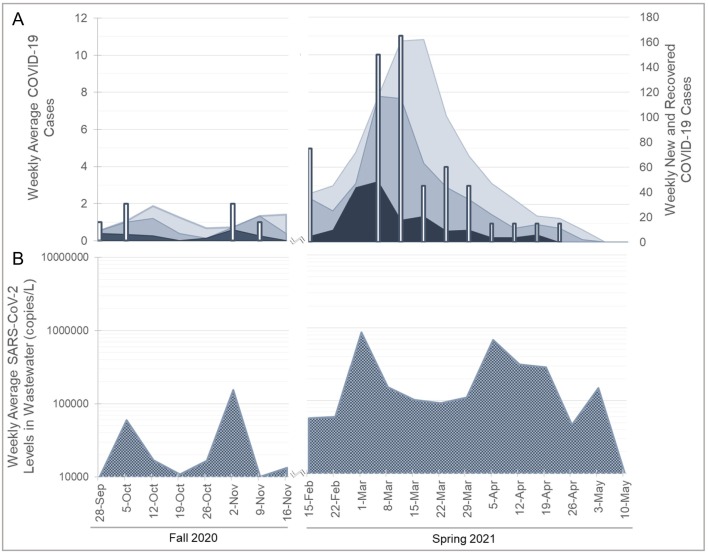
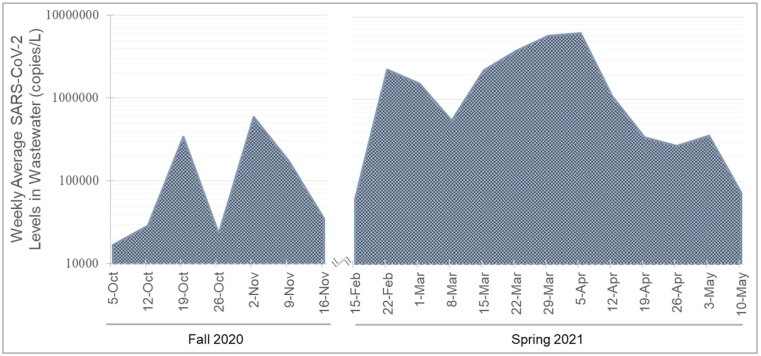
Wastewater surveillance has been a useful tool complementing clinical testing during the COVID-19 pandemic. However, transitioning surveillance approaches to small populations, such as dormitories and assisted living facilities poses challenges including difficulties with sample collection and processing. Recently, the need for reliable and timely data has coincided with the need for precise local forecasting of the trajectory of COVID-19. This study compared wastewater and clinical data from the University of Delaware (Fall 2020 and Spring 2021 semesters), and evaluated wastewater collection practices for enhanced virus detection sensitivity. Fecal shedding of SARS-CoV-2 is known to occur in infected individuals. However, shedding concentrations and duration has been shown to vary. Therefore, three shedding periods (14, 21, and 30 days) were presumed and included for analysis of wastewater data. SARS-CoV-2 levels detected in wastewater correlated with clinical virus detection when a positive clinical test result was preceded by fecal shedding of 21 days (p< 0.05) and 30 days (p < 0.05), but not with new cases (p = 0.09) or 14 days of shedding (p = 0.17). Discretely collected wastewater samples were compared with 24-hour composite samples collected at the same site. The discrete samples (n = 99) were composited examining the influence of sampling duration and time of day on SARS-CoV-2 detection. SARS-CoV-2 detection varied among dormitory complexes and sampling durations of 3-hour, 12-hour, and 24-hour (controls). Collection times frequently showing high detection values were between the hours of 03:00 to 05:00 and 23:00 to 08:00. In each of these times of day 33% of samples (3/9) were significantly higher (p < 0.05) than the control sample. The remainder (6/9) of the collection times (3-hour and 12-hour) were not different (p > 0.05) from the control. This study provides additional framework for continued methodology development for microbiological wastewater surveillance as the COVID-19 pandemic progresses and in preparation for future epidemiological efforts.
污水监测在 COVID-19 大流行期间一直是临床检测的有用补充手段。然而,将监测方法转变为宿舍和辅助生活设施等小群体,存在样本采集和处理方面的困难等挑战。最近,对可靠和及时数据的需求与 COVID-19 轨迹的精确本地预测需求同时出现。本研究比较了特拉华大学的污水和临床数据(2020 年秋季和 2021 年春季学期),并评估了污水收集实践,以提高病毒检测的灵敏度。已知 SARS-CoV-2 在感染个体中会出现粪便脱落。然而,脱落浓度和持续时间已被证明有所不同。因此,假设并包括三个脱落期(14、21 和 30 天)来分析污水数据。当临床阳性检测结果之前出现 21 天(p<0.05)和 30 天(p<0.05)的粪便脱落时,污水中检测到的 SARS-CoV-2 水平与临床病毒检测相关,但与新病例(p=0.09)或 14 天的脱落(p=0.17)无关。离散收集的污水样本与在同一地点收集的 24 小时综合样本进行了比较。离散样本(n=99)在检查采样持续时间和一天中的时间对 SARS-CoV-2 检测的影响时进行了组合。宿舍综合体之间的 SARS-CoV-2 检测情况有所不同,采样持续时间为 3 小时、12 小时和 24 小时(对照)。经常显示高检测值的采集时间在 03:00 至 05:00 之间和 23:00 至 08:00 之间。在这些时间中的每一个,有 33%的样本(3/9)明显高于(p<0.05)对照样本。其余(6/9)的采集时间(3 小时和 12 小时)与对照样本没有差异(p>0.05)。本研究为在 COVID-19 大流行期间继续开发微生物污水监测方法以及为未来的流行病学努力做准备提供了额外的框架。