Melbourne Neuropsychiatry Centre, Department of Psychiatry, The University of Melbourne, Carlton, VIC, Australia.
Centre for Developmental Psychiatry and Psychology, Southern Clinical School, Monash University, Clayton, VIC, 3168, Australia.
Transl Psychiatry. 2022 Aug 9;12(1):322. doi: 10.1038/s41398-022-02084-9.
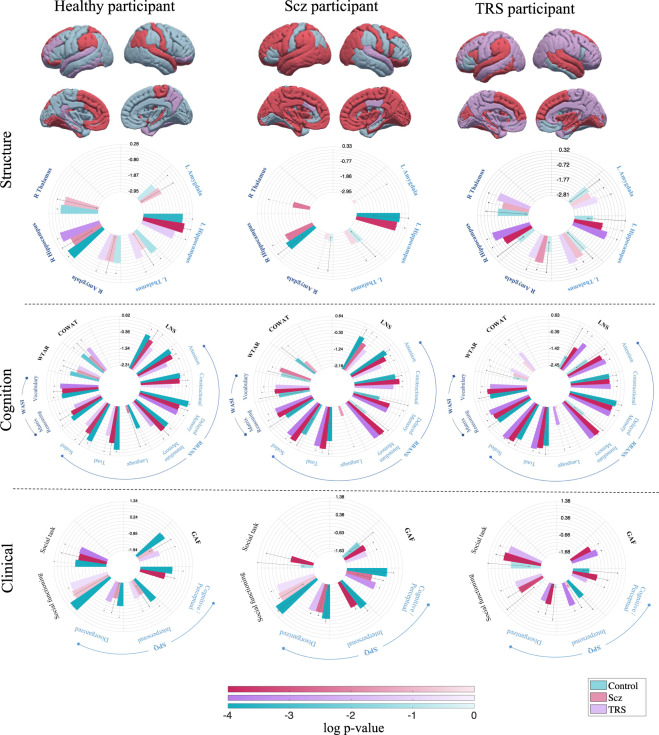
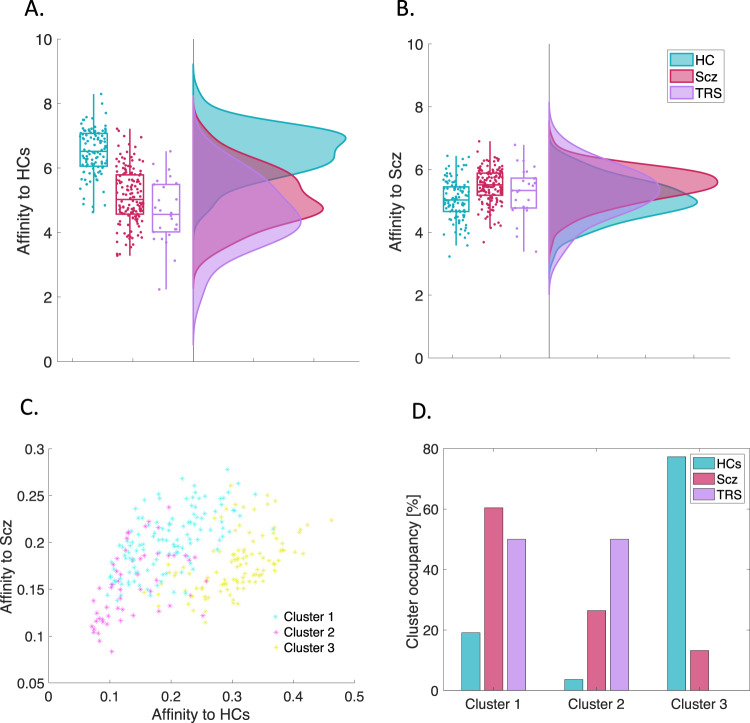
Population-centric frameworks of biomarker identification for psychiatric disorders focus primarily on comparing averages between groups and assume that diagnostic groups are (1) mutually-exclusive, and (2) homogeneous. There is a paucity of individual-centric approaches capable of identifying individual-specific 'fingerprints' across multiple domains. To address this, we propose a novel framework, combining a range of biopsychosocial markers, including brain structure, cognition, and clinical markers, into higher-level 'fingerprints', capable of capturing intra-illness heterogeneity and inter-illness overlap. A multivariate framework was implemented to identify individualised patterns of brain structure, cognition and clinical markers based on affinity to other participants in the database. First, individual-level affinity scores defined each participant's "neighbourhood" across each measure based on variable-specific hop sizes. Next, diagnostic verification and classification algorithms were implemented based on multivariate affinity score profiles. To perform affinity-based classification, data were divided into training and test samples, and 5-fold nested cross-validation was performed on the training data. Affinity-based classification was compared to weighted K-nearest neighbours (KNN) classification. The framework was applied to the Australian Schizophrenia Research Bank (ASRB) dataset, which included data from individuals with chronic and treatment resistant schizophrenia and healthy controls. Individualised affinity scores provided a 'fingerprint' of brain structure, cognition, and clinical markers, which described the affinity of an individual to the representative groups in the dataset. Diagnostic verification capability was moderate to high depending on the choice of multivariate affinity metric. Affinity score-based classification achieved a high degree of accuracy in the training, nested cross-validation and prediction steps, and outperformed KNN classification in the training and test datasets. Affinity scores demonstrate utility in two keys ways: (1) Early and accurate diagnosis of neuropsychiatric disorders, whereby an individual can be grouped within a diagnostic category/ies that best matches their fingerprint, and (2) identification of biopsychosocial factors that most strongly characterise individuals/disorders, and which may be most amenable to intervention.
以人群为中心的精神障碍生物标志物识别框架主要侧重于比较组间平均值,并假设诊断组(1)相互排斥,(2)同质。缺乏能够在多个领域识别个体特异性“指纹”的以个体为中心的方法。为了解决这个问题,我们提出了一种新的框架,将一系列生物心理社会标志物(包括大脑结构、认知和临床标志物)结合到更高层次的“指纹”中,能够捕捉到疾病内的异质性和疾病间的重叠。采用多变量框架根据与数据库中其他参与者的亲和力来识别个体的大脑结构、认知和临床标志物的个体化模式。首先,根据特定于变量的跳跃大小,基于亲和力为每个参与者在每个测量值上定义了其“邻居”的个体水平亲和力得分。接下来,基于多元亲和力得分分布实现了诊断验证和分类算法。为了进行基于亲和力的分类,将数据分为训练和测试样本,并在训练数据上进行 5 折嵌套交叉验证。将基于亲和力的分类与加权 K 最近邻(KNN)分类进行了比较。该框架应用于澳大利亚精神分裂症研究银行(ASRB)数据集,该数据集包括患有慢性和治疗抵抗性精神分裂症的个体以及健康对照者的数据。个性化亲和力得分提供了大脑结构、认知和临床标志物的“指纹”,描述了个体与数据集代表群体的亲和力。诊断验证能力取决于所选择的多元亲和力度量,中等至高。基于亲和力得分的分类在训练、嵌套交叉验证和预测步骤中实现了高度准确性,并且在训练和测试数据集中优于 KNN 分类。亲和力得分在两个关键方面具有实用性:(1)神经精神障碍的早期和准确诊断,即个体可以在最符合其指纹的诊断类别/类别中进行分组,(2)识别最能描述个体/疾病的生物心理社会因素,这些因素可能最容易干预。