Department of Obstetrics and Gynecology, University of Campinas (UNICAMP), Rua Alexander Fleming, 101 - Cidade Universitaria, Campinas, SP, 13083-881, Brazil.
Division of Gynecologic and Breast Oncology, Women's Hospital, UNICAMP, Rua Alexander Fleming, 101 - Cidade Universitaria, Campinas, SP, 13083-881, Brazil.
BMC Public Health. 2020 Apr 28;20(1):576. doi: 10.1186/s12889-020-08688-4.
The causal relationship between high-risk (hr) HPV infection and precancerous lesions or cervical cancer has led to the development of strategies to increase screening performance and prevent this cancer. The increased sensitivity of DNA-HPV testing compared to cervical cytology favors DNA-HPV testing as a primary screening test. Cervical cancer screening in Brazil is opportunistic, and this cancer remains a considerable health problem with a high proportion of diagnoses in advanced stages. This paper aims to describe the design and implementation of the Cervical Cancer Screening Program with primary DNA-HPV testing (CCSP-HPV) planned for Indaiatuba City (SP), Brazil; the strategies to achieve higher population coverage; and a study protocol for cost-effectiveness analyses.
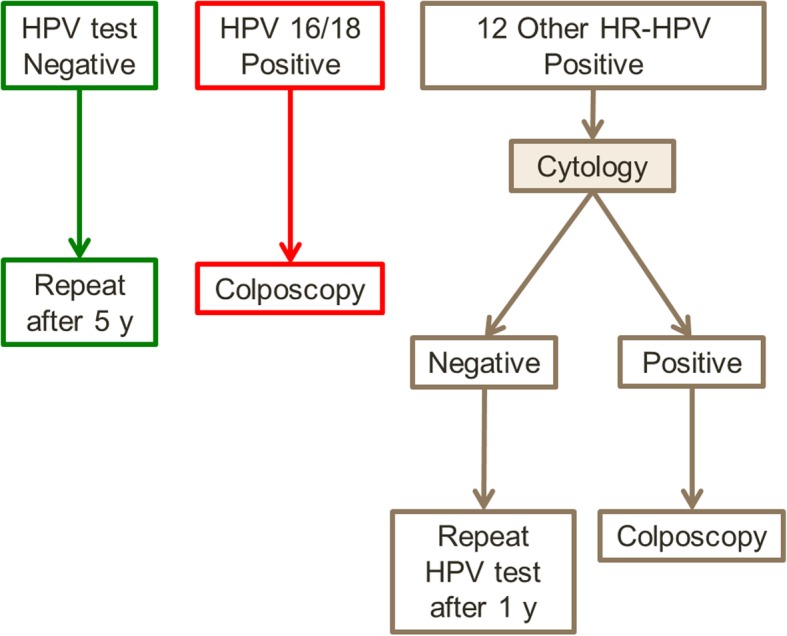
The CCSP-HPV was designed based on successful guidelines that replaced cervical cytology-based screening by the DNA-HPV test performed at 5-year intervals. The screening will be performed for the female population aged 25-64 years cared for by the public health system and aim to reach 80% coverage after completing the first round. The chosen DNA-HPV test detects 14 hr-HPV types and genotypes HPV-16 and 18. All women with a negative test will be reassessed after five years. Women showing a positive test for HPV-16 and/or 18 will be referred for colposcopy. Those showing the other 12 hr-HPV types will be tested by cytology, and if any abnormality is detected, they will also be referred for colposcopy. The histopathologic evaluation will be reviewed by a pathologist panel and aided by p16 immunohistochemistry. A cost-effectiveness analysis will be performed by a Markov model comparing the cost of the new program and the screening performed by conventional cytology five years prior (2011-2016).
The new screening program is considered a breakthrough for public health regarding cervical cancer, which is the third leading cause of cancer death among Brazilian women. Achieving at least 80% coverage will have the possibility to change this scenario. The proposed program will provide a modern cervical cancer screening method for women, and information about cost-effectiveness will help other similar places support the decision of implementing cervical cancer screening using the DNA-HPV test.
高危型(hr)HPV 感染与癌前病变或宫颈癌之间的因果关系,促使人们制定了提高筛查性能和预防该癌症的策略。与宫颈细胞学检查相比,DNA-HPV 检测的敏感性更高,因此 DNA-HPV 检测更适合作为初始筛查检测。巴西的宫颈癌筛查是机会性的,这种癌症仍然是一个相当大的健康问题,有相当大比例的诊断处于晚期。本文旨在描述为巴西因达亚图巴市(SP)计划的基于 DNA-HPV 检测的宫颈癌筛查项目(CCSP-HPV)的设计和实施;实现更高人群覆盖率的策略;以及用于成本效益分析的研究方案。
CCSP-HPV 是基于成功的指南设计的,该指南用 DNA-HPV 检测取代了基于宫颈细胞学的筛查,每 5 年进行一次。该筛查将针对由公共卫生系统照顾的 25-64 岁的女性人口进行,目标是在完成第一轮后覆盖率达到 80%。所选的 DNA-HPV 检测可检测 14 种高危型 HPV 类型和 HPV-16 和 18 型的基因型。所有检测结果为阴性的女性将在五年后重新评估。HPV-16 和/或 18 检测结果为阳性的女性将被转诊行阴道镜检查。其他 12 种高危型 HPV 检测结果为阳性的女性将进行细胞学检查,如果发现任何异常,也将被转诊行阴道镜检查。病理组织学评估将由病理学家小组进行审查,并辅以 p16 免疫组化。将通过 Markov 模型对新方案和五年前常规细胞学筛查(2011-2016 年)的成本效益进行比较,以进行成本效益分析。
对于宫颈癌公共卫生而言,新的筛查方案是一个突破,宫颈癌是巴西女性癌症死亡的第三大原因。至少达到 80%的覆盖率将有可能改变这种情况。该拟议方案将为女性提供一种现代化的宫颈癌筛查方法,有关成本效益的信息将有助于其他类似地区支持使用 DNA-HPV 检测进行宫颈癌筛查的决策。