Yale University, Department of Psychiatry, New Haven, CT, USA.
University of Minnesota, Department of Psychology, Minneapolis, MN, USA.
Transl Psychiatry. 2022 Aug 10;12(1):328. doi: 10.1038/s41398-022-02013-w.
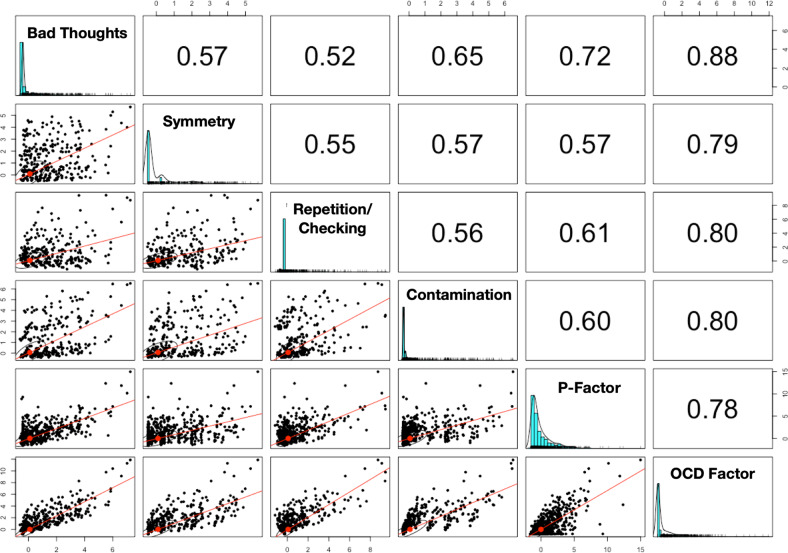
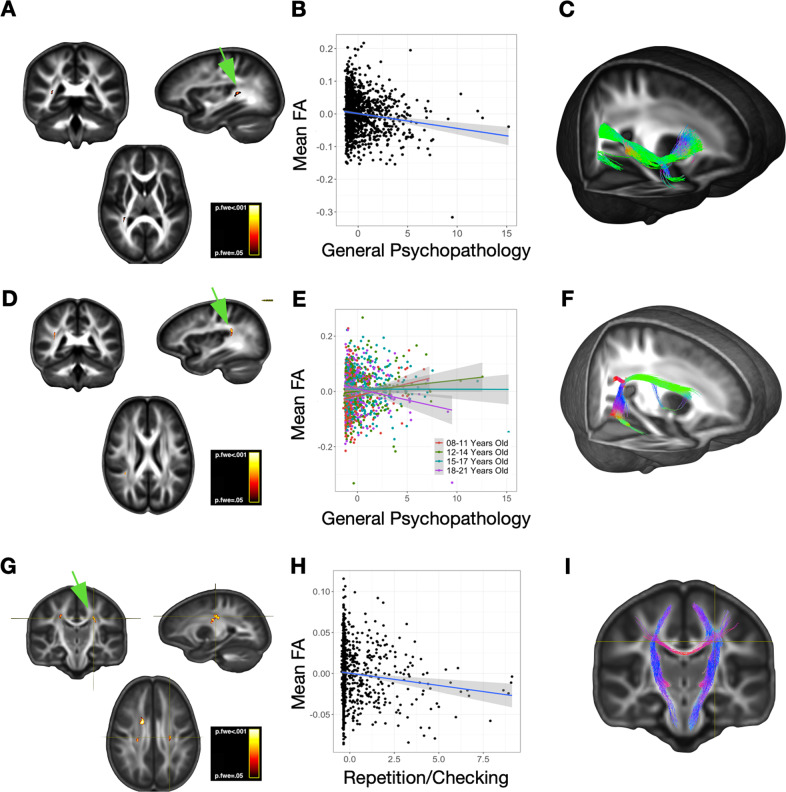
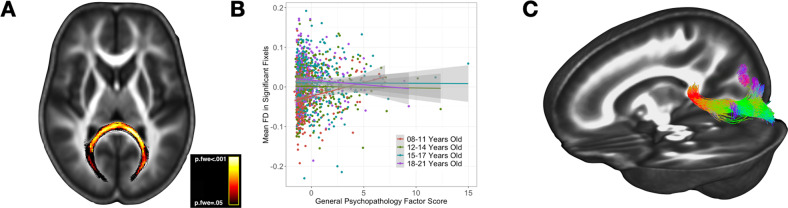
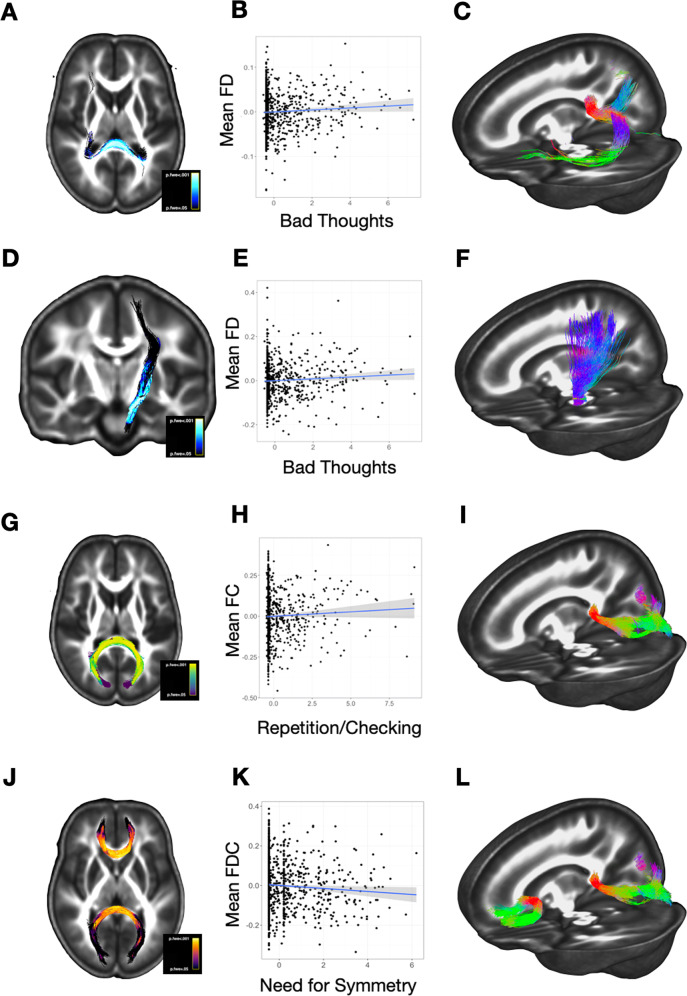
Obsessive-compulsive symptoms (OCS) are common in school-aged children and predict the development of obsessive compulsive disorder (OCD). White-matter abnormalities have been described in OCD, but the white matter correlates of OCS in the developing brain are unclear. Some correlates of OCS (or a diagnosis of OCD) may reflect correlates of a transdiagnostic or even general psychopathology factor. We examined these questions in a large sample of typically developing youth (N = 1208), using a hierarchical analysis of fixel-based white matter measures in relation to OCS and general psychopathology. General psychopathology was associated with abnormalities in the posterior corpus callosum and forceps major in an age-dependent manner, suggesting altered maturation (specifically, hypermaturation in younger subjects). A unidimensional measure of OCS did not associate with any white-matter abnormalities, but analysis of separate OCS dimensions (derived from factor analysis within this sample) revealed the 'Bad Thoughts' dimension to associate with white-matter abnormalities in dorsal parietal white-matter and descending corticospinal tracts, and the 'Symmetry' dimension to associate with abnormalities in the anterior corpus callosum. Repetition/checking and Symmetry OCS were additionally associated with posterior abnormalities overlapping with the correlates of general psychopathology. Contamination symptoms had no white-matter correlates. Secondary analysis of fractional anisotropy (FA) revealed distinct white-matter abnormalities, suggesting that fixel-based and FA analyses identify distinct features of white matter relevant to psychopathology. These findings suggest that OCS dimensions correlate with dissociable abnormalities in white matter, implicating separable networks. Future studies should examine these white-matter signatures in a longitudinal framework.
强迫症状(OCS)在学龄儿童中很常见,并可预测强迫症(OCD)的发展。在强迫症中已经描述了白质异常,但发育中大脑中 OCS 的白质相关性尚不清楚。OCS 的一些相关性(或强迫症的诊断)可能反映了跨诊断甚至一般精神病理学因素的相关性。我们在一个典型的发育中青少年大样本(N=1208)中使用基于固定点的白质测量的层次分析,研究了这些问题,与 OCS 和一般精神病理学有关。一般精神病理学与后部胼胝体和主要内囊在年龄依赖性的异常相关,表明成熟改变(特别是在年轻受试者中过度成熟)。一维 OCS 测量与任何白质异常均无关,但对 OCS 分离维度(源自该样本中的因子分析)的分析表明,“不良思想”维度与背侧顶叶白质和下行皮质脊髓束的白质异常相关,“对称性”维度与前胼胝体的异常相关。重复/检查和对称性 OCS 与与一般精神病理学相关的后部异常重叠。污染症状与白质无相关性。分数各向异性(FA)的二次分析显示出明显的白质异常,表明基于固定点和 FA 的分析确定了与精神病理学相关的白质的不同特征。这些发现表明 OCS 维度与白质的可分离异常相关,暗示了可分离的网络。未来的研究应在纵向框架中检查这些白质特征。