Research Center of Medical Informatics, Kaohsiung Veterans General Hospital, 386, Dazhong 1st Rd., Zuoying Dist., Kaohsiung City, 813414, Taiwan (ROC).
School of Nursing, Fooyin University, 151 Jinxue Rd., Daliao Dist., Kaohsiung City, 83102, Taiwan (ROC).
BMC Palliat Care. 2022 Aug 10;21(1):143. doi: 10.1186/s12904-022-01033-z.
Demoralization is a psychological response that is frequently observed in patients with cancer or advanced diseases. It is affected by national characteristics, culture, disease characteristics and general conditions of the patient such as individual cultural features, nature of stress, personal expression preferences and social behavior. Compared with the results of previous studies on demoralization syndrome, patients with cancer in Taiwan exhibit a higher prevalence of demoralization. We aimed to investigate the prevalence of high demoralization and the changes in the level of demoralization in cancer patients during radiotherapy to explore the associated factors and the contributing factors to the high level of demoralization.
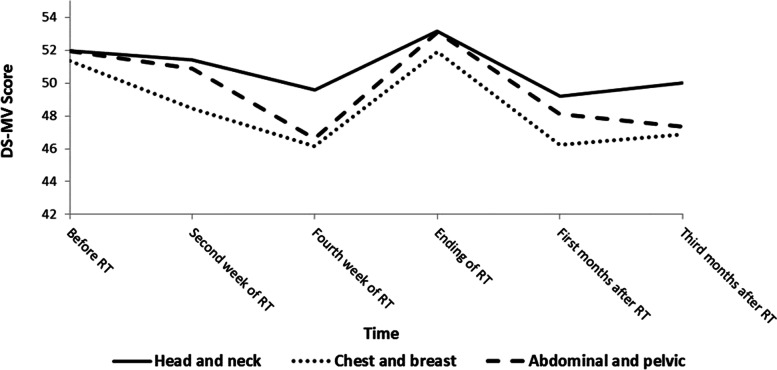
We used the Demoralization Scale-Mandarin Version to evaluate the demoralization level at six-time points in patients admitted for radiotherapy in a 3-month observational period. 101 patients allocated to three groups by cancer region completed the study. We applied the generalized estimating equation (GEE) to analyze the changes in the demoralization level among the three groups. The variables associated with the changes in the demoralization level were also investigated.
In the analysis using univariate GEE, only patients in the chest and breast group exhibited significant changes at two different time points. The results obtained using multivariate GEE revealed that sociodemographic variables, stage of disease and use of surgery or chemotherapy had no impact on the changes in demoralization across three months.
The demoralization level certainly fluctuated in an extremely high range. The higher prevalence of demoralized patients may indicate that if medical staff neglect the importance of demoralization, demoralized patients with cancer may not receive appropriate care.
沮丧是一种常见于癌症或晚期疾病患者的心理反应。它受到国家特征、文化、疾病特征以及患者的一般情况(如个人文化特征、压力性质、个人表达偏好和社会行为)的影响。与之前关于沮丧综合征的研究结果相比,台湾的癌症患者表现出更高的沮丧发生率。我们旨在调查癌症患者在放疗过程中高度沮丧的发生率和沮丧水平的变化,以探讨相关因素和导致高度沮丧的因素。
我们在 3 个月的观察期内,使用中文版沮丧量表评估了 101 名按癌症部位分配到三组的接受放疗的患者在 6 个时间点的沮丧水平。我们应用广义估计方程(GEE)分析三组之间沮丧水平的变化。还调查了与沮丧水平变化相关的变量。
在单变量 GEE 分析中,只有胸部和乳房组的患者在两个不同的时间点显示出显著变化。多变量 GEE 的结果表明,社会人口统计学变量、疾病分期以及手术或化疗的使用对三个月内沮丧变化没有影响。
沮丧水平肯定在极高范围内波动。沮丧患者的高患病率可能表明,如果医务人员忽视沮丧的重要性,癌症沮丧患者可能得不到适当的护理。