Department of Nursing, Towson University, Towson, Maryland, United States of America.
Department of Neural and Pain Sciences, and Brotman Facial Pain Clinic, University of Maryland, Baltimore, Maryland, United States of America.
PLoS One. 2019 Apr 18;14(4):e0215534. doi: 10.1371/journal.pone.0215534. eCollection 2019.
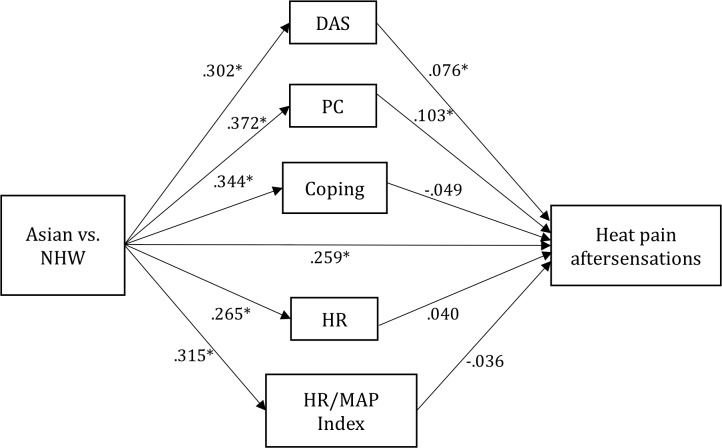
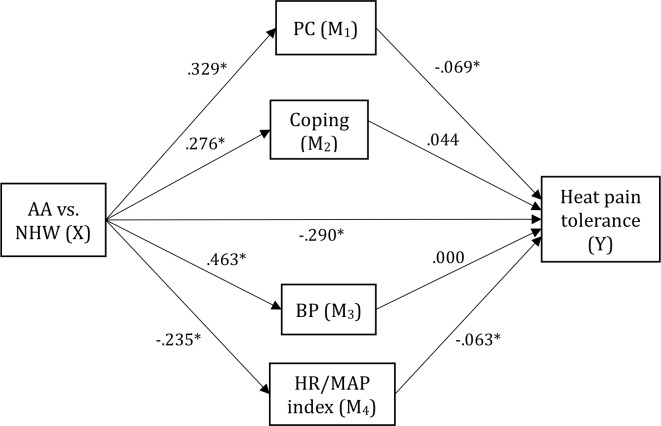
This study evaluated the contributions of psychological status and cardiovascular responsiveness to racial/ethnic differences in experimental pain sensitivity. The baseline measures of 3,159 healthy individuals-non-Hispanic white (NHW): 1,637, African-American (AA): 1,012, Asian: 299, and Hispanic: 211-from the OPPERA prospective cohort study were used. Cardiovascular responsiveness measures and psychological status were included in structural equation modeling based mediation analyses. Pain catastrophizing was a significant mediator for the associations between race/ethnicity and heat pain tolerance, heat pain ratings, heat pain aftersensations, mechanical cutaneous pain ratings and aftersensations, and mechanical cutaneous pain temporal summation for both Asians and AAs compared to NHWs. HR/MAP index showed a significant inconsistent (mitigating) mediating effect on the association between race/ethnicity (AAs vs. NHWs) and heat pain tolerance. Similarly, coping inconsistently mediated the association between race/ethnicity and mechanical cutaneous pain temporal summation in both AAs and Asians, compared to NHWs. The factor encompassing depression, anxiety, and stress was a significant mediator for the associations between race/ethnicity (Asians vs. NHWs) and heat pain aftersensations. Thus, while pain catastrophizing mediated racial/ethnic differences in many of the QST measures, the psychological and cardiovascular mediators were distinctly restrictive, signifying multiple independent mechanisms in racial/ethnic differences in pain.
本研究评估了心理状态和心血管反应对实验性疼痛敏感性的种族/民族差异的贡献。使用 OPPERA 前瞻性队列研究中 3159 名健康个体(非西班牙裔白人[NHW]:1637 人,非裔美国人[AA]:1012 人,亚洲人:299 人,西班牙裔:211 人)的基线测量值。心血管反应措施和心理状态包含在基于结构方程模型的中介分析中。对于亚裔和非裔美国人与 NHW 相比,疼痛灾难化是与热痛耐受力、热痛评分、热痛后感觉、机械性皮肤痛评分和后感觉以及机械性皮肤痛时间总和相关的种族/民族差异的重要中介因素。HR/MAP 指数显示与种族/民族(AA 与 NHW)和热痛耐受力相关的关联存在显著不一致(减轻)的中介效应。同样,对于亚裔和非裔美国人,应对方式不一致地介导了与机械性皮肤痛时间总和相关的种族/民族差异,与 NHW 相比。包含抑郁、焦虑和压力的因素是非裔美国人(与 NHW 相比)和热痛后感觉之间关联的重要中介因素。因此,虽然疼痛灾难化介导了许多 QST 测量指标的种族/民族差异,但心理和心血管中介因素明显具有限制性,表明疼痛的种族/民族差异存在多种独立机制。