Imaging-Based Functional Brain Diagnostics and Therapy, Department of Neurology, High Field Magnetic Resonance Centre, Medical University of Vienna, Spitalgasse 23, 1090, Vienna, Austria.
Department of Neurology, Medical University of Vienna, Vienna, Austria.
J Headache Pain. 2022 Aug 11;23(1):99. doi: 10.1186/s10194-022-01466-0.
Photophobia, the aberrantly increased sensitivity to light, is a common symptom in migraine patients and light discomfort is frequently found as a trigger for migraine attacks. In behavioral studies, planned exposure to light was found to reduce headache in migraine patients with photophobia, potentially by increasing habituation to this migraine trigger. Here, we aimed to elucidate neurophysiological mechanisms of light exposure versus light deprivation in migraine patients using functional magnetic resonance imaging (fMRI).
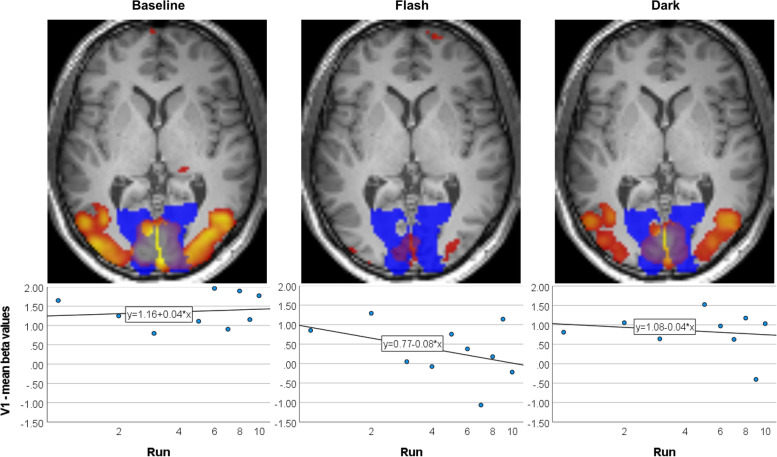
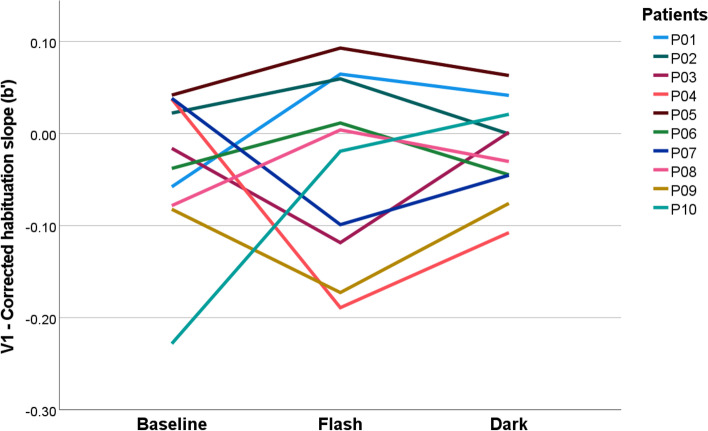
Ten migraine patients (9 female, age = 28.70 ± 8.18 years) and 11 healthy controls (9 female, age = 23.73 ± 2.24 years) spent one hour on 7 consecutive days exposed to flashing light (Flash) or darkness (Dark) using a crossover design with a wash-out period of 3 months. Study participants kept a diary including items on interictal and ictal photophobia, presence and severity of headache 7 days before, during and 7 days after the interventions. One week before and one day after both interventions, fMRI using flickering light in a block design was applied. Functional activation was analyzed at whole-brain level and habituation of the visual cortex (V1) was modeled with the initial amplitude estimate and the corrected habituation slope.
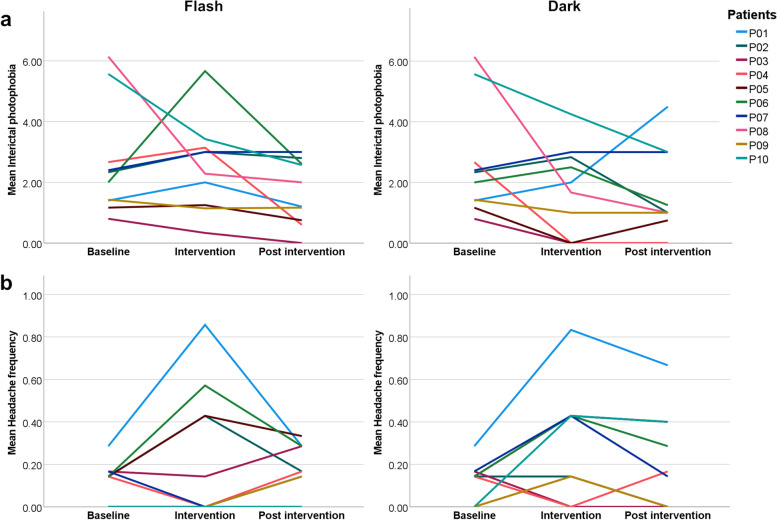
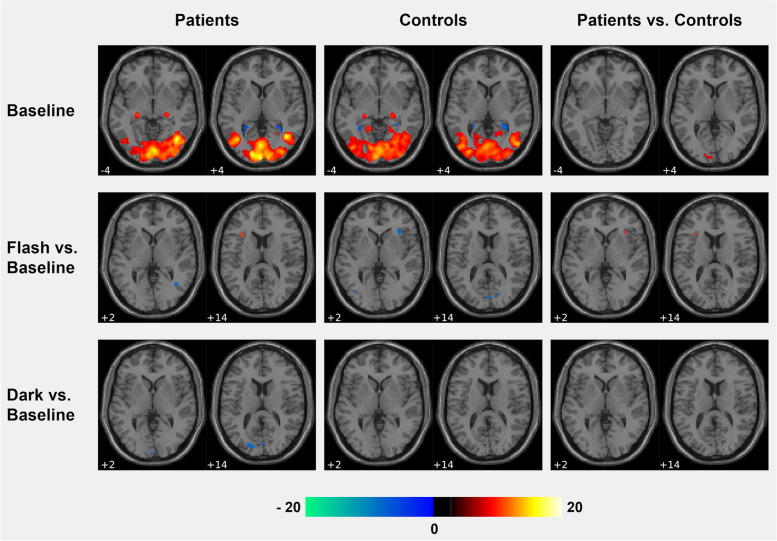
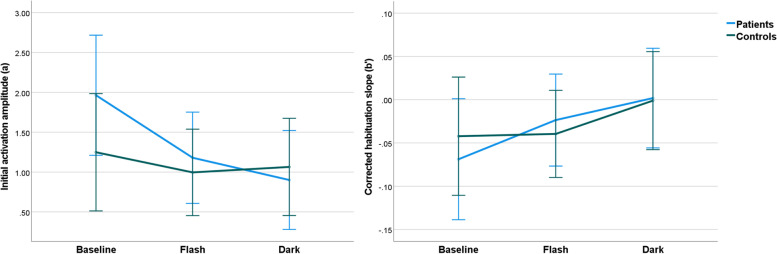
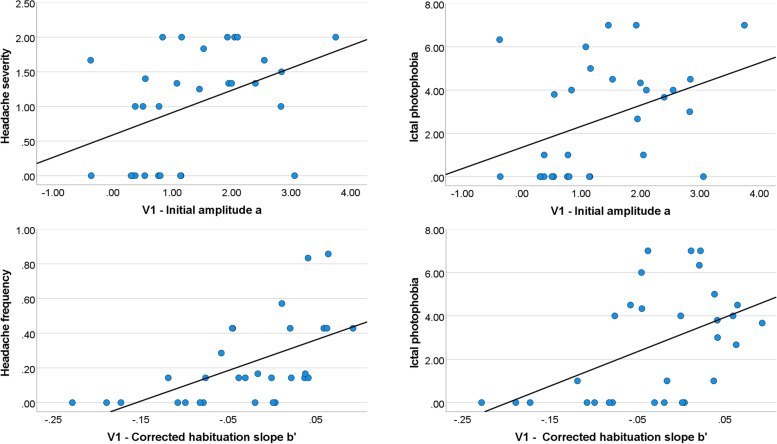
Mean interictal photophobia decreased after both interventions, but differences relative to the baseline did not survive correction for multiple comparisons. At baseline, flickering light induced activation in V1 was higher in the patients compared to the controls, but activation normalized after the Flash and the Dark interventions. V1 habituation indices correlated with headache frequency, headache severity and ictal photophobia. In the Flash condition, the individual change of headache frequency relative to the baseline corresponded almost perfectly to the change of the habituation slope compared to the baseline.
On average, light exposure did not lead to symptom relief, potentially due to the short duration of the intervention and the high variability of the patients' responses to the intervention. However, the strong relationship between visual cortex habituation and headache symptoms and its modulation by light exposure might shed light on the neurophysiological basis of exposure treatment effects.
NCT05369910 (05/06/2022, retrospectively registered).
畏光,即对光的异常敏感,是偏头痛患者的常见症状,而轻度不适常被认为是偏头痛发作的诱因。在行为研究中,有计划地暴露于光线中被发现可以减轻畏光偏头痛患者的头痛,这可能是通过增加对这种偏头痛诱因的习惯化来实现的。在这里,我们旨在使用功能磁共振成像(fMRI)阐明偏头痛患者暴露于光与剥夺光之间的神经生理机制。
十名偏头痛患者(9 名女性,年龄=28.70±8.18 岁)和 11 名健康对照者(9 名女性,年龄=23.73±2.24 岁)在 7 天内连续接受闪光(Flash)或黑暗(Dark)照射,采用交叉设计,洗脱期为 3 个月。研究参与者在干预前后 7 天内每天记录间歇性和发作性畏光、头痛的出现和严重程度。在这两种干预措施之前一周和之后一天,使用闪烁光进行块设计的 fMRI。在全脑水平上分析功能激活,并用初始幅度估计和校正的习惯化斜率对视觉皮层(V1)的习惯化进行建模。
两种干预措施后,间歇性畏光的平均程度均有所降低,但与基线相比的差异在经过多次比较校正后不再显著。在基线时,与对照组相比,患者的闪烁光诱导的 V1 激活更高,但在 Flash 和 Dark 干预后,激活恢复正常。V1 习惯化指数与头痛频率、头痛严重程度和发作性畏光相关。在 Flash 条件下,与基线相比,头痛频率的个体变化几乎完全对应于与基线相比的习惯化斜率的变化。
平均而言,光暴露并没有导致症状缓解,这可能是由于干预时间短和患者对干预的反应高度可变。然而,视觉皮层习惯化与头痛症状之间的强烈关系及其对光暴露的调节可能揭示了暴露治疗效果的神经生理基础。
NCT05369910(2022 年 5 月 6 日,回顾性注册)。