Chaudhury Habib, Xu Mingjun
Department of Gerontology, Simon Fraser University, Vancouver, British Columbia, Canada.
School of Geography and Planning, Sun Yat-sen University, Guangzhou, Guangdong, China.
Innov Aging. 2022 Jul 1;6(5):igac045. doi: 10.1093/geroni/igac045. eCollection 2022.
The quality of the built environmental features in long-term care (LTC) homes significantly influences residents' functioning (e.g., wayfinding, self-care, and social interaction) and well-being. There is limited research on the characteristics of the built environment of LTC and its influence on residents' quality of life in countries in the Asia-Pacific region (e.g., East Asia and South Asia). The older adult population in this region is expected to increase significantly in the coming decades. There are distinctive perceptions of nursing home, nursing home environments, and sociocultural norms in this geographic region. Given this context, a better understanding of the built environment of LTC facilities in this region can inform design professionals and policymakers for evidence-based decision-making. The present study undertakes a scoping review of the empirical research on the characteristics and influence of the built environment of LTC facilities on residents' quality of life in the Asia-Pacific context.
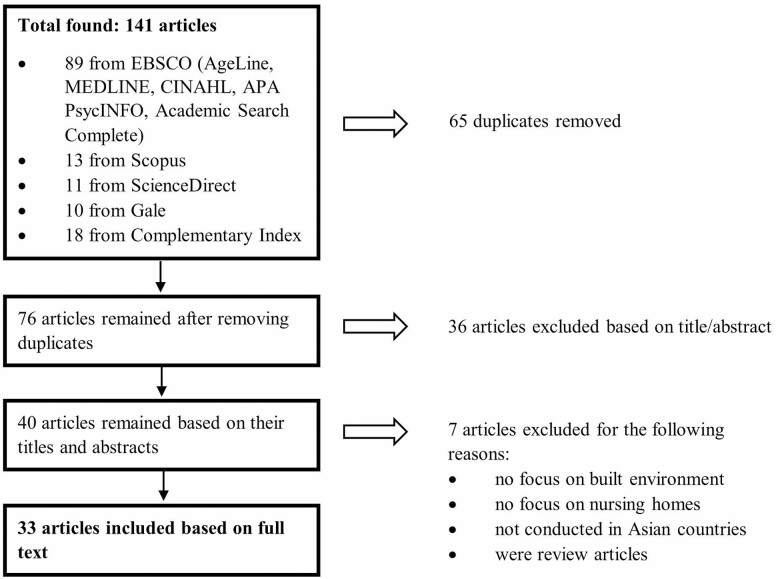
Online relevant databases were used to identify articles published 2000-2021, from which we selected 33 publications.
Three substantive themes were generated from the synthesis of the selected publications. These themes are (a) perceptions of nursing home, (b) impact of the built environment on residents' quality of life, and (c) assessment of the LTC built environment.
We identified research gaps in understanding the role of the built environment in nursing homes in the particular geographic context and future research directions. Five planning and design principles for LTC were derived from the synthesis of key findings to inform design professionals and policymakers.
长期护理(LTC)机构的建筑环境特征质量显著影响居民的功能(如寻路、自我护理和社交互动)及幸福感。在亚太地区国家(如东亚和南亚),关于长期护理机构建筑环境特征及其对居民生活质量影响的研究有限。预计该地区老年人口在未来几十年将大幅增加。在这个地理区域,人们对养老院、养老院环境和社会文化规范有着独特的认知。鉴于此背景,更好地了解该地区长期护理设施的建筑环境可为设计专业人员和政策制定者提供循证决策依据。本研究对亚太地区背景下长期护理设施建筑环境特征及其对居民生活质量影响的实证研究进行了范围综述。
使用在线相关数据库识别2000年至2021年发表的文章,从中选取了33篇出版物。
对所选出版物进行综合分析后得出了三个实质性主题。这些主题分别是:(a)对养老院的认知;(b)建筑环境对居民生活质量的影响;(c)对长期护理机构建筑环境的评估。
我们确定了在特定地理背景下理解建筑环境在养老院中作用方面的研究空白以及未来的研究方向。通过对主要研究结果的综合分析,得出了五项长期护理机构的规划和设计原则,以为设计专业人员和政策制定者提供参考。