University of California, Berkeley, CA, USA.
Facente Consulting, Richmond, CA, USA.
Health Promot Pract. 2024 Mar;25(2):235-243. doi: 10.1177/15248399221115063. Epub 2022 Aug 11.
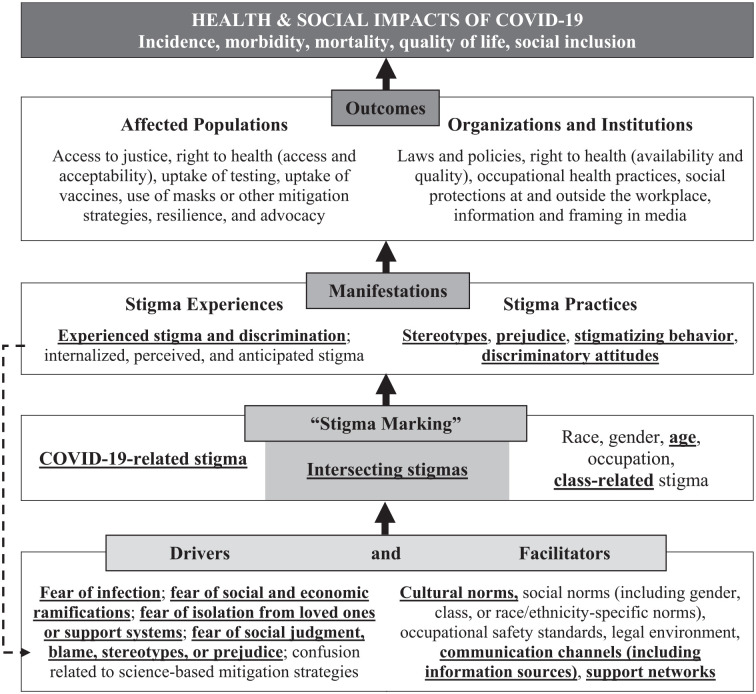
Stigma has inhibited public health practitioners' influence during the COVID-19 pandemic. We explore the experienced and anticipated stigma of people affiliated with a large university in the United States, using the Health Stigma and Discrimination Framework.
We conducted a qualitative secondary substudy of 20 people who tested SARS-CoV-2 positive and 10 who tested negative in the summer of 2020, selected from a study of 3,324 university students and employees.
No participants reported anticipated stigmatization prior to testing positive. However, eight of 20 participants recounted stigma marking (being marked by COVID-19 diagnosis or membership in a "high-risk" group) or manifestations of stigma after testing positive, including feelings of guilt or shame, and concerns about being judged as selfish or irresponsible. Three described being denied services or social interactions as a result of having had COVID-19, long after their infectiousness ended. Participants noted that clear public health messaging must be paired with detailed scientific information, rather than leaving people to resort to non-experts to understand the science.
Public health messaging designed to mitigate spread of SARS-CoV-2 and protect the community may perpetuate stigma and exacerbate inequities. As a result, people may avoid testing or treatment, mistrust public health messaging, or even use risk-increasing behavior as coping mechanisms.
Intentional use of language that promotes equity and deters discrimination must be high priority for any COVID-19-related public health messaging. Partnership with community leaders to co-create programs and disseminate messaging is a critical strategy for reducing stigma, especially for historically mistreated groups.
污名化在新冠疫情期间阻碍了公共卫生从业者的影响力。我们使用健康污名和歧视框架,探索了与美国一所大型大学有关联的人群所经历和预期的污名。
我们对 20 名在 2020 年夏天检测出 SARS-CoV-2 阳性的人和 10 名检测出阴性的人进行了定性二次子研究,这些人是从一项对 3324 名大学生和员工的研究中选择的。
在检测呈阳性之前,没有参与者报告预期的污名化。然而,20 名参与者中有 8 人讲述了污名标记(因 COVID-19 诊断或属于“高风险”群体而被标记)或在检测呈阳性后出现污名的表现,包括内疚或羞耻感,以及担心被视为自私或不负责任。有 3 人描述说,由于感染了新冠病毒,在他们的传染性结束很久之后,他们被拒绝提供服务或社交互动。参与者指出,必须将明确的公共卫生信息与详细的科学信息结合起来,而不是让人们求助于非专家来理解科学。
旨在减缓 SARS-CoV-2 传播和保护社区的公共卫生信息传递可能会延续污名化并加剧不平等。因此,人们可能会避免检测或治疗,不信任公共卫生信息传递,甚至将增加风险的行为作为应对机制。
任何与新冠相关的公共卫生信息传递都必须高度重视使用促进公平和阻止歧视的语言。与社区领袖合作,共同制定计划和传播信息,是减少污名的关键策略,特别是对历史上受到虐待的群体。