Byrd Nick, Białek Michał
Stevens Institute of Technology, Carnegie Mellon University, USA.
University of Wroclaw, Poland.
Cognition. 2021 Jul;212:104649. doi: 10.1016/j.cognition.2021.104649. Epub 2021 Mar 6.
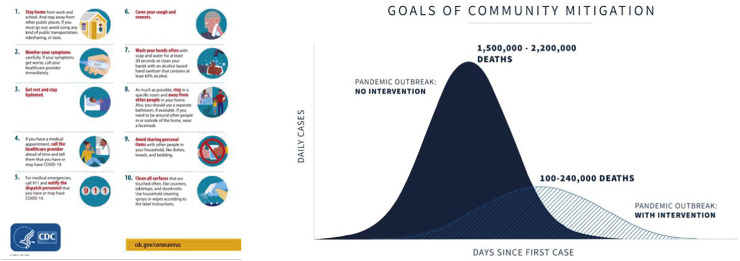
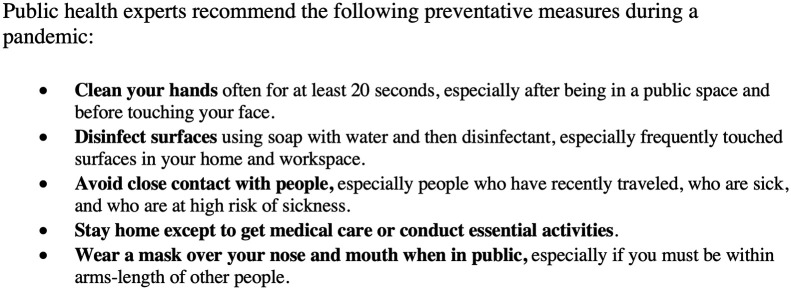
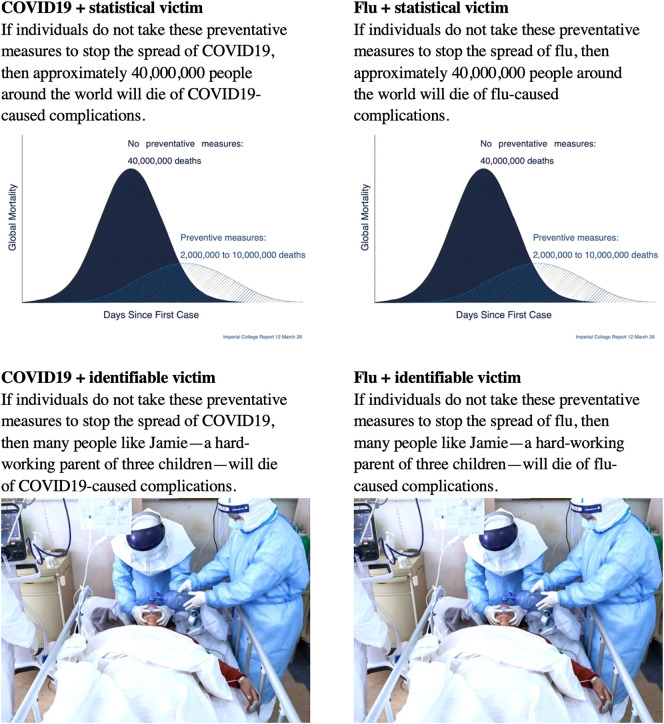
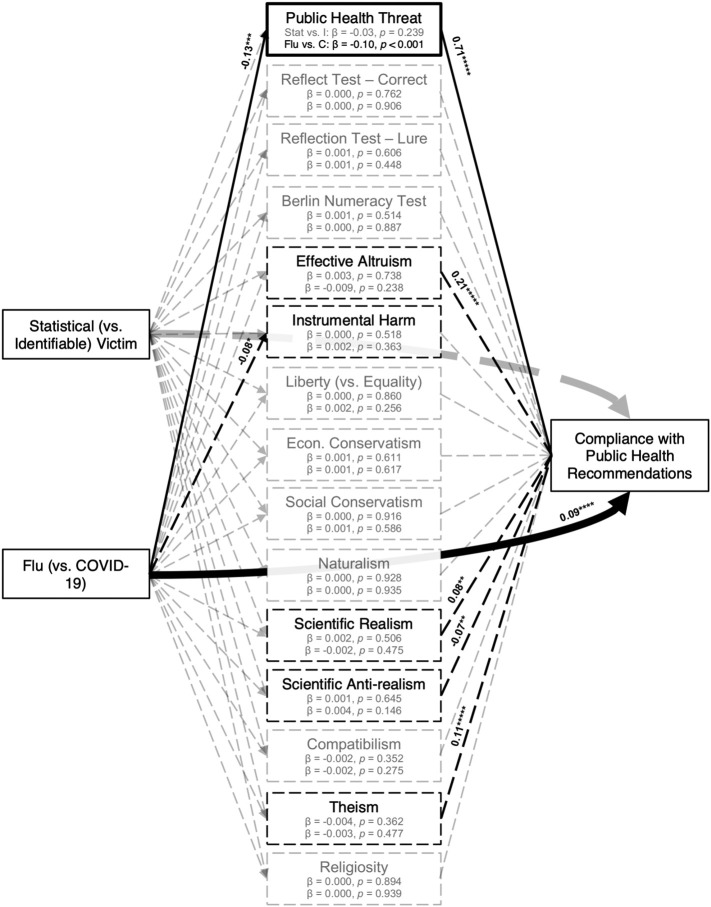
In response to crises, people sometimes prioritize fewer specific identifiable victims over many unspecified statistical victims. How other factors can explain this bias remains unclear. So two experiments investigated how complying with public health recommendations during the COVID19 pandemic depended on victim portrayal, reflection, and philosophical beliefs (Total N = 998). Only one experiment found that messaging about individual victims increased compliance compared to messaging about statistical victims-i.e., "flatten the curve" graphs-an effect that was undetected after controlling for other factors. However, messaging about flu (vs. COVID19) indirectly reduced compliance by reducing perceived threat of the pandemic. Nevertheless, moral beliefs predicted compliance better than messaging and reflection in both experiments. The second experiment's additional measures revealed that religiosity, political preferences, and beliefs about science also predicted compliance. This suggests that flouting public health recommendations may be less about ineffective messaging or reasoning than philosophical differences.
面对危机时,人们有时会优先考虑少数特定的可识别受害者,而非众多未明确指出的统计意义上的受害者。其他因素如何解释这种偏差仍不清楚。因此,两项实验研究了在新冠疫情期间遵守公共卫生建议的情况如何取决于受害者的描述、反思和哲学信仰(总样本量N = 998)。只有一项实验发现,与关于统计意义上的受害者的信息(即“平缓曲线”图表)相比,关于个体受害者的信息会提高人们的遵守程度——在控制其他因素后,这种效果未被发现。然而,关于流感(与新冠相比)的信息通过降低对疫情的感知威胁间接降低了遵守程度。尽管如此,在两项实验中,道德信仰比信息和反思更能预测遵守情况。第二项实验的额外测量结果显示,宗教信仰、政治偏好和对科学的信念也能预测遵守情况。这表明,无视公共卫生建议可能更多是因为哲学差异,而非信息传递无效或推理不当。