Sahebnasagh Adeleh, Eghbali Samira, Saghafi Fatemeh, Sureda Antoni, Avan Razieh
Clinical Research Center, Department of Internal Medicine, School of Medicine, North Khorasan University of Medical Sciences, Bojnurd, Iran.
Department of Pharmacognosy and Traditional Pharmacy, School of Pharmacy, Birjand University of Medical Sciences, Birjand, Iran.
Immun Ageing. 2022 Aug 11;19(1):36. doi: 10.1186/s12979-022-00292-x.
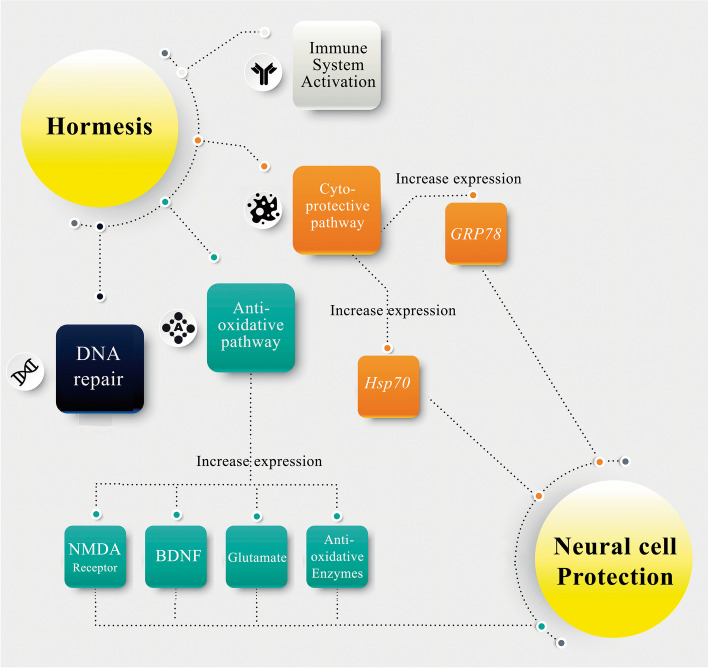
The world population is progressively ageing, assuming an enormous social and health challenge. As the world ages, neurodegenerative diseases are on the rise. Regarding the progressive nature of these diseases, none of the neurodegenerative diseases are curable at date, and the existing treatments can only help relieve the symptoms or slow the progression. Recently, hormesis has increased attention in the treatment of age-related neurodegenerative diseases. The concept of hormesis refers to a biphasic dose-response phenomenon, where low levels of the drug or stress exert protective of beneficial effects and high doses deleterious or toxic effects. Neurohormesis, as the adaptive aspect of hormetic dose responses in neurons, has been shown to slow the onset of neurodegenerative diseases and reduce the damages caused by aging, stroke, and traumatic brain injury. Hormesis was also observed to modulate anxiety, stress, pain, and the severity of seizure. Thus, neurohormesis can be considered as a potentially innovative approach in the treatment of neurodegenerative and other neurologic disorders. Herbal medicinal products and supplements are often considered health resources with many applications. The hormesis phenomenon in medicinal plants is valuable and several studies have shown that hormetic mechanisms of bioactive compounds can prevent or ameliorate the neurodegenerative pathogenesis in animal models of Alzheimer's and Parkinson's diseases. Moreover, the hormesis activity of phytochemicals has been evaluated in other neurological disorders such as Autism and Huntington's disease. In this review, the neurohormetic dose-response concept and the possible underlying neuroprotection mechanisms are discussed. Different neurohormetic phytochemicals used for the better management of neurodegenerative diseases, the rationale for using them, and the key findings of their studies are also reviewed.
世界人口正在逐步老龄化,这带来了巨大的社会和健康挑战。随着世界老龄化,神经退行性疾病正在增加。鉴于这些疾病的渐进性,目前尚无神经退行性疾病可治愈,现有的治疗方法只能帮助缓解症状或减缓疾病进展。最近,兴奋效应在与年龄相关的神经退行性疾病治疗中受到了更多关注。兴奋效应的概念指的是一种双相剂量反应现象,即低剂量的药物或应激产生保护或有益作用,而高剂量则产生有害或毒性作用。神经兴奋效应作为神经元中兴奋剂量反应的适应性方面,已被证明可以延缓神经退行性疾病的发作,并减少衰老、中风和创伤性脑损伤所造成的损害。还观察到兴奋效应可调节焦虑、应激、疼痛和癫痫发作的严重程度。因此,神经兴奋效应可被视为治疗神经退行性疾病和其他神经系统疾病的一种潜在创新方法。草药产品和补充剂通常被认为是具有多种用途的健康资源。药用植物中的兴奋效应现象很有价值,多项研究表明,生物活性化合物的兴奋机制可以预防或改善阿尔茨海默病和帕金森病动物模型中的神经退行性病变。此外,植物化学物质的兴奋活性已在其他神经系统疾病如自闭症和亨廷顿舞蹈病中得到评估。在本综述中,将讨论神经兴奋剂量反应概念以及可能的潜在神经保护机制。还将综述用于更好地管理神经退行性疾病的不同神经兴奋植物化学物质、使用它们的基本原理及其研究的关键发现。