Center for Food and Bioconvergence, College of Agriculture and Life Sciences, Seoul National University, Seoul 08826, Korea.
Int J Mol Sci. 2021 Mar 13;22(6):2929. doi: 10.3390/ijms22062929.
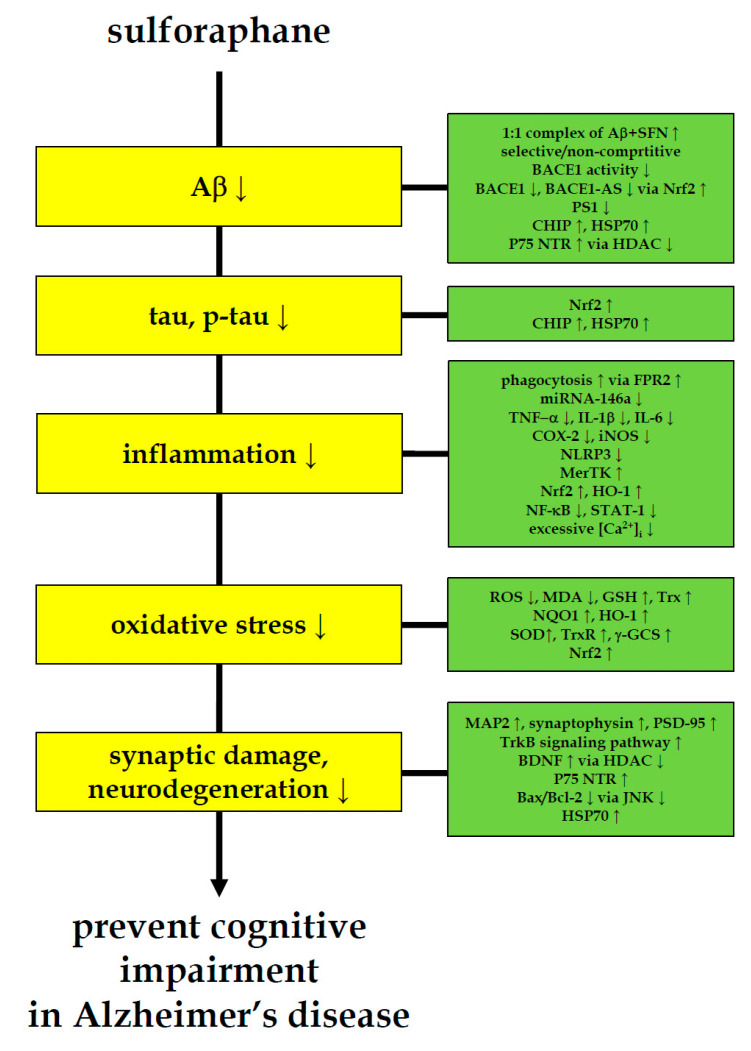
Sulforaphane, a potent dietary bioactive agent obtainable from cruciferous vegetables, has been extensively studied for its effects in disease prevention and therapy. Sulforaphane potently induces transcription factor nuclear factor erythroid 2-related factor 2 (Nrf2)-mediated expression of detoxification, anti-oxidation, and immune system-modulating enzymes, and possibly acts as an anti-carcinogenic agent. Several clinical trials are in progress to study the effect of diverse types of cruciferous vegetables and sulforaphane on prostate cancer, breast cancer, lung cancer, atopic asthmatics, skin aging, dermatitis, obesity, etc. Recently, the protective effects of sulforaphane on brain health were also considerably studied, where the studies have further extended to several neurological diseases, including Alzheimer's disease (AD), Parkinson's disease, Huntington's disease, amyotrophic lateral sclerosis, multiple sclerosis, autism spectrum disorder, and schizophrenia. Animal and cell studies that employ sulforaphane against memory impairment and AD-related pre-clinical biomarkers on amyloid-β, tau, inflammation, oxidative stress, and neurodegeneration are summarized, and plausible neuroprotective mechanisms of sulforaphane to help prevent AD are discussed. The increase in pre-clinical evidences consistently suggests that sulforaphane has a multi-faceted neuroprotective effect on AD pathophysiology. The anti-AD-like evidence of sulforaphane seen in cells and animals indicates the need to pursue sulforaphane research for relevant biomarkers in AD pre-symptomatic populations.
萝卜硫素是一种从十字花科蔬菜中提取的强效膳食生物活性物质,其在疾病预防和治疗方面的作用已得到广泛研究。萝卜硫素可强力诱导转录因子核因子红细胞 2 相关因子 2(Nrf2)介导的解毒、抗氧化和免疫系统调节酶的表达,并可能作为一种抗癌剂发挥作用。目前正在进行多项临床试验,以研究不同类型的十字花科蔬菜和萝卜硫素对前列腺癌、乳腺癌、肺癌、特应性哮喘、皮肤衰老、皮炎、肥胖症等的影响。最近,萝卜硫素对大脑健康的保护作用也得到了相当多的研究,研究范围进一步扩展到几种神经退行性疾病,包括阿尔茨海默病(AD)、帕金森病、亨廷顿病、肌萎缩侧索硬化症、多发性硬化症、自闭症谱系障碍和精神分裂症。本文总结了使用萝卜硫素对抗记忆障碍和 AD 相关临床前生物标志物(如淀粉样蛋白-β、tau、炎症、氧化应激和神经退行性变)的动物和细胞研究,并讨论了萝卜硫素预防 AD 的可能神经保护机制。越来越多的临床前证据表明,萝卜硫素有多种针对 AD 病理生理学的神经保护作用。细胞和动物中观察到的萝卜硫素具有抗 AD 样作用,这表明需要针对 AD 亚临床人群的相关生物标志物来开展萝卜硫素研究。