Khan Jaffar, Ullah Asad, Waheed Abdul, Karki Nabin Raj, Adhikari Nawaraj, Vemavarapu Lakshmi, Belakhlef Sami, Bendjemil Samy Malik, Mehdizadeh Seraj Siamak, Sidhwa Feroze, Ghleilib Intisar, Foroutan Shahin, Blakely Andrew M, Del Rivero Jaydira, Karim Nagla Abdel, Vail Eric, Heneidi Saleh, Mesa Hector
Department of Pathology, Indiana University School of Medicine, Indianapolis, IN 46202, USA.
Department of Pathology, Vanderbilt University Medical Center, Nashville, TN 37232, USA.
Cancers (Basel). 2022 Jul 28;14(15):3689. doi: 10.3390/cancers14153689.
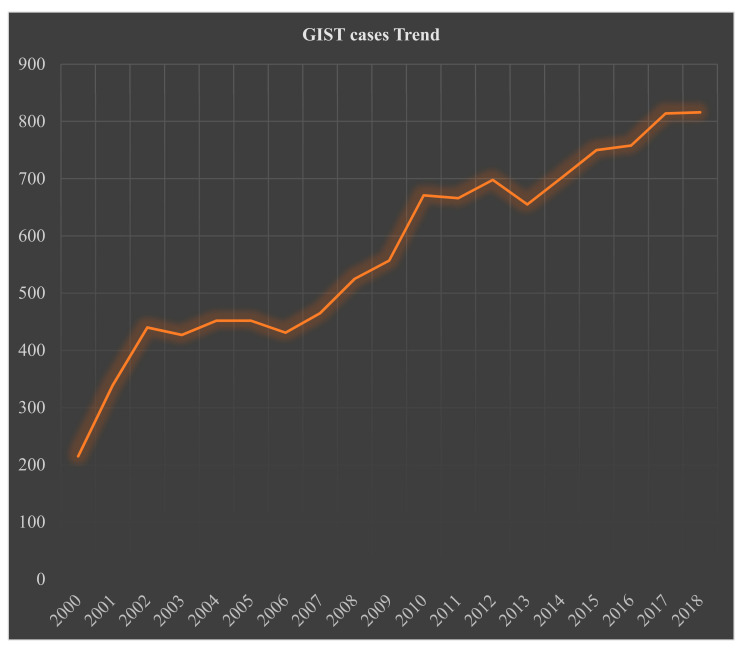
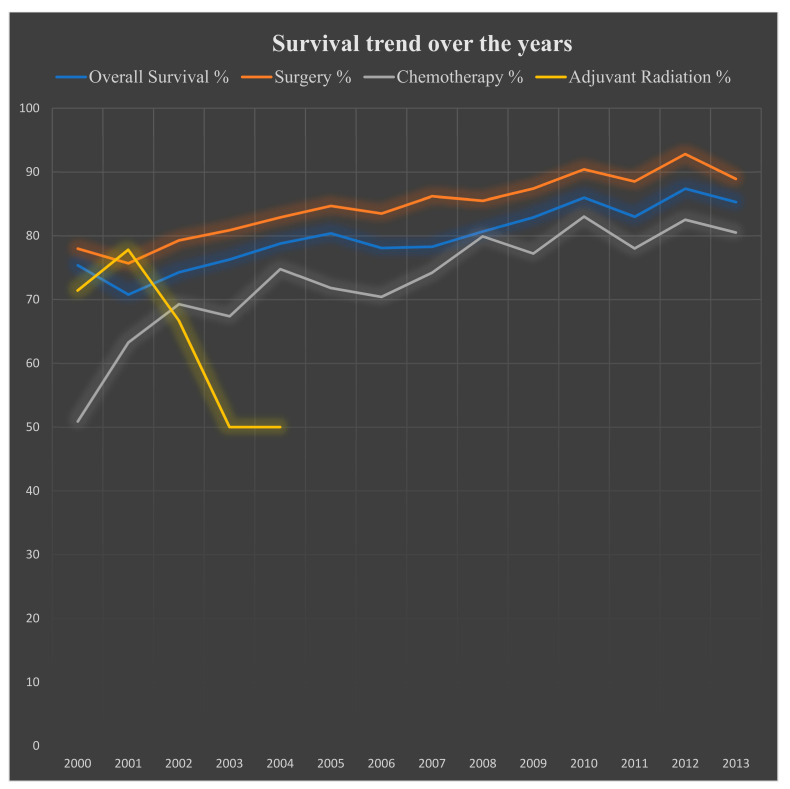
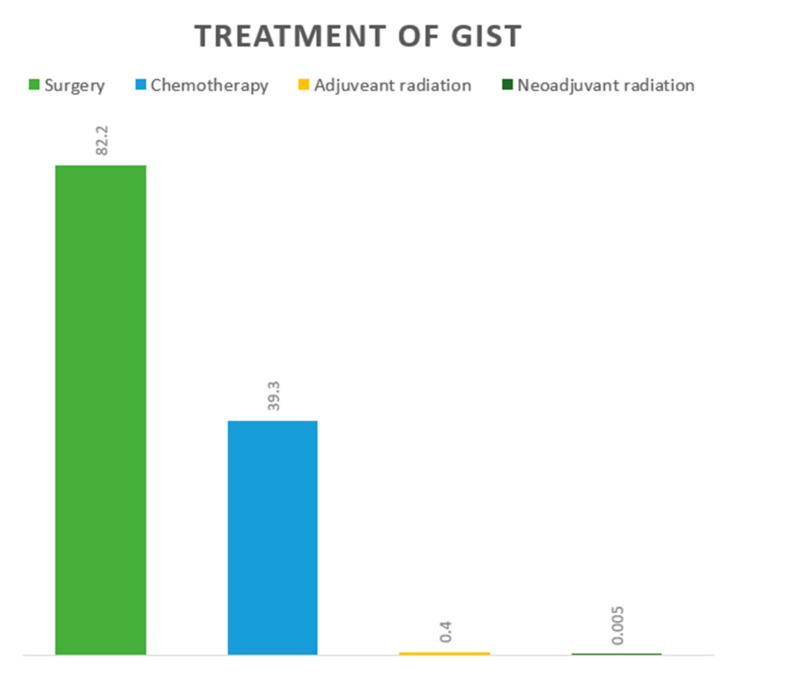
Introduction: Gastrointestinal stromal tumors (GISTs) are the most common mesenchymal neoplasm of the gastrointestinal (GI) system. Most GISTs originate from the interstitial cells of Cajal (ICC), the pacemaker cell situated between the circular and longitudinal layers of the muscularis propria along the GI tract. In this population-based study using the SEER database, we sought to identify demographic, clinical, and pathologic factors that affect the prognosis and survival of patients with this neoplasm. Molecular genetic advances, current management guidelines, and advances in targeted therapy are discussed. Methods: Demographic and clinical data from GIST patients were retrieved from the SEER research plus database for the period 2000−2018. Statistical analysis was performed with IBM SPSS® v20.2 software using the Chi-square test, paired t-test, multivariate analysis, and Kaplan−Meier functions. Results: A total of 10,833 patients with GIST were identified. Most patients were between 60−74 years of age: 40%, Caucasian: 68%, and the male to female ratio was 1.1:1. The most common primary tumor sites were stomach: 63%, small intestine: 30%, rectum: 3%, and esophagus: 0.7%. When reported, the grade of differentiation was well: 38%, moderately: 32%, undifferentiated: 19%, poorly: 12%. The size of most tumors ranged between 6−10 cm: 36% and they were treated by surgical intervention: 82% and/or chemotherapy/targeted therapy: 39%. The stage was localized: 66%, advanced: 19%, and regional: 15%. The 5-year survival was 74% (95% confidence interval (95% CI) = 72.6−74.7), and the 5-year cause-specific survival 82% (95% CI = 80.7−82.6). The 5-year cause-specific survival by treatment included surgery at 86% (95% CI = 85.4−87.3), chemotherapy/targeted therapy with or without surgery at 77% (95% CI = 75.7−78.9), and radiation at 75% (95% CI = 74.5−80). On multivariable analysis tumor size > 5 cm, poorly and undifferentiated grade, age > 60, and distant metastases at presentation were associated with worse overall survival. Conclusion: GISTs comprise 1−2% of malignancies of the GI tract, usually affect male Caucasians between the ages of 60 and 74 years, most tumors occur in the stomach and small intestine, and are usually >5 cm, but still localized, at the time of diagnosis. Most tumors receive multimodality surgical and chemotherapy/targeted therapy treatment, with a 5-year overall survival of 74% and cause-specific survival of 82%. GIST patients would benefit from enrollment in large clinical trials to establish better therapy guidelines for unresectable, treatment-refractory, and recurrent tumors.
胃肠道间质瘤(GIST)是胃肠道(GI)系统最常见的间叶性肿瘤。大多数GIST起源于Cajal间质细胞(ICC),这是一种位于胃肠道肌层固有层环形肌层和纵行肌层之间的起搏细胞。在这项基于人群的使用SEER数据库的研究中,我们试图确定影响该肿瘤患者预后和生存的人口统计学、临床和病理因素。讨论了分子遗传学进展、当前的管理指南以及靶向治疗的进展。方法:从SEER研究加数据库中检索2000 - 2018年期间GIST患者的人口统计学和临床数据。使用IBM SPSS® v20.2软件进行统计分析,采用卡方检验、配对t检验、多变量分析和Kaplan - Meier函数。结果:共识别出10833例GIST患者。大多数患者年龄在60 - 74岁之间:40%,白种人:68%,男女比例为1.1:1。最常见的原发肿瘤部位是胃:63%,小肠:30%,直肠:3%,食管:0.7%。当报告分化程度时,高分化:38%,中分化:32%,未分化:19%,低分化:12%。大多数肿瘤大小在6 - 10 cm之间:36%,并且接受了手术干预:82%和/或化疗/靶向治疗:39%。分期为局限性:66%,晚期:19%,区域性:15%。5年生存率为74%(95%置信区间(95%CI)= 72.6 - 74.7),5年病因特异性生存率为82%(95%CI = 80.7 - 82.6)。按治疗方式的5年病因特异性生存率包括手术为86%(95%CI = 85.4 - 87.3),化疗/靶向治疗联合或不联合手术为77%(95%CI = 75.7 - 78.9),放疗为75%(95%CI = 74.5 - 80)。多变量分析显示,肿瘤大小>5 cm、低分化和未分化分级、年龄>60岁以及初诊时远处转移与较差的总生存相关。结论:GIST占胃肠道恶性肿瘤的1 - 2%,通常影响60至74岁的白种男性,大多数肿瘤发生在胃和小肠,诊断时通常>5 cm,但仍为局限性。大多数肿瘤接受多模式手术及化疗/靶向治疗,5年总生存率为74%,病因特异性生存率为82%。GIST患者将受益于参加大型临床试验,以建立针对不可切除、治疗难治性和复发性肿瘤的更好治疗指南。