Wang Lufan, Langlais Crystal S, Kenfield Stacey A, Chan June M, Graff Rebecca E, Allen Isabel E, Atreya Chloe E, Van Blarigan Erin L
Department of Epidemiology & Biostatistics, University of California, San Francisco, CA 94158, USA.
Department of Urology, University of California, San Francisco, CA 94158, USA.
Cancers (Basel). 2022 Aug 6;14(15):3816. doi: 10.3390/cancers14153816.
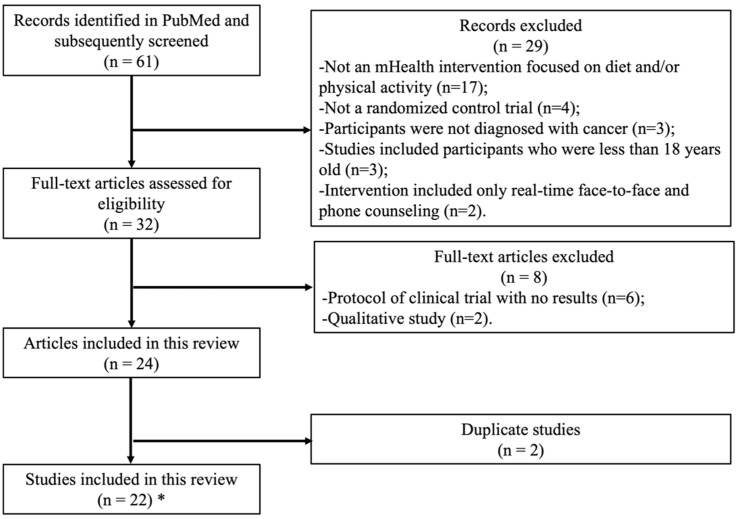
: Technology-based interventions are increasingly used to improve physical activity (PA) and diet. : We conducted a systematic review of randomized controlled trials (RCTs) published up to August 2021 that tested mobile health (mHealth) PA and/or dietary interventions among cancer survivors and reported on the feasibility, satisfaction, behavioral change, and/or quality of life (QOL) outcomes. : In total, 61 articles were identified on PubMed, and 23 of those met the inclusion criteria. The most common cancers were breast ( = 1000), prostate ( = 713), and colorectal ( = 650). Participants were predominantly White (median: 84%, interquartile range (IQR): 20%) and college-educated (58%). The interventions varied, but the most common combination of components (six studies) was a website/mobile app with an activity tracker and coaching. In terms of duration, 70% ( = 16) of the interventions lasted 12 weeks. The median total tracker wear was 87% of the study days (IQR: 6%) and the median text-message reply rate was 73% (IQR 4%). Most participants (median: 87%; IQR: 16%) were satisfied with at least one intervention component. Eleven out of 18 studies examining behavioral change reported significant between-group differences and six out of 11 studies examining QoL reported significant improvements. : mHealth interventions are a promising approach to improving the PA and diets of cancer survivors. Research in racially/ethnically and socioeconomically diverse populations is needed.
基于技术的干预措施越来越多地用于促进身体活动(PA)和改善饮食。我们对截至2021年8月发表的随机对照试验(RCT)进行了系统评价,这些试验测试了癌症幸存者的移动健康(mHealth)PA和/或饮食干预措施,并报告了可行性、满意度、行为改变和/或生活质量(QOL)结果。总共在PubMed上识别出61篇文章,其中23篇符合纳入标准。最常见的癌症是乳腺癌(n = 1000)、前列腺癌(n = 713)和结直肠癌(n = 650)。参与者主要是白人(中位数:84%,四分位间距(IQR):20%)且受过大学教育(58%)。干预措施各不相同,但最常见的组成部分组合(六项研究)是带有活动追踪器和指导的网站/移动应用程序。在持续时间方面,70%(n = 16)的干预措施持续12周。追踪器佩戴的总天数中位数为研究天数的87%(IQR:6%),短信回复率中位数为73%(IQR 4%)。大多数参与者(中位数:87%;IQR:16%)对至少一种干预组成部分感到满意。在18项研究行为改变的研究中,11项报告了组间存在显著差异,在11项研究生活质量的研究中,6项报告有显著改善。mHealth干预措施是改善癌症幸存者PA和饮食的一种有前景的方法。需要在种族/民族和社会经济背景多样的人群中开展研究。