Punset Miquel, Brizuela Aritza, Pérez-Pevida Esteban, Herrero-Climent Mariano, Manero José Maria, Gil Javier
Biomaterials, Biomechanics and Tissue Engineering Group (BBT), Department of Materials Science and Engineering, Universitat Politècnica de Catalunya (UPC), Av. Eduard Maristany 16, 08019 Barcelona, Spain.
Barcelona Research Center in Multiscale Science and Engineering, Technical University of Catalonia (UPC), Av. Eduard Maristany 10-14, 08019 Barcelona, Spain.
Materials (Basel). 2022 Aug 5;15(15):5391. doi: 10.3390/ma15155391.
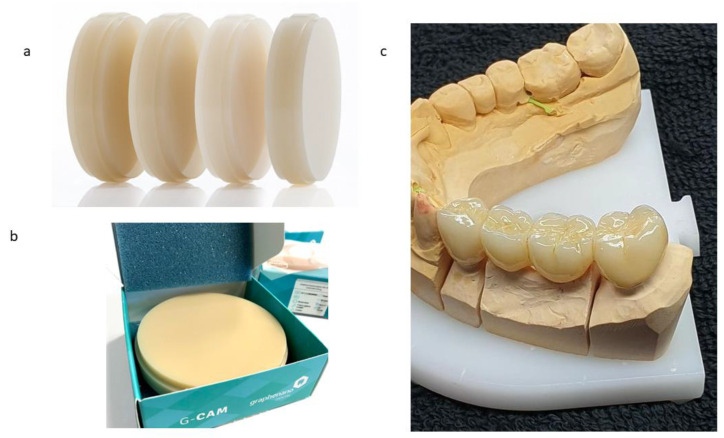
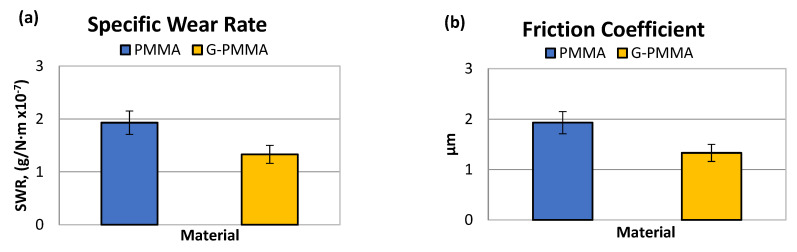
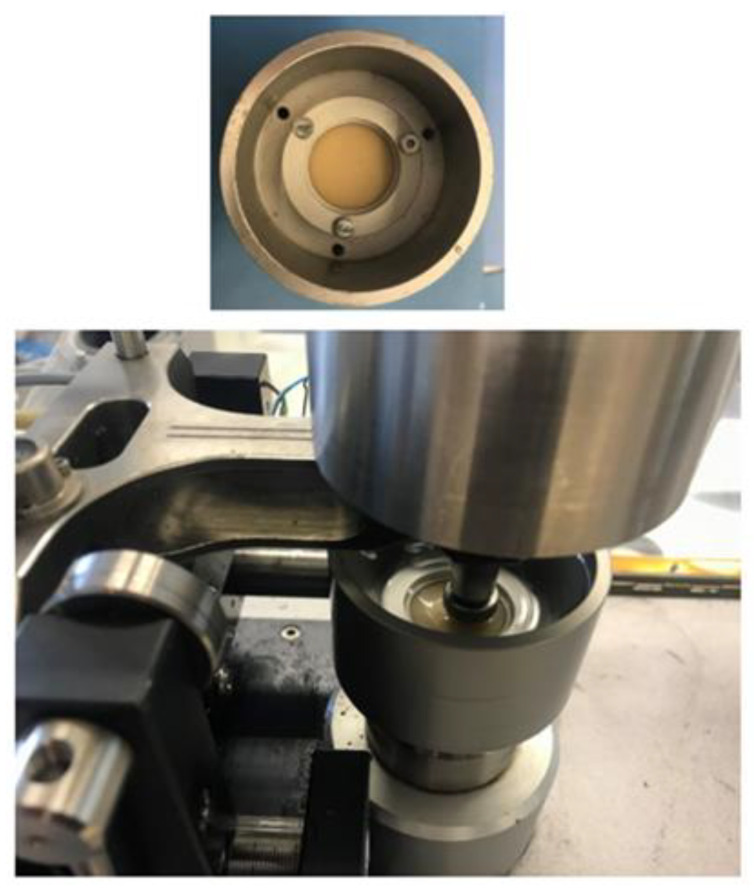
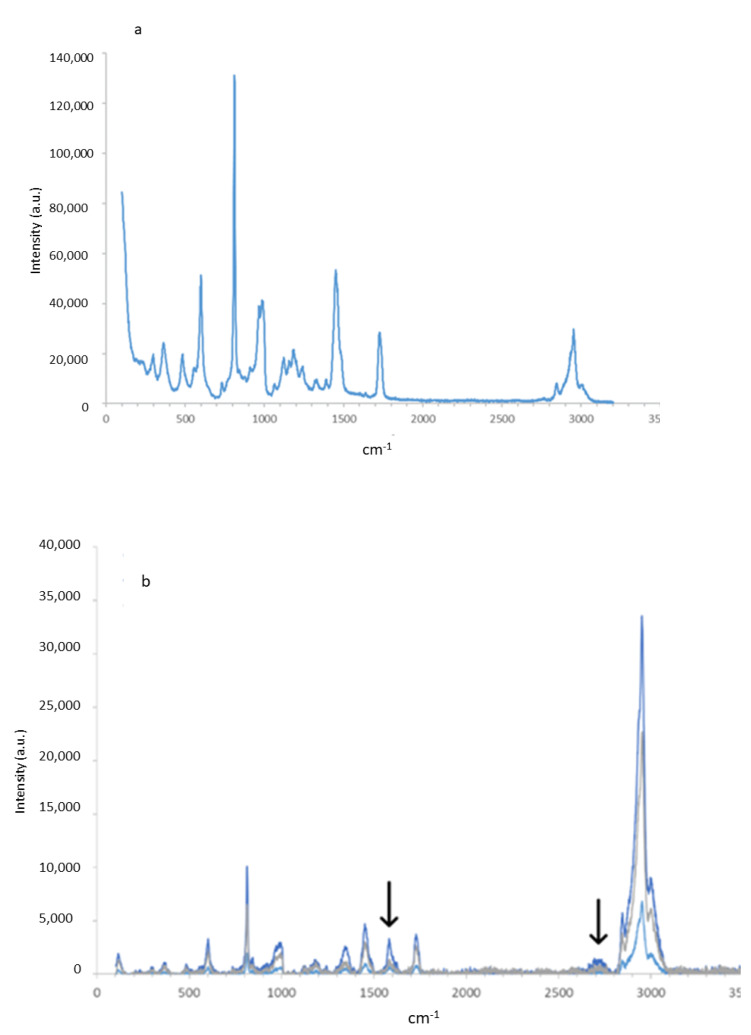
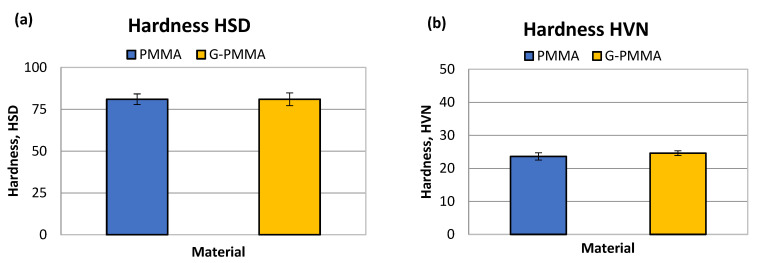
The use of a PMMA composite with graphene is being commercialized for application as dental prostheses. The different proportions of fibers provide a wide range of colors that favors dental esthetics in prostheses. However, there are no studies that have explained the influence that graphene has on the mechanical properties. In this contribution, we studied the PMMA and PMMA material with graphene fibers (PMMA-G) in the form of discs as supplied for machining. The presence of graphene fibers has been studied by Raman spectroscopy and the Shore hardness and Vickers micro hardness were determined. Mechanical compression tests were carried out to obtain the values of maximum strength and Young’s modulus (E) and by means of pin-on-disc wear tests, the specific wear rate and the friction coefficients were determined following the established international standards. Finally, the samples were characterized by field emission scanning electron microscopy (FESEM) to characterize the graphene’s morphology inside the PMMA. The results showed the presence of graphene in PMMA and was estimated in an amount of 0.1027% by weight in G-PMMA. The Shore hardness and Vickers microhardness values did not show statistically significant differences. Differences were observed in the compression maximum strength (129.43 MPa for PMMA and 140.23 for PMMA-G) and E values (2.01 for PMMA and 2.89 GPa for PMMA-G) as well as in the lower wear rate for the G-PMMA samples (1.93 × 10⁻⁷ for PMMA and 1.33 × 10⁻⁷ mm3/N·m) with a p < 0.005. The coefficients of friction for PMMA-G decreased from 0.4032 for PMMA to 0.4001 for PMMA-G. From the results obtained, a slight content in graphene produced a significant improvement in the mechanical properties that could be observed in the prosthesis material. Therefore, we can state that the main attraction of this material for dental prosthesis is its esthetics.
一种含石墨烯的聚甲基丙烯酸甲酯(PMMA)复合材料正被商业化用于制作牙科假体。不同比例的纤维提供了广泛的颜色,有利于假体的牙齿美观。然而,尚无研究解释石墨烯对机械性能的影响。在本研究中,我们研究了用于加工的圆盘状聚甲基丙烯酸甲酯(PMMA)和含石墨烯纤维的聚甲基丙烯酸甲酯材料(PMMA-G)。通过拉曼光谱研究了石墨烯纤维的存在情况,并测定了肖氏硬度和维氏显微硬度。进行了机械压缩试验以获得最大强度和杨氏模量(E)的值,并通过销盘磨损试验,按照既定的国际标准测定了比磨损率和摩擦系数。最后,通过场发射扫描电子显微镜(FESEM)对样品进行表征,以确定PMMA内部石墨烯的形态。结果表明PMMA中存在石墨烯,在G-PMMA中其重量含量估计为0.1027%。肖氏硬度和维氏显微硬度值没有显示出统计学上的显著差异。在压缩最大强度(PMMA为129.43MPa,PMMA-G为140.23MPa)和E值(PMMA为2.01GPa,PMMA-G为2.89GPa)方面观察到差异,以及G-PMMA样品的磨损率较低(PMMA为1.93×10⁻⁷,PMMA-G为1.33×10⁻⁷mm3/N·m),p<0.005。PMMA-G的摩擦系数从PMMA的0.4032降至PMMA-G的0.4001。从获得的结果来看,石墨烯的少量含量使机械性能有了显著改善,这在假体材料中可以观察到。因此,我们可以说这种材料用于牙科假体的主要吸引力在于其美观性。