Laboratory for Evaluation of the Bioactivity and Toxicology of Nanomaterials, University of Sorocaba (UNISO), Sorocaba 18023-000, Brazil.
Int J Mol Sci. 2022 Jul 27;23(15):8317. doi: 10.3390/ijms23158317.
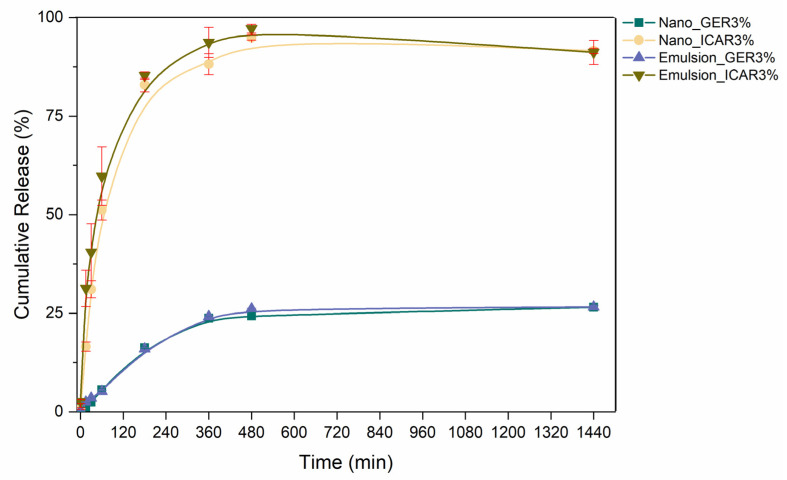
Repellents are among the leading products used against diseases transmitted by the Aedes aegypti mosquito. However, their indiscriminate use or high concentrations can cause severe adverse reactions, particularly in children and pregnant women. To protect them, nanotechnology is a promising tool to encapsulate active compounds against degradation, increase their effectiveness, and decrease their toxicity, as it can promote the modified release of the active compound. This study aimed to develop polymeric nanocapsules containing the repellent actives geraniol and icaridin using low concentrations of the active component, with the objective of promoting effective activity and greater safety against adverse reactions. The nanocapsules were developed by the interfacial deposition method, and the physicochemical properties of the nanocapsules were evaluated using dynamic light scattering (DLS), nanoparticle tracking analysis (NTA), zeta potential, differential scanning calorimetry (DSC), Fourier transform infrared spectroscopy (FTIR), atomic force microscopy (AFM), release kinetics assay, and mathematical modeling. Cell viability was assessed by the MTT assay and genotoxicity analysis using the comet assay. The developed nanocapsules containing geraniol and icaridin showed mean diameters of 260 nm and 314 nm, respectively, with a polydispersity index < 0.2. The nanocapsules showed encapsulation efficiency values of 73.7 ± 0.1% for icaridin and 98.7 ± 0.1% for geraniol. Morphological analysis showed spherical nanocapsules with low polydispersity. The kinetic parameters calculated using the Korsmeyer−Peppas model indicated an anomalous release profile. Cell viability and genotoxicity analyses showed that the nanocapsules did not alter cell viability or damage DNA. The results demonstrate a promising nanostructured system with good physicochemical characteristics and good stability, with repellent activity against Aedes aegypti.
驱避剂是用于防治埃及伊蚊传播疾病的主要产品之一。然而,它们的滥用或高浓度使用可能会导致严重的不良反应,特别是在儿童和孕妇中。为了保护他们,纳米技术是一种有前途的工具,可以封装活性化合物以防止降解,提高其有效性,并降低其毒性,因为它可以促进活性化合物的改性释放。本研究旨在开发含有香茅醇和依卡瑞丁的聚合物纳米胶囊,使用低浓度的活性成分,旨在促进有效活性和对不良反应更大的安全性。纳米胶囊是通过界面沉积法开发的,使用动态光散射(DLS)、纳米颗粒跟踪分析(NTA)、zeta 电位、差示扫描量热法(DSC)、傅里叶变换红外光谱(FTIR)、原子力显微镜(AFM)、释放动力学测定和数学模型评估纳米胶囊的物理化学性质。通过 MTT 测定和彗星试验进行的细胞活力评估和遗传毒性分析。含有香茅醇和依卡瑞丁的纳米胶囊的平均粒径分别为 260nm 和 314nm,多分散指数<0.2。纳米胶囊对依卡瑞丁和香茅醇的包封效率值分别为 73.7±0.1%和 98.7±0.1%。形态分析显示纳米胶囊呈球形,多分散性低。使用 Korsmeyer-Peppas 模型计算的动力学参数表明释放呈异常模式。细胞活力和遗传毒性分析表明,纳米胶囊不会改变细胞活力或损伤 DNA。结果表明,该纳米结构系统具有良好的物理化学特性和良好的稳定性,具有驱避埃及伊蚊的活性。