Graduate School of Science and Technology, University of Tsukuba, Tennodai 1-1-1, Tsukuba 305-8577, Japan.
Faculty of Life and Environmental Sciences, University of Tsukuba, Tennodai 1-1-1, Tsukuba 305-8577, Japan.
Sensors (Basel). 2022 Aug 4;22(15):5820. doi: 10.3390/s22155820.
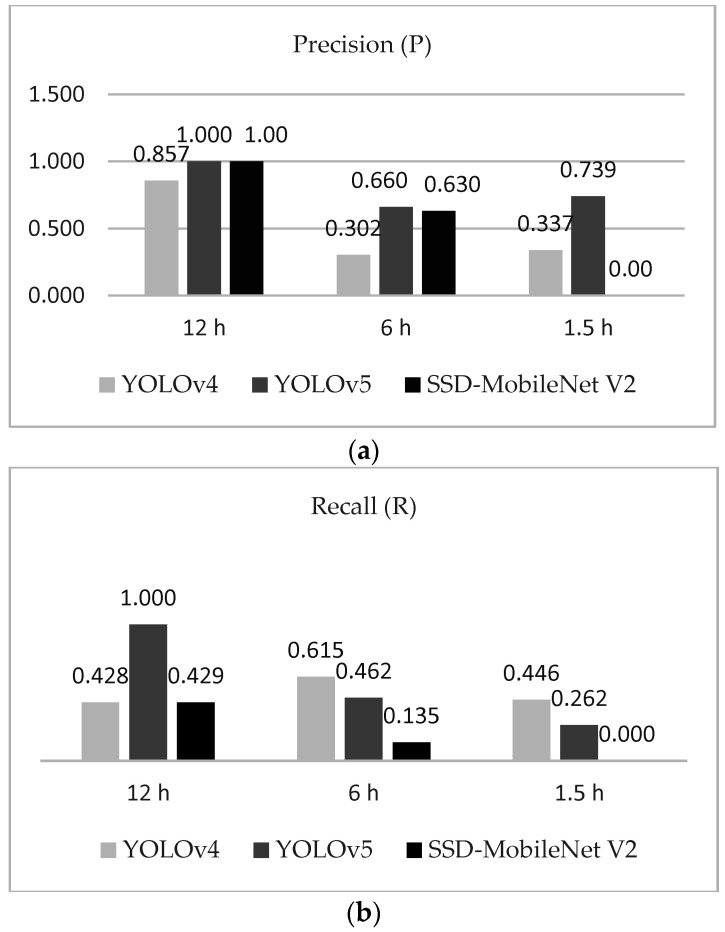
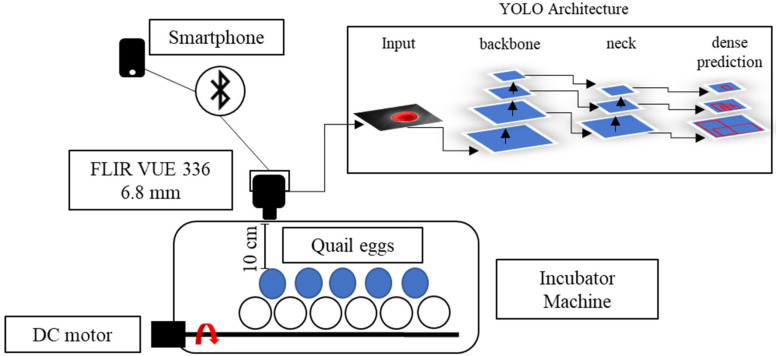
Poultry production utilizes many available technologies in terms of farm-industry automation and sanitary control. However, there is a lack of robust techniques and affordable equipment for avian embryo detection and sexual segregation at the early stages. In this work, we aimed to evaluate the potential use of thermal micro cameras for detecting embryos in quail eggs via thermal images during the first 168 h (7 days) of incubation. We propose a methodology to collect data during the incubation period. Additionally, to support the visual analysis, YOLO deep learning object detection algorithms were applied to detect unfertilized eggs; the results showed its potential to distinguish fertilized eggs from unfertilized eggs during the incubation period, after filtering radiometric images. We compared YOLOv4, YOLOv5 and SSD-MobileNet V2 trained models. The mAP@0.50 of the YOLOv4, YOLOv5 and SSD-MobileNet V2 was 98.62%, 99.5% and 91.8%, respectively. We also compared three testing datasets for different intervals of rotation of eggs, as our hypothesis was that fewer turning periods could improve the visualization of fertilized egg features, and applied three treatments: 1.5 h, 6 h, and 12 h. The results showed that turning eggs in different periods did not exhibit a linear relation, as the F1 Score for YOLOv4 of detection for the 12 h period was 0.569, that for the 6 h period was 0.404 and that for the 1.5 h period was 0.384. YOLOv5 F1 Scores for 12 h, 6 h and 1.5 h were 1, 0.545 and 0.386, respectively. SSD-MobileNet V2 performed F1 scores of 0.60 for 12 h, 0.22 for 6 h and 0 for 1.5 h turning periods.
家禽生产在农场-工业自动化和卫生控制方面利用了许多现有技术。然而,在禽类胚胎检测和早期性别分离方面,缺乏强大的技术和经济实惠的设备。在这项工作中,我们旨在评估在孵化的头 168 小时(7 天)内通过热图像检测鹌鹑蛋中胚胎的热微相机的潜在用途。我们提出了一种在孵化期间收集数据的方法。此外,为了支持视觉分析,应用了 YOLO 深度学习目标检测算法来检测未受精的鸡蛋;结果表明,在过滤辐射图像后,该算法有可能在孵化期间区分受精鸡蛋和未受精鸡蛋。我们比较了训练后的 YOLOv4、YOLOv5 和 SSD-MobileNet V2 模型。YOLOv4、YOLOv5 和 SSD-MobileNet V2 的 mAP@0.50 分别为 98.62%、99.5%和 91.8%。我们还比较了三个用于不同蛋旋转间隔的测试数据集,因为我们的假设是,减少旋转周期可以改善受精蛋特征的可视化效果,并应用了三种处理方式:1.5 小时、6 小时和 12 小时。结果表明,在不同时期旋转鸡蛋没有表现出线性关系,因为 YOLOv4 对 12 小时时期的检测的 F1 分数为 0.569,6 小时时期为 0.404,1.5 小时时期为 0.384。YOLOv5 在 12 小时、6 小时和 1.5 小时的 F1 分数分别为 1、0.545 和 0.386。SSD-MobileNet V2 在 12 小时、6 小时和 1.5 小时的 F1 分数分别为 0.60、0.22 和 0。