
严重主动脉瓣狭窄患者髋关节骨折手术:影响死亡率的因素研究。
Hip Fracture Surgery in Severe Aortic Stenosis: A Study of Factors Affecting Mortality.
机构信息
Department of Experimental and Clinical Medicine, University of Florence, Florence, Italy.
Department of Internal and Post-Surgery Unit, AOU Careggi, Florence, Italy.
出版信息
Clin Interv Aging. 2022 Aug 4;17:1163-1171. doi: 10.2147/CIA.S360538. eCollection 2022.
BACKGROUND
In elderly patients with hip fracture, the prevalence of severe aortic stenosis (valve area <1 cm) is close to 5%. Few studies have evaluated the prognostic role of aortic stenosis in hip fracture surgery and none has considered the effects of the postoperative setting (intensive care unit vs general ward) on clinical outcome.
PURPOSE
The aim of the present study was to evaluate the factors affecting mortality in patients with severe aortic stenosis undergoing surgery for hip fracture. We also evaluated whether postoperative monitoring in the intensive care unit may affect the prognosis in comparison to return to the general ward after surgery.
PATIENTS AND METHODS
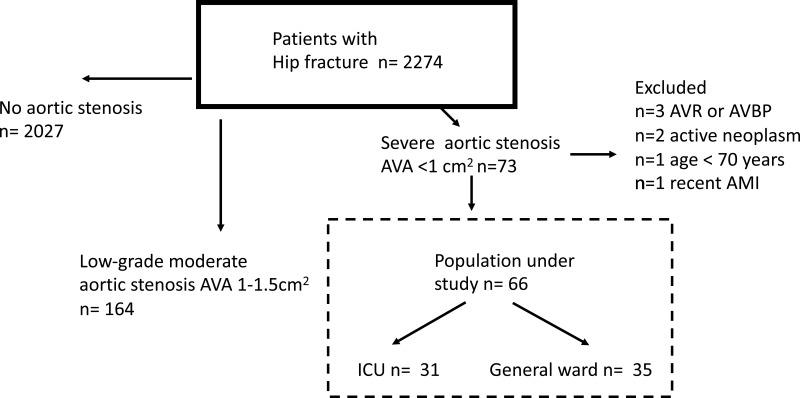
All 2274 patients referred for hip fracture to our tertiary teaching hospital between January 1 2015 and December 31 2019 were screened for the presence of severe aortic stenosis, defined by an aortic valve area <1.0 cm.
RESULTS
The study included 66 patients (27 males, 39 females) with a mean±SD age of 85±7 years. The average time between trauma and surgery was 2.6±3 days. The mean aortic valve area was 0.74±0.15 cm. Seven patients died during hospitalization (10.4%). Diabetes, having two or more comorbidities, a low degree of autonomy, heart failure, history of coronary artery disease, atrial fibrillation, postoperative delirium and pulmonary hypertension were associated with poorer outcome. In logistic multivariate analysis, the number of diseases and values of pulmonary artery pressure were the only independent factors related to mortality. In hospital mortality (12 and 9%, respectively) and complication rates were not statistically different between patients referred to the intensive care unit for postoperative monitoring and patients returned to the general ward after surgery.
CONCLUSION
In patients undergoing hip fracture surgery, severe aortic stenosis is associated with high hospital mortality, and two or more comorbidities and pulmonary hypertension are associated with a worse prognosis. The postoperative setting (intensive care unit or general ward) does not affect outcome.
背景
在老年髋部骨折患者中,严重主动脉瓣狭窄(瓣口面积<1cm)的患病率接近 5%。很少有研究评估主动脉瓣狭窄在髋部骨折手术中的预后作用,也没有研究考虑术后环境(重症监护病房与普通病房)对临床结果的影响。
目的
本研究旨在评估严重主动脉瓣狭窄患者行髋部骨折手术后死亡的相关因素。我们还评估了手术后在重症监护病房进行监测与返回普通病房相比是否会影响预后。
患者与方法
2015 年 1 月 1 日至 2019 年 12 月 31 日,我们对我院三级教学医院所有 2274 例髋部骨折患者进行了筛查,以确定是否存在严重主动脉瓣狭窄,其定义为主动脉瓣口面积<1.0cm。
结果
本研究纳入 66 例患者(男 27 例,女 39 例),平均年龄为 85±7 岁。创伤与手术之间的平均时间为 2.6±3 天。平均主动脉瓣口面积为 0.74±0.15cm。7 例患者在住院期间死亡(10.4%)。糖尿病、合并两种或两种以上合并症、自理能力低、心力衰竭、冠心病史、心房颤动、术后谵妄和肺动脉高压与较差的预后相关。在多变量逻辑回归分析中,疾病数量和肺动脉压值是与死亡率相关的唯一独立因素。在重症监护病房接受术后监测和手术后返回普通病房的患者之间,住院死亡率(分别为 12%和 9%)和并发症发生率无统计学差异。
结论
在髋部骨折手术患者中,严重主动脉瓣狭窄与较高的院内死亡率相关,两种或两种以上合并症和肺动脉高压与预后较差相关。术后环境(重症监护病房或普通病房)不会影响结果。
 Zotero 插件