Weisstaub Gerardo, Gonzalez Bravo María Angelica, García-Hermoso Antonio, Salazar Gabriela, López-Gil José Francisco
Institute of Nutrition and Food Technology (INTA), University of Chile, Santiago, Chile.
School of Nutrition, University of Talca, Talca, Chile.
Transl Pediatr. 2022 Jul;11(7):1085-1094. doi: 10.21037/tp-22-25.
Previous studies have examined the "fat but fit" paradox, revealing that greater levels of physical fitness may diminish the harmful consequences of excess weight on cardiometabolic risk. Despite the above, specific information about the "fat but fit" paradox in prepuberal population is scarce. The aim of this study was to determine the relationship between cardiometabolic risk across (individual and combined) physical fitness and excess weight status and whether the "fat but fit" paradox is met in the sample of schoolchildren analyzed.
A cross-sectional study was conducted including 452 children (59.1% girls), aged 7-9 years from Santiago (Chile). Physical fitness was assessed as cardiorespiratory fitness and muscular fitness. Cardiorespiratory fitness was determined by the 6-minute-walk-test and muscle strength was assessed by the handgrip and standing long jump tests. Excess weight (overweight and obesity) was computed through body mass index (z-score). Cardiometabolic risk was established by summing the z-score of the serum glucose, triglycerides, high-density lipoprotein, insulin and waist-to-height ratio.
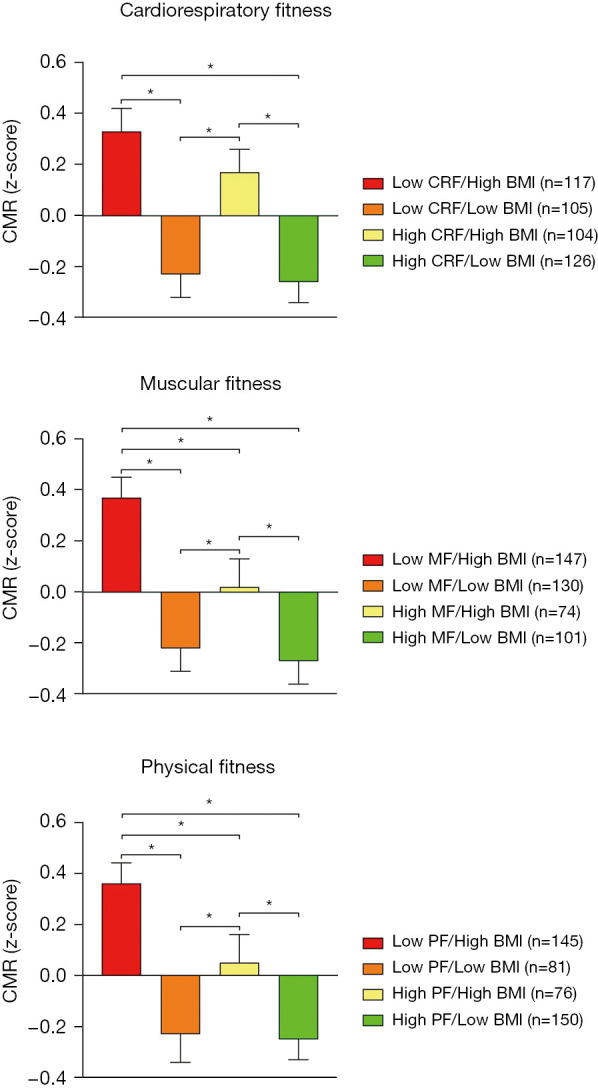
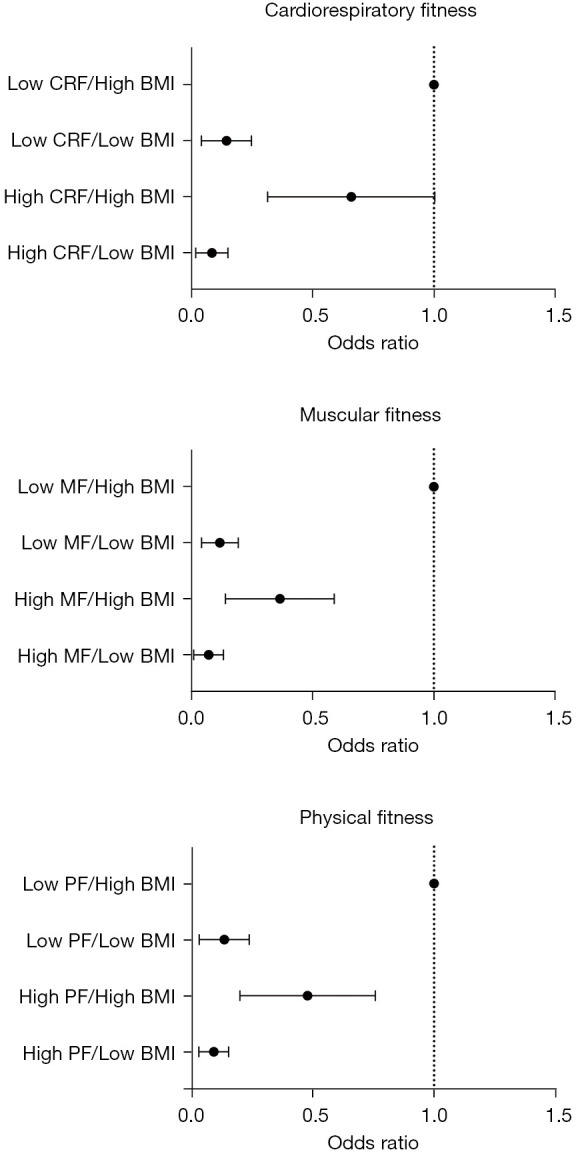
Schoolchildren with high physical fitness (individual or combined) showed the lowest cardiometabolic risk mean scores (P for trend <0.001 for all physical fitness groups). Conversely, schoolchildren with low physical fitness (individual or combined) showed the highest cardiometabolic risk mean scores (P for trend <0.001 for all categories). Additionally, schoolchildren without excess weight and with high individual or combined physical fitness status exhibits lower cardiometabolic risk mean scores compared to schoolchildren with excess weight and low physical fitness status (individual or combined) (P for trend <0.001 for all physical fitness groups). A lower odd of having high cardiometabolic risk was found in schoolchildren without excess weight and with both high physical fitness (both cardiorespiratory fitness and muscular fitness) [odds ratio (OR) =0.08; 95% confidence interval (CI): 0.04 to 0.16] in comparison to those with excess weight and low physical fitness.
Our results suggest that improvements in both fatness and aerobic fitness could be associated with lower cardiometabolic risk.
以往研究探讨了“肥胖但健康”的悖论,发现较高的身体素质水平可能会减轻超重对心脏代谢风险的有害影响。尽管如此,关于青春期前人群中“肥胖但健康”悖论的具体信息却很少。本研究的目的是确定(个体和综合)身体素质与超重状态下心脏代谢风险之间的关系,以及在所分析的学童样本中是否存在“肥胖但健康”的悖论。
开展了一项横断面研究,纳入了来自智利圣地亚哥的452名7至9岁儿童(59.1%为女孩)。身体素质评估包括心肺适能和肌肉适能。心肺适能通过6分钟步行测试确定,肌肉力量通过握力和立定跳远测试评估。超重(包括超重和肥胖)通过体重指数(z评分)计算得出。心脏代谢风险通过血清葡萄糖、甘油三酯、高密度脂蛋白、胰岛素的z评分与腰高比相加得出。
身体素质高(个体或综合)的学童心脏代谢风险平均得分最低(所有身体素质组的趋势P<0.001)。相反,身体素质低(个体或综合)的学童心脏代谢风险平均得分最高(所有类别趋势P<0.001)。此外,与超重且身体素质低(个体或综合)学生相比,体重正常且个体或综合身体素质高的学童心脏代谢风险平均得分更低(所有身体素质组趋势P<0.001)。与超重且身体素质低的学童相比,体重正常且心肺适能和肌肉适能均高的学童发生高心脏代谢风险的几率更低[比值比(OR)=0.08;95%置信区间(CI):0.04至0.16]。
我们的结果表明,肥胖和有氧适能的改善可能与较低的心脏代谢风险有关。