Lee Sang-Beom, Kim Gyeong-Jin, Shin Jung-Du, Chung Woojin, Park Soo-Kwon, Choi Geun-Hyoung, Park Sang-Won, Park Yong-Jin
Crop Foundation Research Division, National Institute of Crop Science, Wanju, South Korea.
Residual Agrochemical Assessment Division, National Institute of Agriculture Science, Wanju, South Korea.
Front Plant Sci. 2022 Jul 18;13:905842. doi: 10.3389/fpls.2022.905842. eCollection 2022.
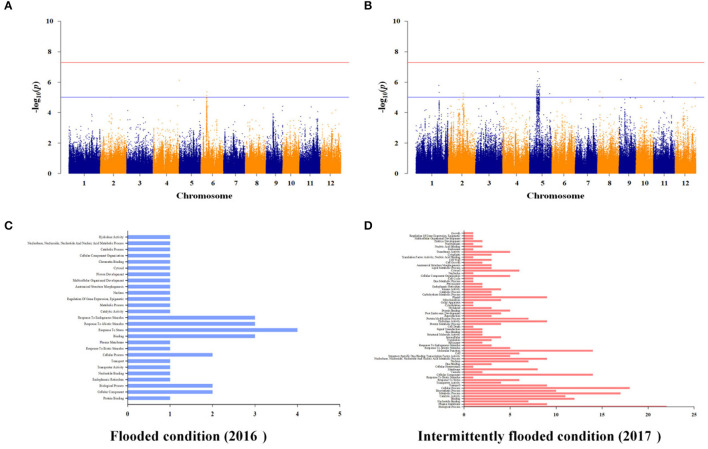
Ionomics, the study of the composition of mineral nutrients and trace elements in organisms that represent the inorganic component of cells and tissues, has been widely studied to explore to unravel the molecular mechanism regulating the elemental composition of plants. However, the genetic factors of rice subspecies in the interaction between arsenic and functional ions have not yet been explained. Here, the correlation between As and eight essential ions in a rice core collection was analyzed, taking into account growing condition and genetic factors. The results demonstrated that the correlation between As and essential ions was affected by genetic factors and growing condition, but it was confirmed that the genetic factor was slightly larger with the heritability for arsenic content at 53%. In particular, the cluster coefficient of (0.428) was larger than that of (0.414) in the co-expression network analysis for 23 arsenic genes, and it was confirmed that the distance between genes involved in As induction and detoxification of was far than that of . These findings provide evidence that populations could accumulate more As than populations. In addition, the -eQTLs of AIR2 (arsenic-induced RING finger protein) were isolated through transcriptome-wide association studies, and it was confirmed that AIR2 expression levels of were lower than those of . This was consistent with the functional haplotype results for the genome sequence of AIR2, and finally, eight rice varieties with low AIR2 expression and arsenic content were selected. In addition, As-related QTLs were identified on chromosomes 5 and 6 under flooded and intermittently flooded conditions through genome-scale profiling. Taken together, these results might assist in developing markers and breeding plans to reduce toxic element content and breeding high-quality rice varieties in future.
离子组学是对生物体中矿物质营养素和微量元素组成的研究,这些元素代表细胞和组织的无机成分,人们对其进行了广泛研究以探索揭示调节植物元素组成的分子机制。然而,水稻亚种在砷与功能离子相互作用中的遗传因素尚未得到解释。在此,考虑到生长条件和遗传因素,分析了水稻核心种质中砷与八种必需离子之间的相关性。结果表明,砷与必需离子之间的相关性受遗传因素和生长条件影响,但证实遗传因素影响稍大,砷含量的遗传力为53%。特别是,在23个砷基因的共表达网络分析中,(某基因)的聚类系数(0.428)大于(另一基因)的聚类系数(0.414),并且证实参与砷诱导和解毒的基因之间的距离(某基因的)比(另一基因的)远。这些发现提供了证据,表明(某群体)种群比(另一群体)种群能积累更多的砷。此外,通过全转录组关联研究分离出了AIR2(砷诱导的泛素连接酶)的-eQTLs,并且证实(某群体)的AIR2表达水平低于(另一群体)的。这与AIR2基因组序列的功能单倍型结果一致,最后,选择了八个AIR2表达水平低且砷含量低的水稻品种。此外,通过基因组规模分析在淹水和间歇淹水条件下在第5和第6号染色体上鉴定出了与砷相关的QTLs。综上所述,这些结果可能有助于未来开发标记和育种计划,以降低有毒元素含量并培育优质水稻品种。