Bosch Begona M, Bosch-Rue Elia, Perpiñan-Blasco Marina, Perez Roman A
Bioengineering Institute of Technology (BIT), Universitat Internacional de Catalunya, Barcelona 08195, Spain.
Regen Biomater. 2022 Jul 29;9:rbac052. doi: 10.1093/rb/rbac052. eCollection 2022.
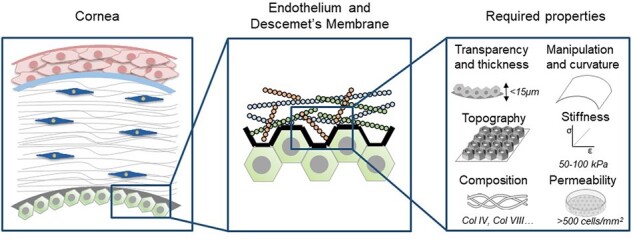
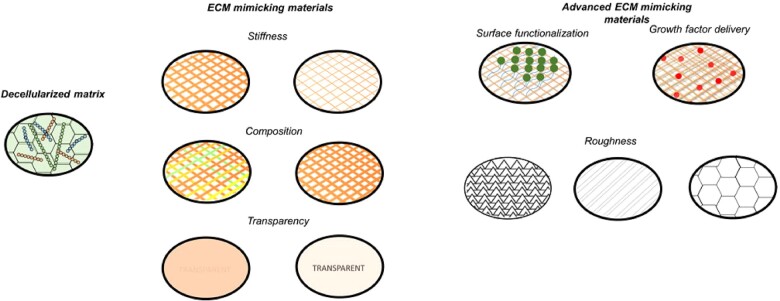
Corneal endothelium defects are one of the leading causes of blindness worldwide. The actual treatment is transplantation, which requires the use of human cadaveric donors, but it faces several problems, such as global shortage of donors. Therefore, new alternatives are being developed and, among them, cell therapy has gained interest in the last years due to its promising results in tissue regeneration. Nevertheless, the direct administration of cells may sometimes have limited success due to the immune response, hence requiring the combination with extracellular mimicking materials. In this review, we present different methods to obtain corneal endothelial cells from diverse cell sources such as pluripotent or multipotent stem cells. Moreover, we discuss different substrates in order to allow a correct implantation as a cell sheet and to promote an enhanced cell behavior. For this reason, natural or synthetic matrixes that mimic the native environment have been developed. These matrixes have been optimized in terms of their physicochemical properties, such as stiffness, topography, composition and transparency. To further enhance the matrixes properties, these can be tuned by incorporating certain molecules that can be delivered in a sustained manner in order to enhance biological behavior. Finally, we elucidate future directions for corneal endothelial regeneration, such as 3D printing, in order to obtain patient-specific substrates.
角膜内皮缺陷是全球失明的主要原因之一。实际治疗方法是移植,这需要使用人类尸体供体,但面临着几个问题,比如供体全球短缺。因此,正在开发新的替代方法,其中,细胞疗法在过去几年因其在组织再生方面的 promising 结果而受到关注。然而,由于免疫反应,细胞的直接给药有时可能效果有限,因此需要与细胞外模拟材料结合使用。在本综述中,我们介绍了从多能或多能干细胞等不同细胞来源获得角膜内皮细胞的不同方法。此外,我们讨论了不同的基质,以便作为细胞片正确植入并促进增强的细胞行为。因此,已经开发出模仿天然环境的天然或合成基质。这些基质在其物理化学性质方面进行了优化,如硬度、形貌、组成和透明度。为了进一步增强基质的性能,可以通过掺入某些可以持续递送以增强生物学行为的分子来对其进行调整。最后,我们阐明了角膜内皮再生的未来方向,如 3D 打印,以便获得患者特异性基质。