Yao Xinlei, Chen Xinran, Sun Yu, Yang Pengxiang, Gu Xiaosong, Dai Xiu
Key Laboratory of Neuroregeneration of Jiangsu and Ministry of Education, Co-Innovation Center of Neuroregeneration, Nantong University, Nantong 226001, China.
Regen Biomater. 2024 Feb 1;11:rbae009. doi: 10.1093/rb/rbae009. eCollection 2024.
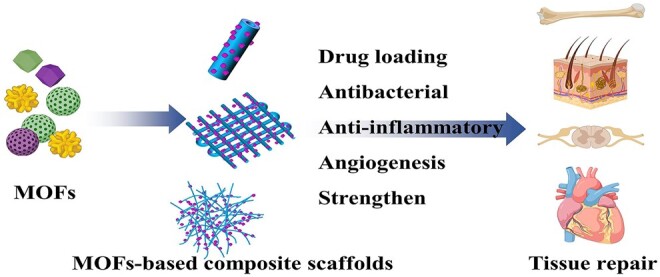
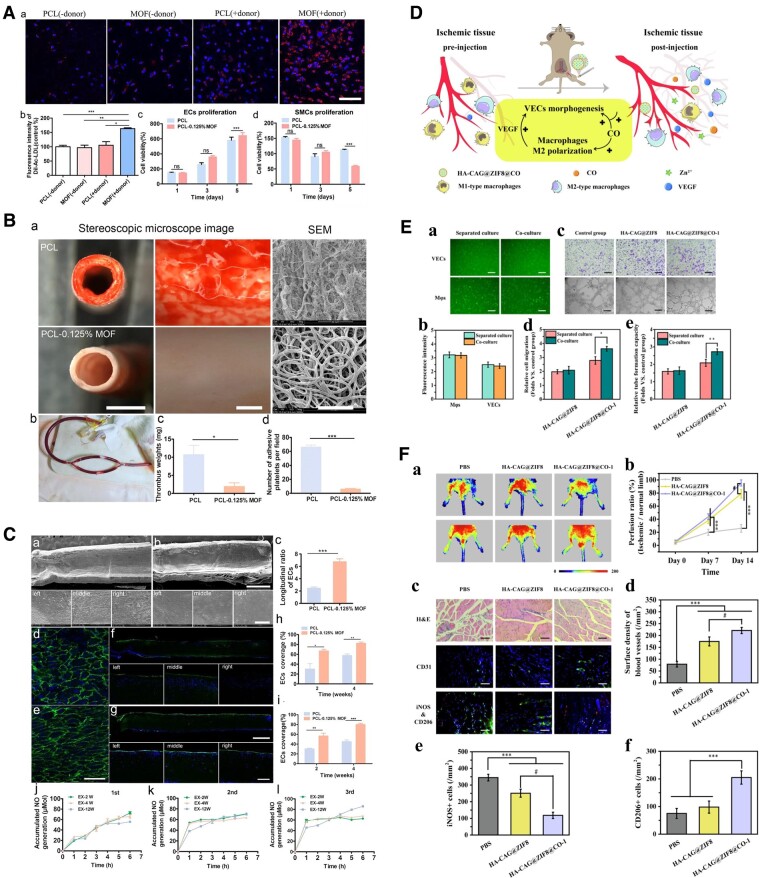
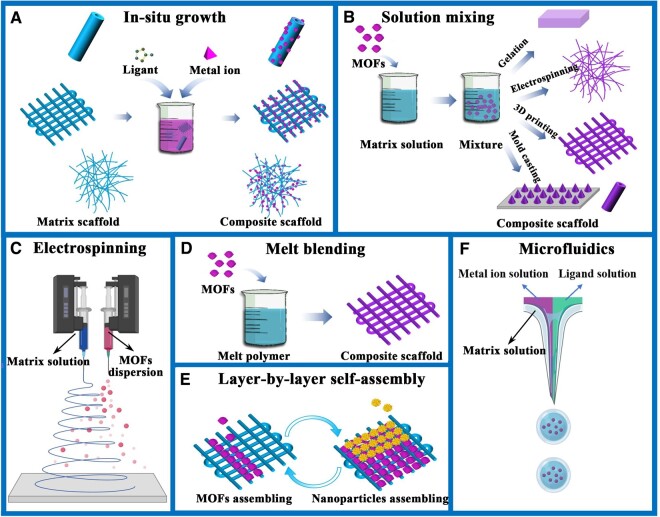
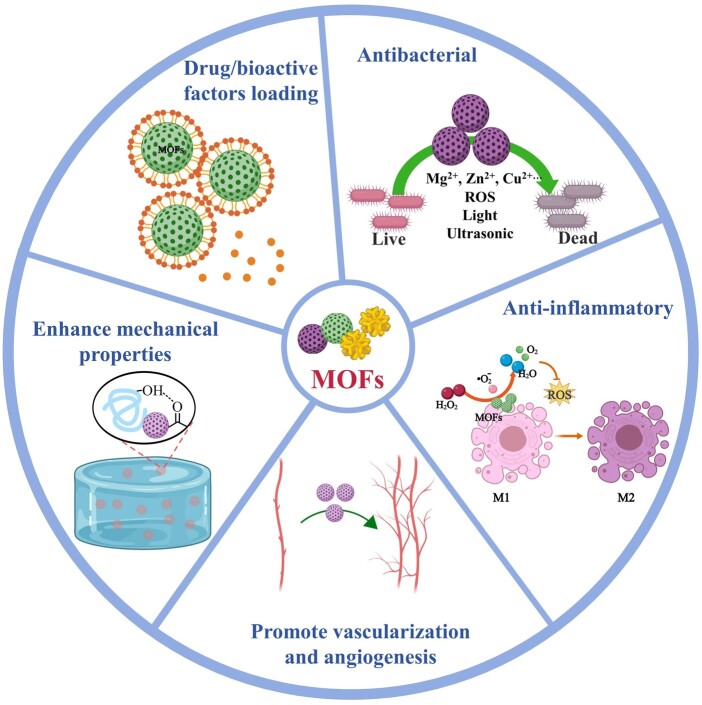
With the rapid development of materials science and tissue engineering, a variety of biomaterials have been used to construct tissue engineering scaffolds. Due to the performance limitations of single materials, functional composite biomaterials have attracted great attention as tools to improve the effectiveness of biological scaffolds for tissue repair. In recent years, metal-organic frameworks (MOFs) have shown great promise for application in tissue engineering because of their high specific surface area, high porosity, high biocompatibility, appropriate environmental sensitivities and other advantages. This review introduces methods for the construction of MOFs-based functional composite scaffolds and describes the specific functions and mechanisms of MOFs in repairing damaged tissue. The latest MOFs-based functional composites and their applications in different tissues are discussed. Finally, the challenges and future prospects of using MOFs-based composites in tissue engineering are summarized. The aim of this review is to show the great potential of MOFs-based functional composite materials in the field of tissue engineering and to stimulate further innovation in this promising area.
随着材料科学和组织工程的快速发展,多种生物材料已被用于构建组织工程支架。由于单一材料的性能限制,功能性复合生物材料作为提高生物支架组织修复效果的工具受到了极大关注。近年来,金属有机框架(MOFs)因其高比表面积、高孔隙率、高生物相容性、适当的环境敏感性等优点,在组织工程应用中显示出巨大潜力。本文综述介绍了基于MOFs的功能性复合支架的构建方法,并描述了MOFs在修复受损组织中的具体功能和机制。讨论了最新的基于MOFs的功能复合材料及其在不同组织中的应用。最后,总结了基于MOFs的复合材料在组织工程中面临的挑战和未来前景。本文综述的目的是展示基于MOFs的功能复合材料在组织工程领域的巨大潜力,并激发这一有前景领域的进一步创新。