Farkouh Ala'a, Salvio Gianmaria, Kuroda Shinnosuke, Saleh Ramadan, Vogiatzi Paraskevi, Agarwal Ashok
Global Andrology Forum, American Center for Reproductive Medicine, Moreland Hills, Ohio, USA.
Division of Endocrinology, Department of Clinical and Molecular Sciences (DISCLIMO), Polytechnic University of Marche, Ancona, Italy.
Transl Androl Urol. 2022 Jul;11(7):1023-1044. doi: 10.21037/tau-22-149.
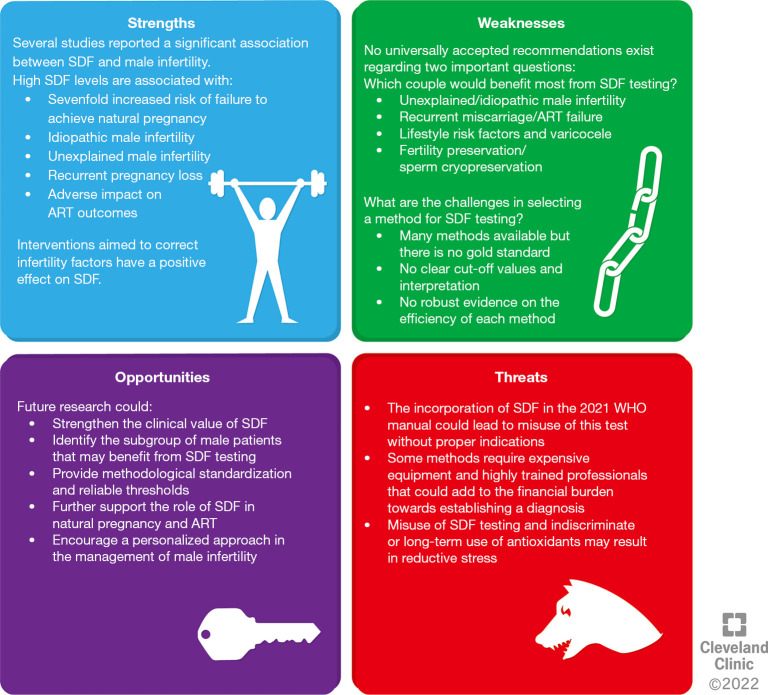
Conventional semen analysis (SA) remains an essential tool in the initial male fertility evaluation and subsequent follow-up. However, it neither provides information about the functional status of spermatozoa nor addresses disorders such as idiopathic or unexplained infertility (UI). Recently, assessment of sperm DNA fragmentation (SDF) has been proposed as an extended sperm test that may help overcome these inherent limitations of basic SA. In this review, we aim to: (I) discuss the pathophysiological aspects of SDF, including natural repair mechanisms, causes, and impact on reproductive outcomes; (II) explain different assessment tools of SDF, and describe potential therapeutic options to manage infertile men with high SDF; and (III) analyse the strengths, weaknesses, opportunities and threats (SWOT) of current research on the topic.
This review was constructed from original studies, systematic reviews and meta-analyses that were published over the years up until August 2021, related to the various aspects of SDF.
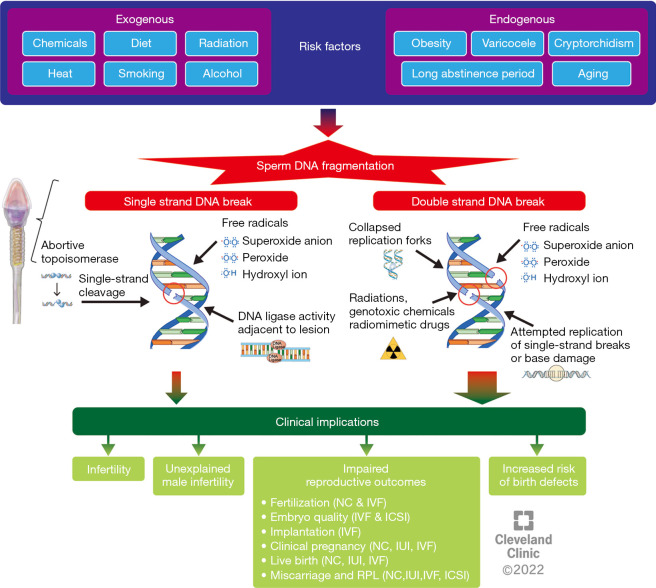
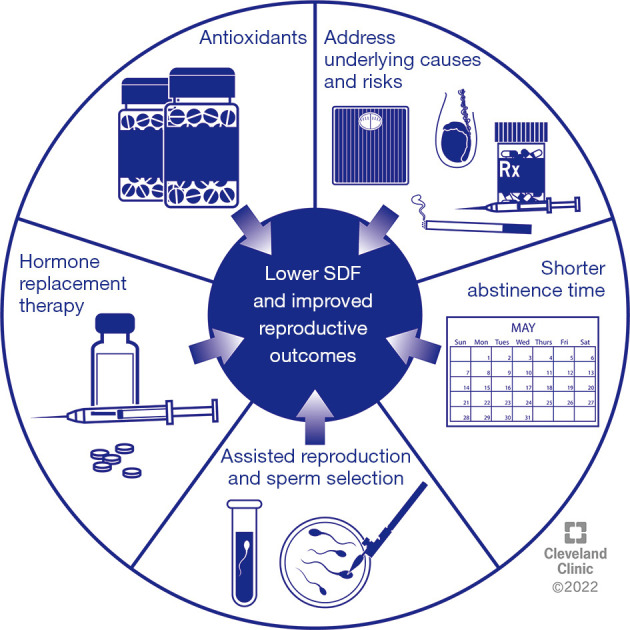
Different mechanisms lead to high SDF, including defective chromatin packaging, apoptosis, and seminal oxidative stress. The relevance of sperm DNA integrity to male fertility/infertility has been supported by the frequent observation of high levels of SDF in infertile men, and in association with risk factors for infertility. Additionally, high SDF levels have been inversely correlated with the outcomes of natural pregnancy and assisted reproduction. Terminal deoxynucleotidyl transferase dUTP nick end labelling, sperm chromatin structure assay, sperm chromatin dispersion, and Comet assay are four commonly used assays for measurement of SDF. Addressing lifestyle risks and underlying conditions, antioxidants, hormonal therapy, and advanced sperm selection techniques have all been proposed as potential therapeutic options to lower SDF.
The sum of literature provides evidence of detrimental effects of high SDF on both natural and assisted fertility outcomes. Standardization of the techniques used for assessment of SDF and their incorporation into the work up of infertile couples may have significant implications on the future management of a selected category of infertile men with high SDF.
传统精液分析(SA)仍是男性生育力初步评估及后续随访的重要手段。然而,它既无法提供精子功能状态的信息,也无法解决诸如特发性或不明原因不孕症(UI)等问题。近年来,精子DNA碎片率(SDF)评估被提议作为一种扩展的精子检测方法,可能有助于克服基础精液分析的这些固有局限性。在本综述中,我们旨在:(I)讨论SDF的病理生理学方面,包括自然修复机制、病因及其对生殖结局的影响;(II)解释SDF的不同评估工具,并描述针对SDF高的不育男性的潜在治疗选择;以及(III)分析该主题当前研究的优势、劣势、机会和威胁(SWOT)。
本综述基于截至2021年8月多年来发表的与SDF各方面相关的原始研究、系统评价和荟萃分析构建而成。
不同机制可导致高SDF,包括染色质包装缺陷、细胞凋亡和精液氧化应激。不育男性中频繁观察到高SDF水平,且与不孕风险因素相关,这支持了精子DNA完整性与男性生育力/不育的相关性。此外,高SDF水平与自然妊娠和辅助生殖的结局呈负相关。末端脱氧核苷酸转移酶介导的dUTP缺口末端标记法、精子染色质结构分析、精子染色质扩散分析和彗星试验是四种常用的SDF检测方法。改变生活方式风险因素和潜在疾病、使用抗氧化剂、激素治疗以及先进的精子筛选技术都已被提议作为降低SDF的潜在治疗选择。
文献综述表明,高SDF对自然生育和辅助生育结局均有不利影响。用于评估SDF的技术标准化以及将其纳入不育夫妇的检查流程,可能对未来特定类型SDF高的不育男性的管理产生重大影响。