Department of Epidemiology and Health Statistics, Xiangya School of Public Health, Central South University.
National Health Commission Key Laboratory for Birth Defect Research and Prevention, Changsha, Hunan.
Medicine (Baltimore). 2021 Mar 12;100(10):e24828. doi: 10.1097/MD.0000000000024828.
To assess the association of conventional semen parameters and sperm DNA fragmentation with risk of recurrent spontaneous abortion (RSA).
Systematic review and meta-analysis.
Not applicable.
Total 1,690 male partners of women with RSA, and 1,337 male partners of fertile control women.
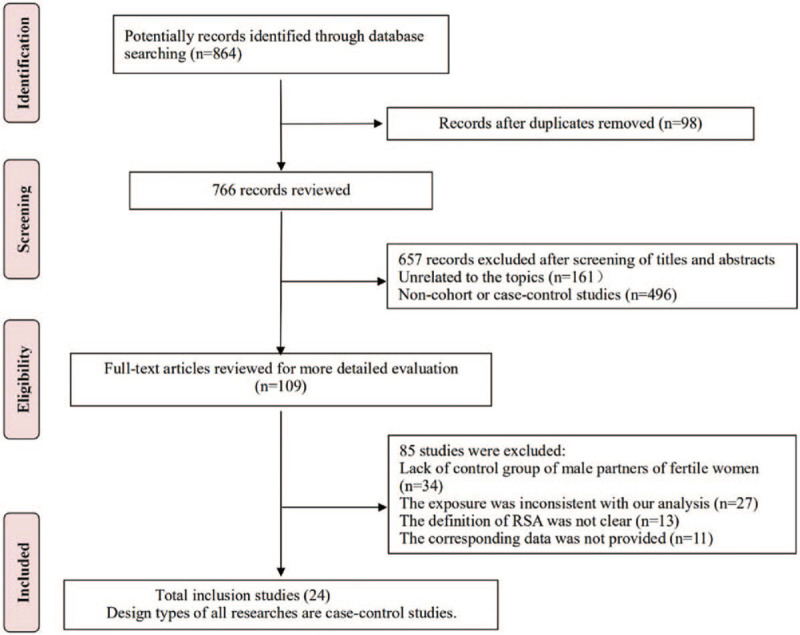
Case-control or cohort studies were determined by searching PubMed, Google Scholar, Cochrane Libraries, China Biology Medicine disc, Chinese Scientific Journals Fulltext Database, China National Knowledge Infrastructure, and Wanfang Database. RSA was defined as two or more previous pregnancy losses. The fertile women refer to the reproductive women who have had at least a normal pregnancy history and no history of abortion.
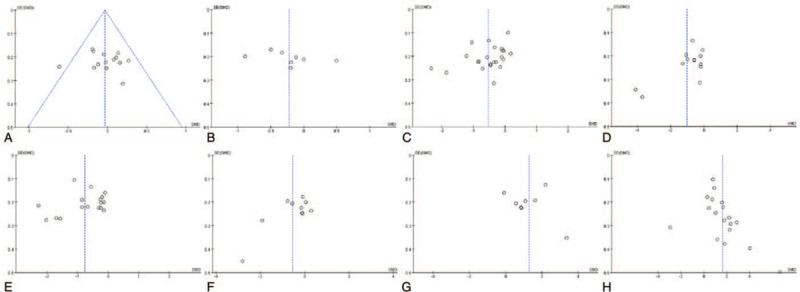
This study included eight outcome measures: semen volume(ml), semen pH value, sperm density(106/ml), sperm viability (%), sperm progressive motility rate (%), normal sperm morphology rate (%), sperm deformity rate(%), sperm DNA fragmentation index (DFI) (%). The summary measures were reported as standardized mean difference (SMD) with 95% confidence interval (CI).
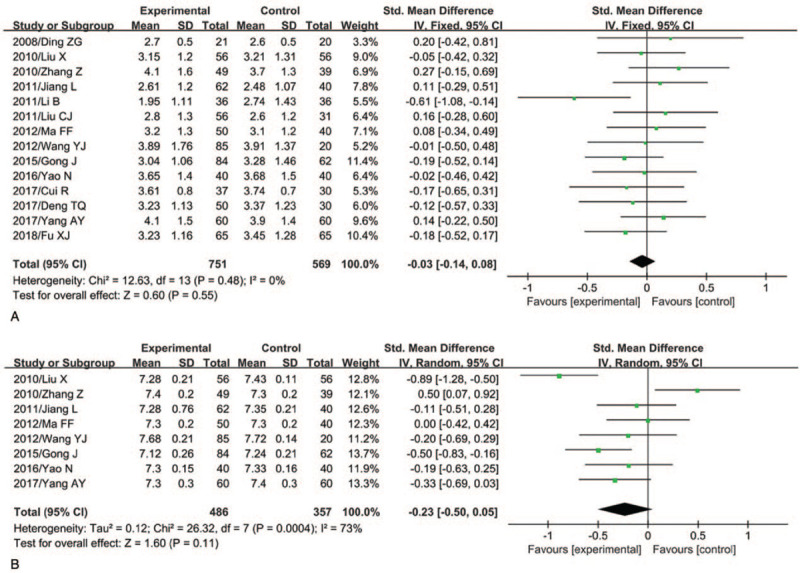
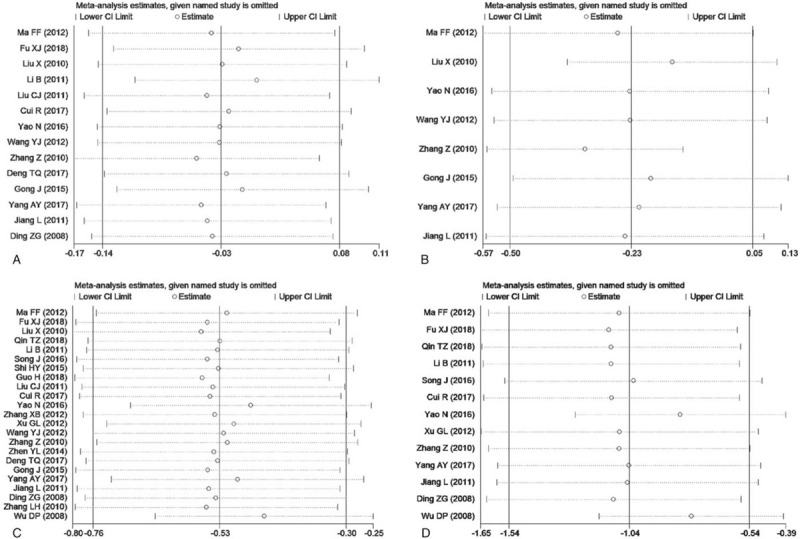
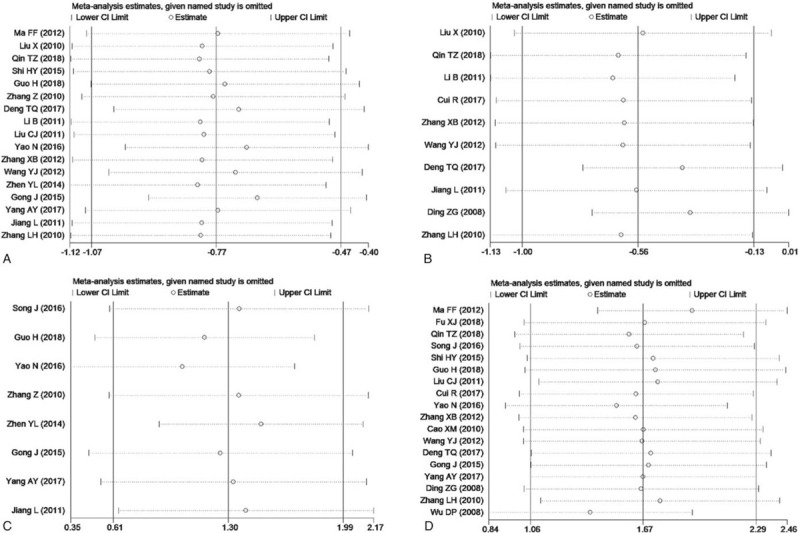
Finally, twenty-four studies were included for analysis. Overall, male partners of women with RSA had a significantly lower level of sperm density (SMD = -0.53, 95%CI: - 0.75 to -0.30), sperm viability (SMD = -1.03, 95%CI: - 1.52 to -0.54), sperm progressive motility rate (SMD = -0.76, 95%CI:-1.06 - -0.46), and normal sperm morphology rate (SMD = -0.56, 95%CI: - 0.99 to -0.12), and had a significantly higher rate of sperm deformity rate (SMD = 1.29, 95%CI: 0.60 - 1.97), and sperm DFI (SMD = 1.60, 95%CI: 1.04 to 2.17), when compared with the reference group. However, there were no statistically significant differences for semen volume (SMD = -0.03, 95%CI: -0.14 - 0.08) and semen pH value (SMD = -0.23, 95% CI: -0.50 to 0.05) among 2 groups.
The results of this analysis support an association of sperm density, sperm viability, sperm progressive motility rate, normal sperm morphology rate, sperm deformity rate, as well as sperm DFI with RSA. However, given the significant heterogeneity between studies and the lack of more detailed data on the subjects, further large-scale prospective studies are needed.
评估常规精液参数和精子 DNA 碎片与复发性自然流产(RSA)风险的关联。
系统评价和荟萃分析。
不适用。
共 1690 名 RSA 女性的男性伴侣,以及 1337 名生育能力正常女性的男性伴侣。
通过搜索 PubMed、Google Scholar、Cochrane 图书馆、中国生物医学文献数据库、中国科学期刊全文数据库、中国国家知识基础设施和万方数据库,确定病例对照或队列研究。RSA 定义为两次或两次以上的妊娠丢失。生育能力正常的女性是指有过至少一次正常妊娠史且无流产史的生殖女性。
本研究包括 8 个结局指标:精液量(ml)、精液 pH 值、精子密度(106/ml)、精子存活率(%)、精子前向运动率(%)、正常精子形态率(%)、精子畸形率(%)、精子 DNA 碎片指数(DFI)(%)。汇总指标以标准化均数差(SMD)和 95%置信区间(CI)报告。
最终纳入 24 项研究进行分析。总体而言,RSA 女性的男性伴侣的精子密度(SMD=-0.53,95%CI:-0.75 至 -0.30)、精子存活率(SMD=-1.03,95%CI:-1.52 至 -0.54)、精子前向运动率(SMD=-0.76,95%CI:-1.06 至 -0.46)和正常精子形态率(SMD=-0.56,95%CI:-0.99 至 -0.12)显著较低,而精子畸形率(SMD=1.29,95%CI:0.60 至 1.97)和精子 DFI(SMD=1.60,95%CI:1.04 至 2.17)显著较高。然而,两组间的精液量(SMD=-0.03,95%CI:-0.14 至 0.08)和精液 pH 值(SMD=-0.23,95%CI:-0.50 至 0.05)无统计学差异。
本分析结果支持精子密度、精子存活率、精子前向运动率、正常精子形态率、精子畸形率以及精子 DFI 与 RSA 之间的关联。然而,由于研究间存在显著的异质性,且缺乏关于受试者的更详细数据,还需要进一步的大规模前瞻性研究。