Cui Jue, Zong Wenyi, Zhao Nannan, Yuan Rui
School of Food and Biological Engineering Xuzhou University of Technology Xuzhou China.
Jiangsu Key Laboratory of Food Resource Development and Quality Safe Xuzhou Institute of Technology Xuzhou China.
Food Sci Nutr. 2022 May 12;10(8):2718-2726. doi: 10.1002/fsn3.2875. eCollection 2022 Aug.
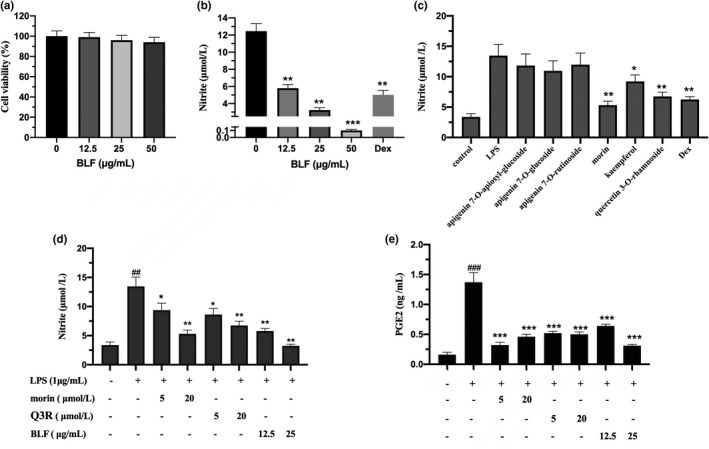
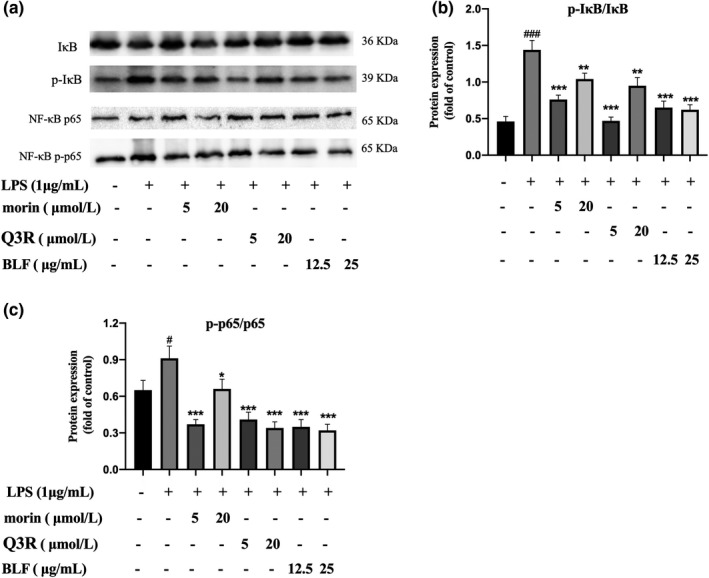
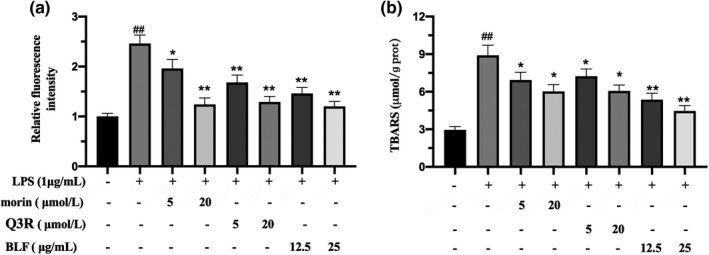
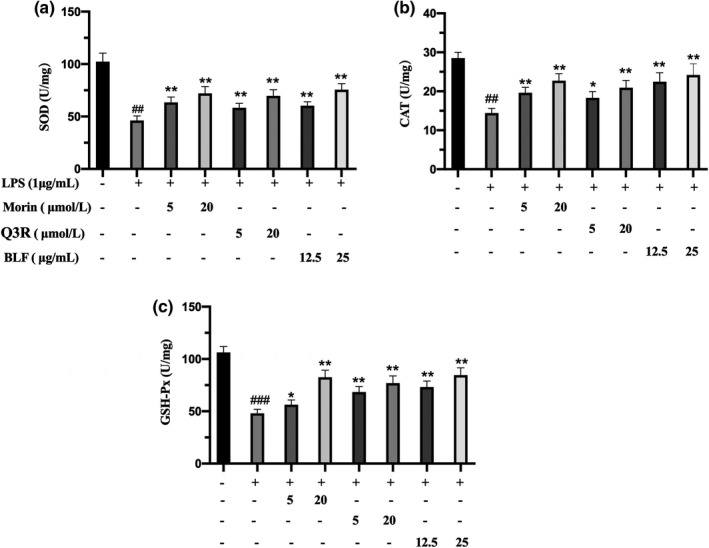
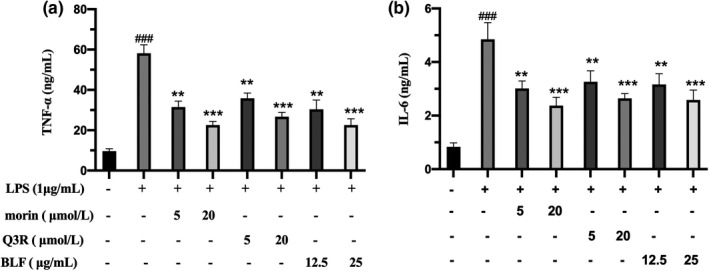
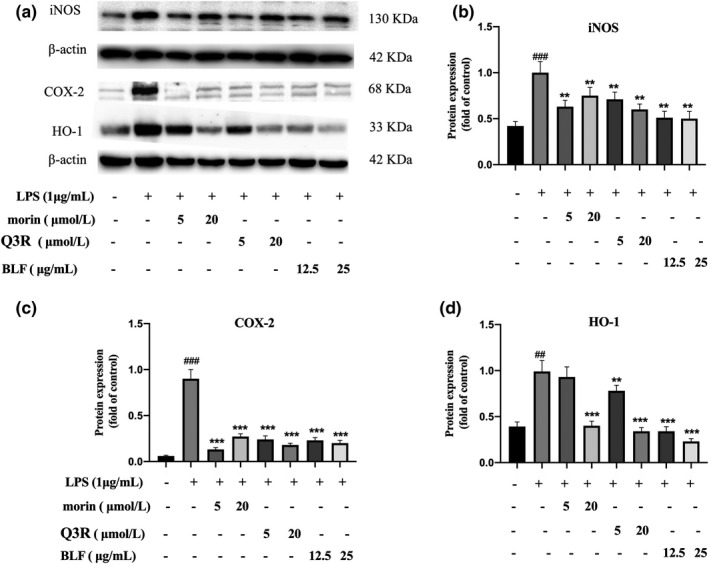
In this study, the anti-inflammatory and antioxidant activities and mechanism of burdock leaf flavonoids (BLF) on LPS-stimulated inflammation in RAW264.7 macrophage cells were explored. We have observed that BLF and main effective components morin and quercetin 3-O-rhamnoside pretreatment significantly inhibited LPS-stimulated inflammatory activation of RAW264.7 cells by lowering the levels of NO, PGE2, TNF-α, and IL-6 production ( < .05). At the same time, BLF not only had potent free radical scavenging ability in vitro (DPPH: 2025.33 ± 84.15 μmol Trolox/g, ABTS: 159.14 ± 5.28 μmol Trolox/g, and ORAC: 248.72 ± 9.74 μmol Trolox/g) but also effectively ameliorated cellular oxidative stress status by restoring the decreased activity of antioxidant enzymes (SOD, CAT, and GSH-Px) and decreasing the elevated levels of ROS and TBARS in LPS-stimulated macrophages ( < .05). The western blot analysis indicated that BLF and main components morin and quercetin 3-O-rhamnoside mainly inhibited LPS-stimulated inflammation by reducing the iNOS and COX-2 protein expression, decreasing cellular ROS, and blocking the activation of NF-κB signaling pathway in macrophages. Our results collectively imply that BLF could be used as a new type of functional factor for the development of antioxidant and anti-inflammatory foods.
本研究探讨了牛蒡叶黄酮(BLF)对脂多糖(LPS)刺激的RAW264.7巨噬细胞炎症的抗炎和抗氧化活性及作用机制。我们观察到,BLF以及主要有效成分桑色素和槲皮素3-O-鼠李糖苷预处理可通过降低一氧化氮(NO)、前列腺素E2(PGE2)、肿瘤坏死因子-α(TNF-α)和白细胞介素-6(IL-6)的产生水平,显著抑制LPS刺激的RAW264.7细胞的炎症激活(P<0.05)。同时,BLF不仅在体外具有强大的自由基清除能力(二苯基苦味酰基自由基(DPPH):2025.33±84.15μmol Trolox/g,2,2'-联氮-双-3-乙基苯并噻唑啉-6-磺酸(ABTS):159.14±5.28μmol Trolox/g,氧自由基吸收能力(ORAC):248.72±9.74μmol Trolox/g),还通过恢复抗氧化酶(超氧化物歧化酶(SOD)、过氧化氢酶(CAT)和谷胱甘肽过氧化物酶(GSH-Px))降低的活性,并降低LPS刺激的巨噬细胞中升高的活性氧(ROS)和丙二醛(TBARS)水平,有效改善细胞氧化应激状态(P<0.05)。蛋白质免疫印迹分析表明,BLF以及主要成分桑色素和槲皮素3-O-鼠李糖苷主要通过降低诱导型一氧化氮合酶(iNOS)和环氧化酶-2(COX-2)蛋白表达、减少细胞ROS以及阻断巨噬细胞中核因子κB(NF-κB)信号通路的激活来抑制LPS刺激的炎症。我们的结果共同表明,BLF可作为一种新型功能因子用于开发抗氧化和抗炎食品。