Ungureanu Alexandru Nicolae, Beratto Luca, Daga Federico Abate, Boccia Gennaro, Lupo Corrado, Brustio Paolo Riccado
NeuroMuscularFunction Research Group; School of Exercise & Sport Sciences, SUISM; University of Turin, Turin, Italy.
Department of Medical Sciences; University of Turin, Turin, Italy.
Biol Sport. 2022 Sep;39(3):621-628. doi: 10.5114/biolsport.2022.106384. Epub 2021 Jul 28.
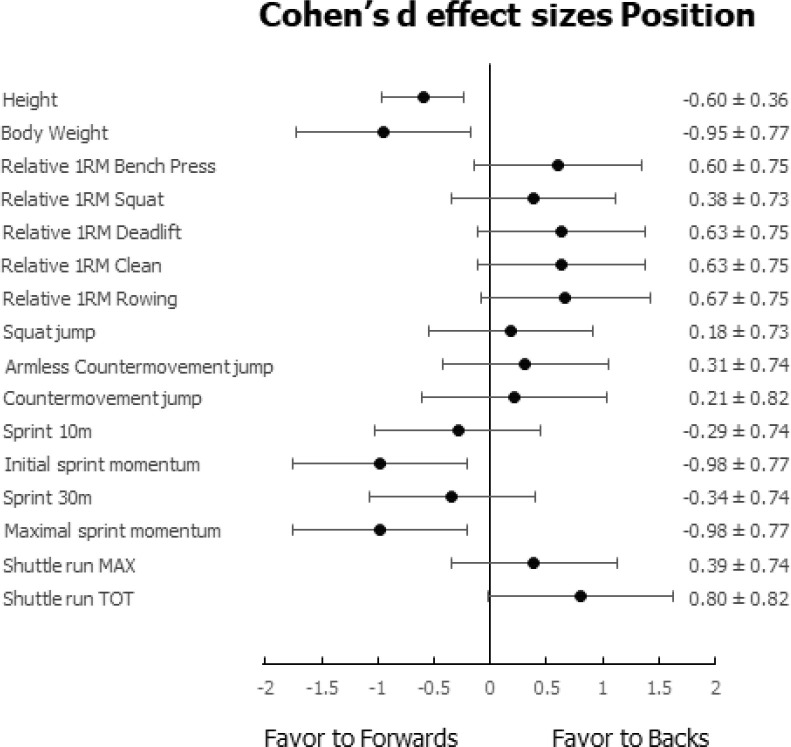
In rugby union, physical characteristics may partially contribute to long-term career progression, especially during adolescence. Therefore, the primary purpose of the study was to evaluate Italian regional rugby union academy players' (i.e., under-18) anthropometric and physical characteristics during a competitive season. Body mass, height, upper- and lower-body maximal strength, sprint, and high-intensity running ability were assessed in 29 elite players (backs, n = 13, forwards, n = 16). A mixed-design analysis of variance (ANOVA) for repeated measures showed that backs were shorter (ES = 0.59), lighter (ES = 0.94), stronger relative to body mass (bench press; ES = 0.60; deadlift; ES = 0.63; clean ES = 0.63; rowing ES = 0.67), and fitter (shuttle run max; ES = 0.38; shuttle run tot; ES = 0.79) than forwards. However, the forwards achieved greater sprint momentum (initial sprint momentum; ES = 0.97; maximal sprint momentum; ES = 0.98). During the season, players changed in stature, upper-body maximal strength, jumping, and high intensity running (p < 0.05), but not in body weight or lower-body maximal strength (p > 0.05). Maximal strength improved in the first part of the season, whereas jumping and sprinting performances increased in the last part of the season. Therefore, these findings highlight the importance of regularly monitoring the physical development in a long-term perspective, even suggesting that physiological adaptations are heterochronic between positional roles.
在英式橄榄球联合会比赛中,身体特征可能在一定程度上有助于长期的职业生涯发展,尤其是在青少年时期。因此,本研究的主要目的是评估意大利地区橄榄球联合会青训学院球员(即18岁以下)在一个比赛赛季中的人体测量学和身体特征。对29名精英球员(后卫,n = 13;前锋,n = 16)进行了体重、身高、上半身和下半身最大力量、短跑和高强度跑步能力的评估。重复测量的混合设计方差分析(ANOVA)表明,后卫比前锋更矮(效应量 = 0.59)、更轻(效应量 = 0.94),相对于体重更强壮(卧推;效应量 = 0.60;硬拉;效应量 = 0.63;挺举效应量 = 0.63;划船效应量 = 0.67),且更健康(穿梭跑最大值;效应量 = 0.38;穿梭跑总计;效应量 = 0.79)。然而,前锋的短跑动量更大(初始短跑动量;效应量 = 0.97;最大短跑动量;效应量 = 0.98)。在赛季中,球员的身高、上半身最大力量、跳跃和高强度跑步发生了变化(p < 0.05),但体重和下半身最大力量没有变化(p > 0.05)。最大力量在赛季的第一部分有所提高,而跳跃和短跑成绩在赛季的最后一部分有所增加。因此,这些发现强调了从长期角度定期监测身体发育的重要性,甚至表明不同位置角色之间的生理适应是不同时的。