Department of Pediatrics, Division of Advanced General Pediatrics and Primary Care, Northwestern University Feinberg School of Medicine, Chicago, Illinois, USA.
Mary Ann & J. Milburn Smith Child Health Outcomes, Research, and Evaluation Center, Stanley Manne Children's Research Institute, Ann & Robert H. Lurie Children's Hospital of Chicago, Chicago, Illinois, USA.
Pediatr Pulmonol. 2022 Nov;57(11):2735-2744. doi: 10.1002/ppul.26092. Epub 2022 Aug 24.
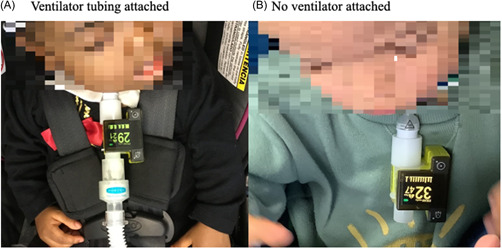
Carbon dioxide concentration trending is used in chronic management of children with invasive home mechanical ventilation (HMV) in clinical settings, but options for end-tidal carbon dioxide (EtCO ) monitoring at home are limited. We hypothesized that a palm-sized, portable endotracheal capnograph (PEC) that measures EtCO could be adapted for in-home use in children with HMV.
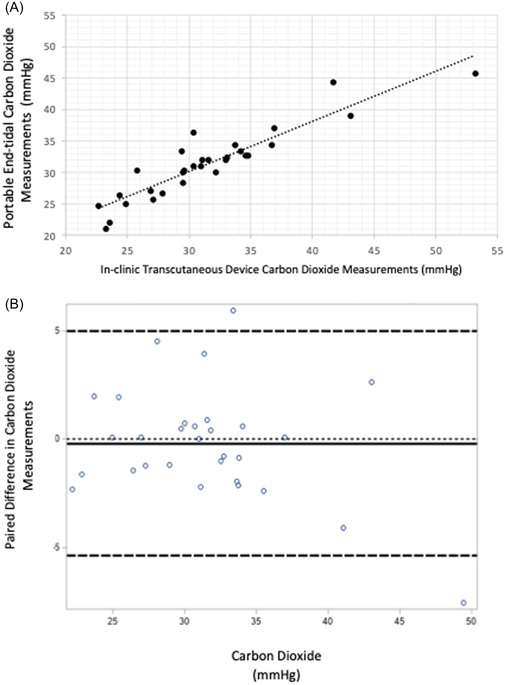
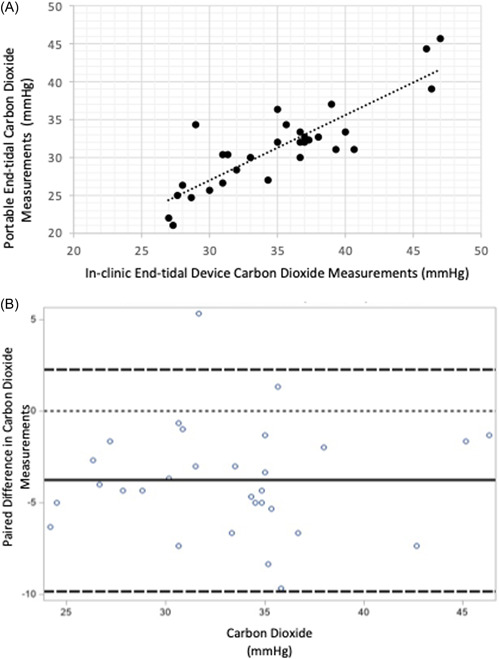
We evaluated the internal consistency of the PEC by calculating an intraclass correlation coefficient of three back-to-back breaths by children (0-17 years) at baseline health in the clinic. Pearson's correlation was calculated for PEC EtCO values with concurrent mean values of in-clinic EtCO and transcutaneous CO (TCM) capnometers. The Bland-Altman test determined their level of agreement. Qualitative interviews and surveys assessed usability and acceptability by family-caregivers at home.
CO values were collected in awake children in varied activity levels and positions (N = 30). The intraclass correlation coefficient for the PEC was 0.95 (p < 0.05). The correlation between the PEC and in-clinic EtCO device was 0.85 with a mean difference of -3.8 mmHg and precision of ±1.1 mmHg. The correlation between the PEC and the clinic TCM device was 0.92 with a mean difference of 0.2 mmHg and precision of ±1.0. Family-caregivers (N = 10) trialed the PEC at home; all were able to obtain measurements at home while children were awake and sometimes asleep.
A portable, noninvasive device for measuring EtCO was feasible and acceptable, with values that trend similarly to currently in-practice, outpatient models. These devices may facilitate monitoring of EtCO at home in children with invasive HMV.
二氧化碳浓度趋势在临床环境中用于患有侵袭性家庭机械通气(HMV)的儿童的慢性管理,但家庭端呼气末二氧化碳(EtCO)监测的选择有限。我们假设一种手掌大小的、便携式的气管内二氧化碳描记器(PEC)可以测量 EtCO,可适应患有 HMV 的儿童家庭使用。
我们通过在诊所中处于基线健康的 0-17 岁儿童进行三次连续呼吸来评估 PEC 的内部一致性,计算其组内相关系数。我们计算了 PEC 的 EtCO 值与在诊所中使用的 EtCO 和经皮 CO(TCM)二氧化碳描记器的同步平均值之间的 Pearson 相关性。Bland-Altman 检验确定了它们的一致性水平。定性访谈和调查评估了家庭护理人员在家中的可用性和可接受性。
我们在清醒的、处于不同活动水平和体位的儿童中收集了 CO 值(N=30)。PEC 的组内相关系数为 0.95(p<0.05)。PEC 与在诊所中的 EtCO 设备之间的相关性为 0.85,平均差异为-3.8mmHg,精度为±1.1mmHg。PEC 与诊所 TCM 设备之间的相关性为 0.92,平均差异为 0.2mmHg,精度为±1.0mmHg。10 名家庭护理人员在家中试用了 PEC;当孩子清醒且有时睡着时,他们都能够在家中获得测量值。
一种用于测量 EtCO 的便携式、非侵入性设备是可行且可接受的,其数值与目前门诊实践中的模型趋势相似。这些设备可能便于对患有侵袭性 HMV 的儿童在家中进行 EtCO 监测。