Division of Urology, Taiwan Adventist Hospital, Taipei, Taiwan.
Division of Pediatric Psychiatry and Sleep Center, Chang Gung Memorial Hospital, Taoyuan, Taiwan.
Medicine (Baltimore). 2022 Aug 12;101(32):e29129. doi: 10.1097/MD.0000000000029129.
Accumulated studies revealed that electromagnetic field can affect human brain and sleep. We explored the effectiveness of electromagnetic field [Schumann resonance (SR)] on nocturia symptoms, quality of life, and sleep in patients with nocturia.
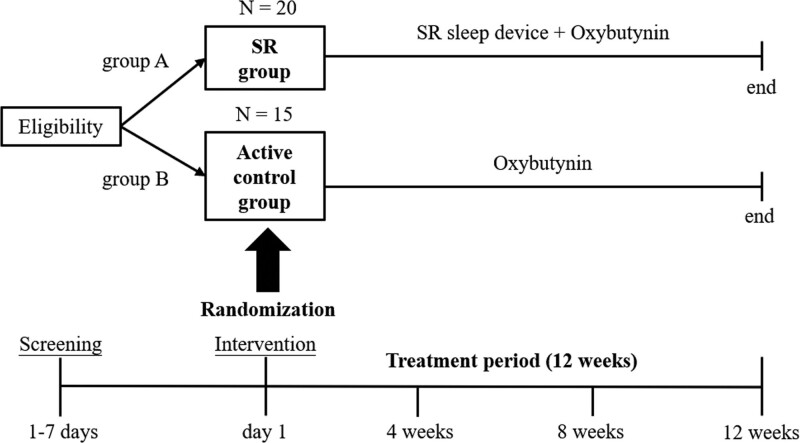
This is a randomized, open-label, and active-controlled study, in which 35 participants were randomized into 2 groups. Group A received oxybutynin and the SR device for 12 weeks, while the active-control group received only the medication. We followed these patients every 4 weeks with a number of questionnaires, including the Pittsburgh sleep quality index (PSQI) and Epworth sleepiness scale (ESS) for sleep, the American Urological Association Symptom Score (AUASS) for nocturia symptoms, and the Nocturia-Quality-of-Life-questionnaire (N-QOL) for quality of life. Descriptive statistics, pair t-tests, Chi-squared tests, and repeated measures were applied for data analysis.
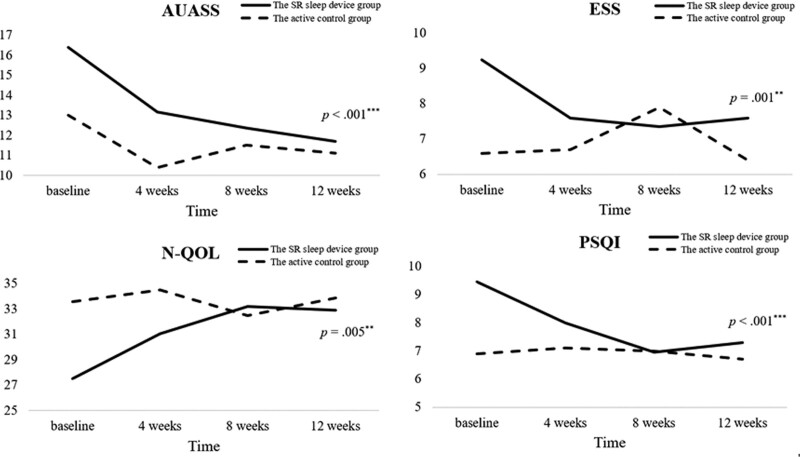
No significant difference was found in the demographic data between the 2 groups. The AUASS, N-QOL, PSQI, and ESS total scores were significantly improved in the SR-sleep-device group (P < .001, P = .005, P < .001, P = .001) after treatment, but no significant change was found in the active-control group. Several variables of AUASS in the SR-sleep-device group were significantly improved, especially streaming and sleeping (both P = .001), and subjective sleep quality and sleep efficiency also demonstrated significant improvement (both P < .001).
Our study revealed that electromagnetic field (SR) as an add-on can improve not only sleep and quality of life but also nocturia symptoms in patients with nocturia. These findings suggest that SR can be effective for sleep disturbance secondary to physical disease, which can be a new application of the electromagnetic field.
越来越多的研究表明,电磁场会影响人类大脑和睡眠。我们探索了电磁场(舒曼共振(SR))对夜尿症症状、生活质量和睡眠的影响。
这是一项随机、开放标签、阳性对照研究,共纳入 35 名参与者,随机分为 2 组。A 组接受奥昔布宁和 SR 设备治疗 12 周,而阳性对照组仅接受药物治疗。我们每 4 周通过一系列问卷对这些患者进行随访,包括匹兹堡睡眠质量指数(PSQI)和 Epworth 嗜睡量表(ESS)评估睡眠,美国泌尿协会症状评分(AUASS)评估夜尿症症状,以及夜尿症生活质量问卷(N-QOL)评估生活质量。采用描述性统计、配对 t 检验、卡方检验和重复测量进行数据分析。
两组患者的人口统计学数据无显著差异。治疗后,SR 睡眠设备组的 AUASS、N-QOL、PSQI 和 ESS 总分均显著改善(P <.001,P =.005,P <.001,P =.001),但阳性对照组无显著变化。SR 睡眠设备组的 AUASS 多个变量明显改善,尤其是流畅性和睡眠(均 P =.001),主观睡眠质量和睡眠效率也有显著改善(均 P <.001)。
我们的研究表明,电磁场(SR)作为附加治疗不仅可以改善夜尿症患者的睡眠和生活质量,还可以改善夜尿症症状。这些发现表明,SR 对因躯体疾病引起的睡眠障碍可能有效,这可能是电磁场的一个新应用。