Pacific Biosciences Research Center, University of Hawai'i at Mānoa, Honolulu, HI 96822.
Biomedical Informatics and Personalized Medicine, University of Colorado Boulder, Aurora, CO 80045.
Proc Natl Acad Sci U S A. 2022 Aug 16;119(33):e2204146119. doi: 10.1073/pnas.2204146119. Epub 2022 Aug 12.
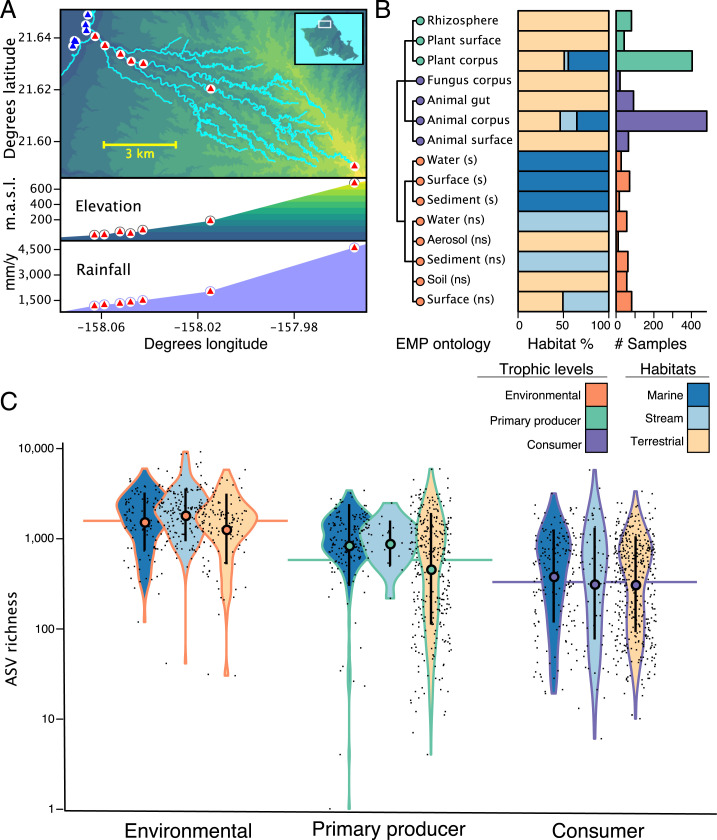
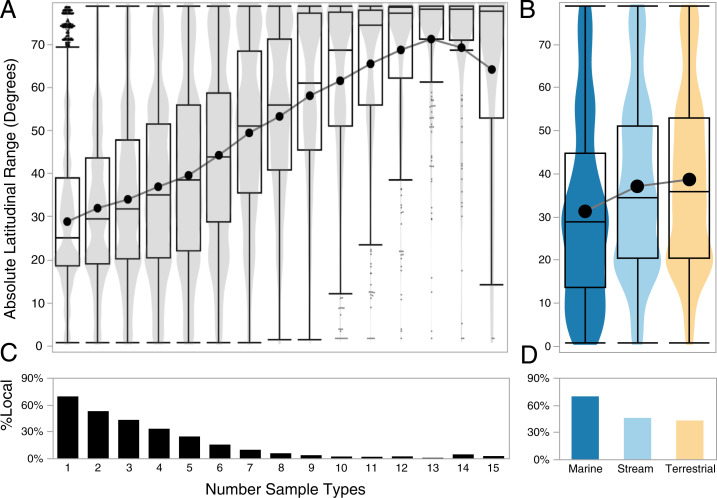
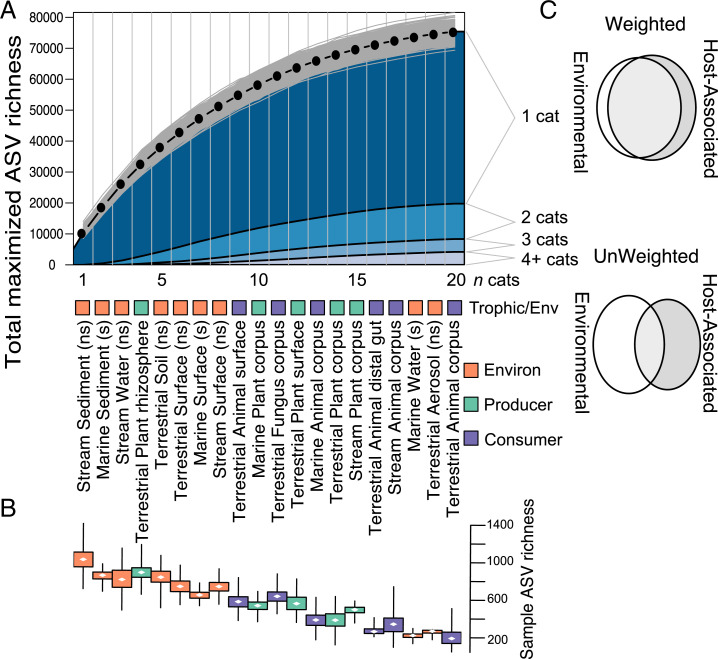
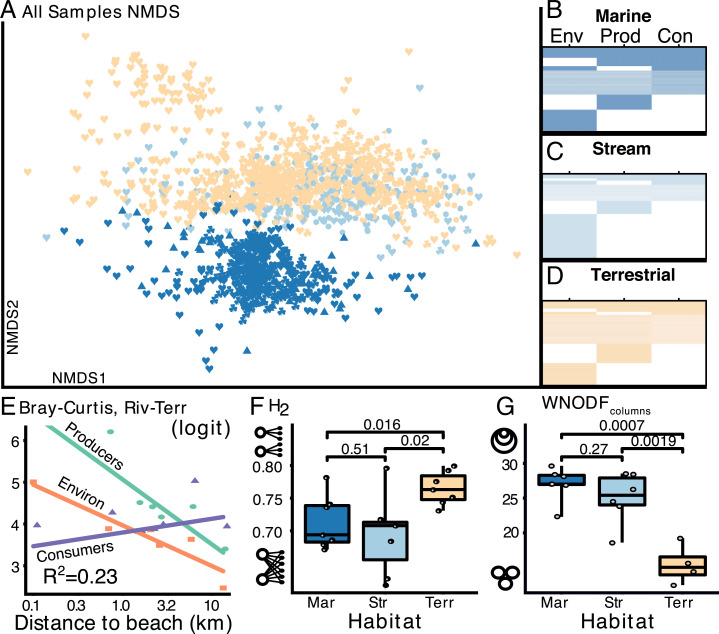
Microbes are found in nearly every habitat and organism on the planet, where they are critical to host health, fitness, and metabolism. In most organisms, few microbes are inherited at birth; instead, acquiring microbiomes generally involves complicated interactions between the environment, hosts, and symbionts. Despite the criticality of microbiome acquisition, we know little about where hosts' microbes reside when not in or on hosts of interest. Because microbes span a continuum ranging from generalists associating with multiple hosts and habitats to specialists with narrower host ranges, identifying potential sources of microbial diversity that can contribute to the microbiomes of unrelated hosts is a gap in our understanding of microbiome assembly. Microbial dispersal attenuates with distance, so identifying sources and sinks requires data from microbiomes that are contemporary and near enough for potential microbial transmission. Here, we characterize microbiomes across adjacent terrestrial and aquatic hosts and habitats throughout an entire watershed, showing that the most species-poor microbiomes are partial subsets of the most species-rich and that microbiomes of plants and animals are nested within those of their environments. Furthermore, we show that the host and habitat range of a microbe within a single ecosystem predicts its global distribution, a relationship with implications for global microbial assembly processes. Thus, the tendency for microbes to occupy multiple habitats and unrelated hosts enables persistent microbiomes, even when host populations are disjunct. Our whole-watershed census demonstrates how a nested distribution of microbes, following the trophic hierarchies of hosts, can shape microbial acquisition.
微生物存在于地球上几乎每一个栖息地和生物体中,它们对宿主的健康、适应能力和新陈代谢至关重要。在大多数生物体中,很少有微生物是在出生时遗传的;相反,获得微生物组通常涉及环境、宿主和共生体之间复杂的相互作用。尽管微生物组的获取至关重要,但我们对宿主的微生物在非目标宿主或其体内时的栖息地知之甚少。由于微生物从与多个宿主和栖息地相关的广义专家到具有更窄宿主范围的狭义专家都有涉及,因此确定可能有助于非相关宿主微生物组的微生物多样性的潜在来源是我们对微生物组组装理解的一个空白。微生物的扩散随着距离的增加而减弱,因此确定来源和汇需要来自微生物组的当代数据,并且这些数据要足够接近潜在的微生物传播。在这里,我们描述了整个流域内相邻陆地和水生宿主和栖息地的微生物组,结果表明,物种最贫乏的微生物组是物种最丰富的微生物组的部分子集,并且植物和动物的微生物组嵌套在其环境的微生物组中。此外,我们还表明,单个生态系统内微生物的宿主和栖息地范围可以预测其全球分布,这与全球微生物组装过程的关系具有重要意义。因此,微生物占据多个栖息地和无关宿主的趋势使得即使宿主种群不连续,微生物组也能持续存在。我们的全流域普查表明,遵循宿主营养层次结构的微生物嵌套分布如何影响微生物的获取。