Section of Orthodontics, Department of Dentistry and Oral Health, Aarhus University, Aarhus, Denmark.
Department of Orthodontics, Institute of Clinical Dentistry, Faculty of Dentistry, University of Oslo, Norway.
Eur J Orthod. 2023 Feb 10;45(1):58-67. doi: 10.1093/ejo/cjac042.
The primary aim of this two-arm parallel two-centre randomized controlled trial was to compare computer-aided design and computer-aided manufacturing (CAD/CAM) versus conventional multistranded fixed retainers (FRs) in terms of stability over 6 months. Secondary outcomes were failure rates and patient satisfaction.
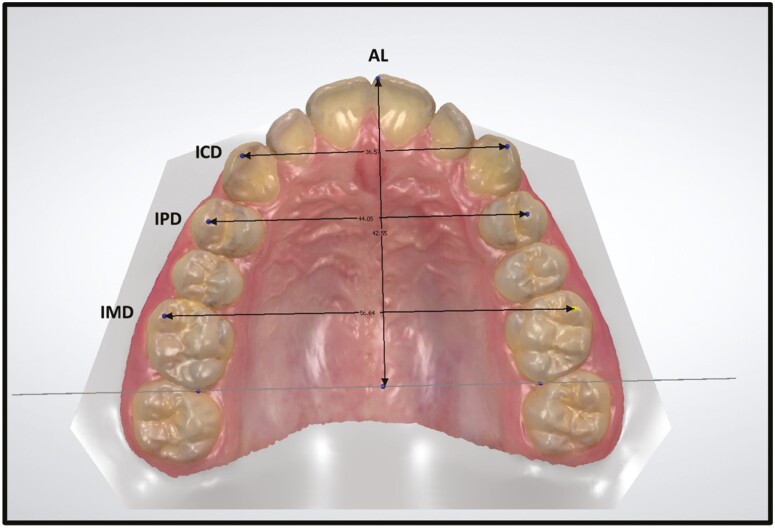
Patients were randomized to CAD/CAM or conventional FRs in both arches, in 1:1 ratio and blocks of four. Allocation concealment was secured by using sequentially numbered envelopes. Patients were blinded. Retainers were bonded at the end of orthodontic treatment (T0), and patients were recalled after 1 (T1), 3 (T3), and 6 (T6) months. First-time retainer failures were recorded and digital impressions were taken. Arch widths and lengths, as well as Little's Irregularity Index (LII), were measured. Additionally, patients answered satisfaction questionnaires. Linear mixed models were applied for measurements and patient satisfaction. Survival analyses were estimated with Kaplan-Meier curves, along with Cox-regression modelling.
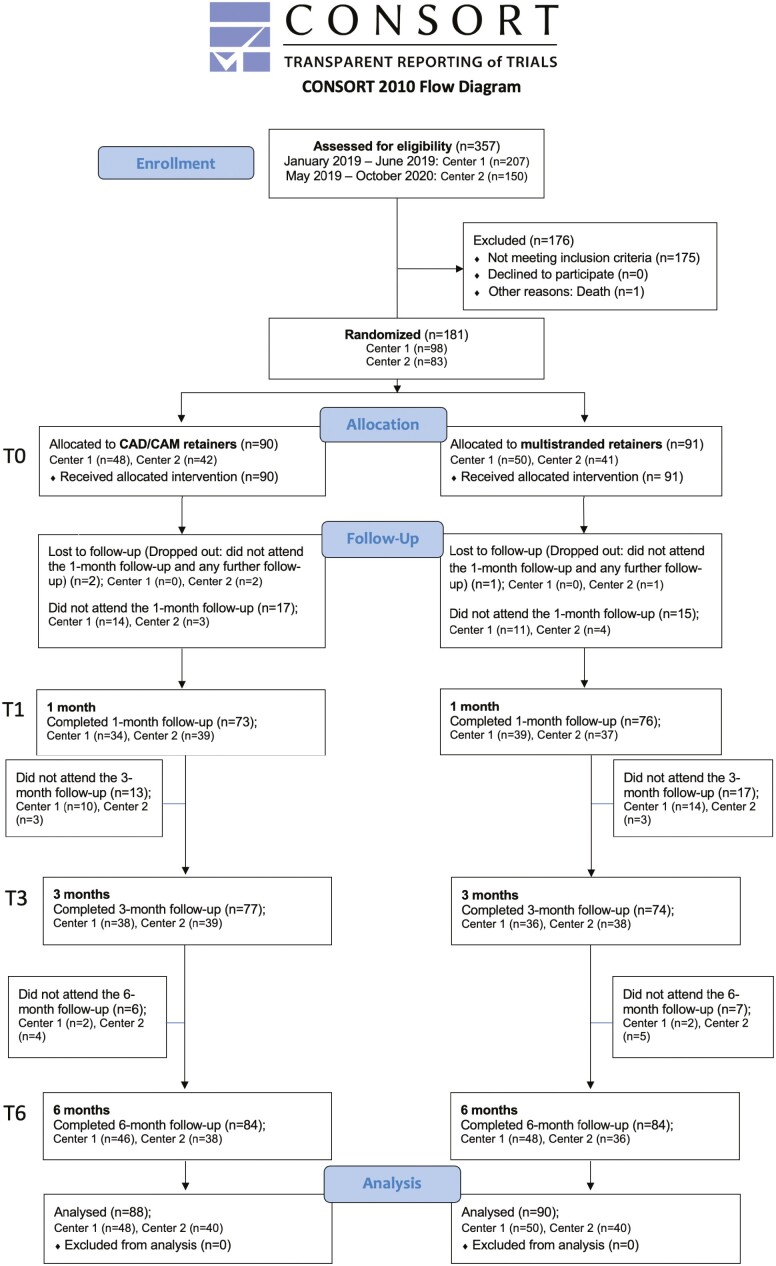
One hundred and eighty-one patients were randomized (98 in Centre 1, and 83 in Centre 2): Ninety in the CAD/CAM group and 91 in the conventional group. Three subjects dropped out at baseline, as they did not attend any of the follow-up appointments.168 patients attended the T6 visit. There were no significant differences in arch dimensions between T0 and T6, whilst the LII was different only in the CAD/CAM group (mean difference: 0.2 mm; 95% confidence interval: 0.1 to 0.4; P < 0.001). Within 6 months, 39 upper retainers (19 out of 88 CAD/CAM and 20 out of 90 conventional retainers) and 52 lower retainers failed (26 out of 88 CAD/CAM and 26 out of 90 conventional retainers), with no significant difference between the survival of both types of retainers (hazard ratios conventional to CAD/CAM: upper arch: 0.99 [P =0.99], lower arch: 0.93 [P = 0.80]). There were no significant changes in patient satisfaction between the groups. No harms were observed.
There were no clinically significant differences in LII, arch widths and lengths between CAD/CAM and conventional retainers after 6 months. There was no difference in failures and in patient satisfaction between both types of FRs.
ClinicalTrials.gov NCT04389879.
本双臂平行、两中心随机对照试验的主要目的是比较计算机辅助设计和计算机辅助制造(CAD/CAM)与传统多股固定保持器(FR)在 6 个月内的稳定性。次要结果是失败率和患者满意度。
患者以 1:1 的比例和 4 个块随机分为 CAD/CAM 或传统 FR 两组,分别在两个弓中。使用连续编号的信封确保了分配的隐蔽性。患者被蒙蔽。在正畸治疗结束时(T0)粘结保持器,然后在 1(T1)、3(T3)和 6(T6)个月后进行随访。记录首次保持器失败,并进行数字印模。测量牙弓宽度和长度,以及 Little 不规则指数(LII)。此外,患者回答了满意度问卷。线性混合模型用于测量和患者满意度。使用 Kaplan-Meier 曲线和 Cox 回归模型估计生存分析。
共有 181 名患者被随机分配(中心 1 98 名,中心 2 83 名):CAD/CAM 组 90 名,传统组 91 名。3 名患者在基线时退出,因为他们没有参加任何随访。168 名患者参加了 T6 次就诊。在 T0 和 T6 之间,牙弓尺寸没有显著差异,而 LII 仅在 CAD/CAM 组有差异(平均差异:0.2mm;95%置信区间:0.1 至 0.4;P<0.001)。在 6 个月内,39 个上保持器(CAD/CAM 88 个中的 19 个和传统 90 个中的 20 个)和 52 个下保持器失效(CAD/CAM 88 个中的 26 个和传统 90 个中的 26 个),两种保持器的存活率无显著差异(传统与 CAD/CAM 相比的危险比:上弓:0.99[P=0.99],下弓:0.93[P=0.80])。两组患者的满意度均无显著变化。未观察到任何危害。
在 6 个月后,CAD/CAM 和传统保持器在 LII、牙弓宽度和长度方面没有临床显著差异。两种 FR 之间的失败率和患者满意度无差异。
ClinicalTrials.gov NCT04389879。