Institute for Clinical Diabetology, German Diabetes Center, Leibniz Center for Diabetes Research at Heinrich Heine University, Düsseldorf, Germany.
German Center for Diabetes Research (DZD e. V.), Partner Düsseldorf, Neuherberg, Germany.
J Clin Endocrinol Metab. 2022 Sep 28;107(10):e4167-e4176. doi: 10.1210/clinem/dgac480.
Endothelial dysfunction may occur early in the development of cardiovascular and metabolic diseases; however, it remains often underestimated and studies rarely discriminate between diabetes types. We have examined endothelial function and its determinants during the early course of type 1 and type 2 diabetes.
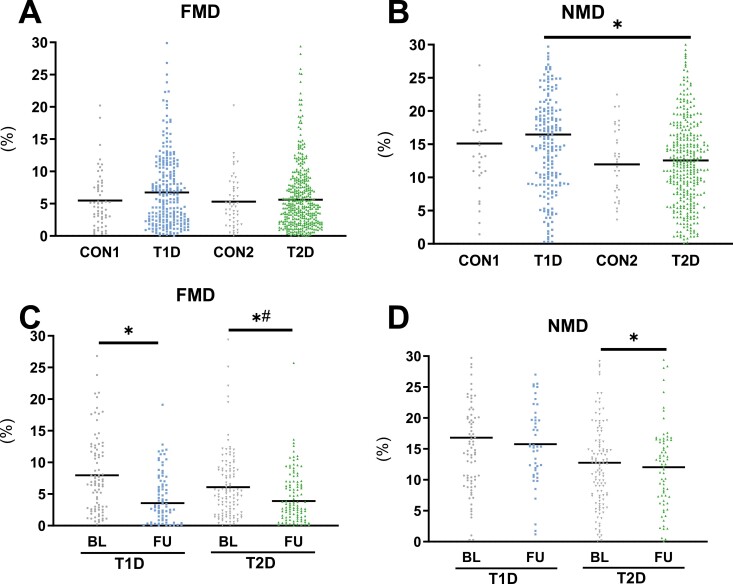
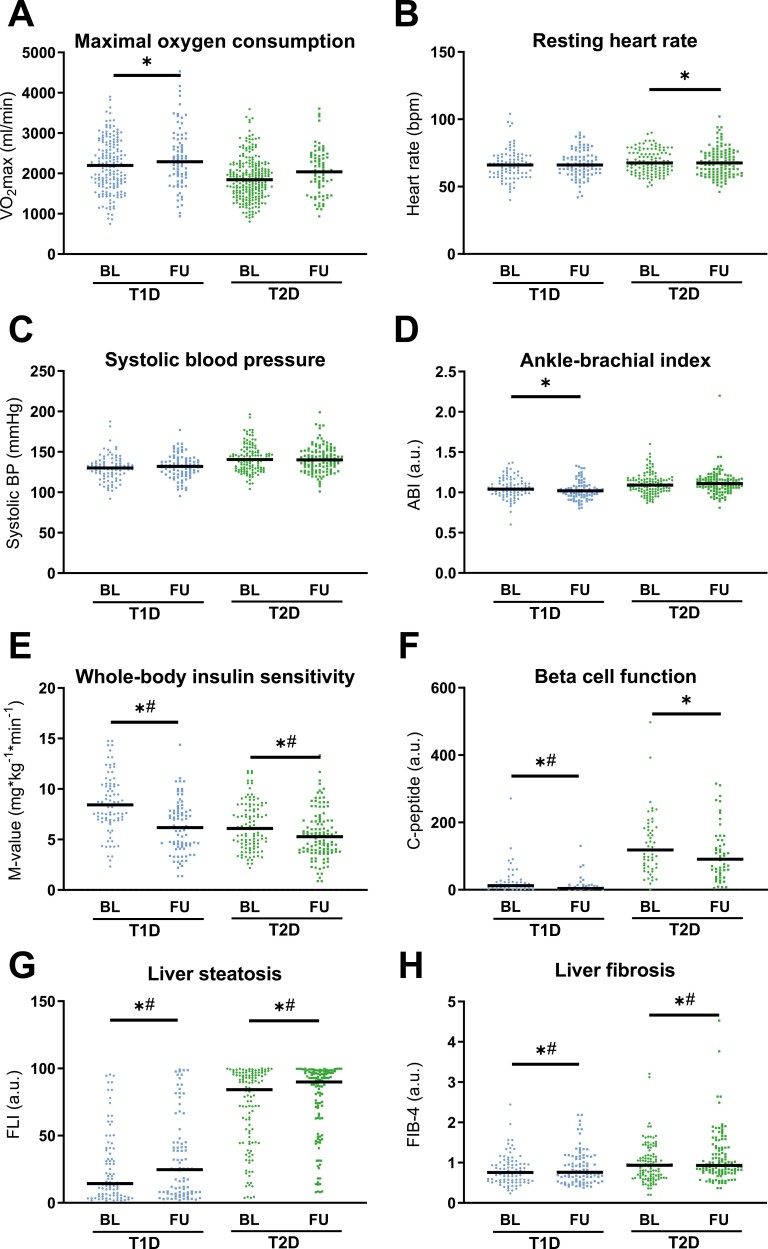
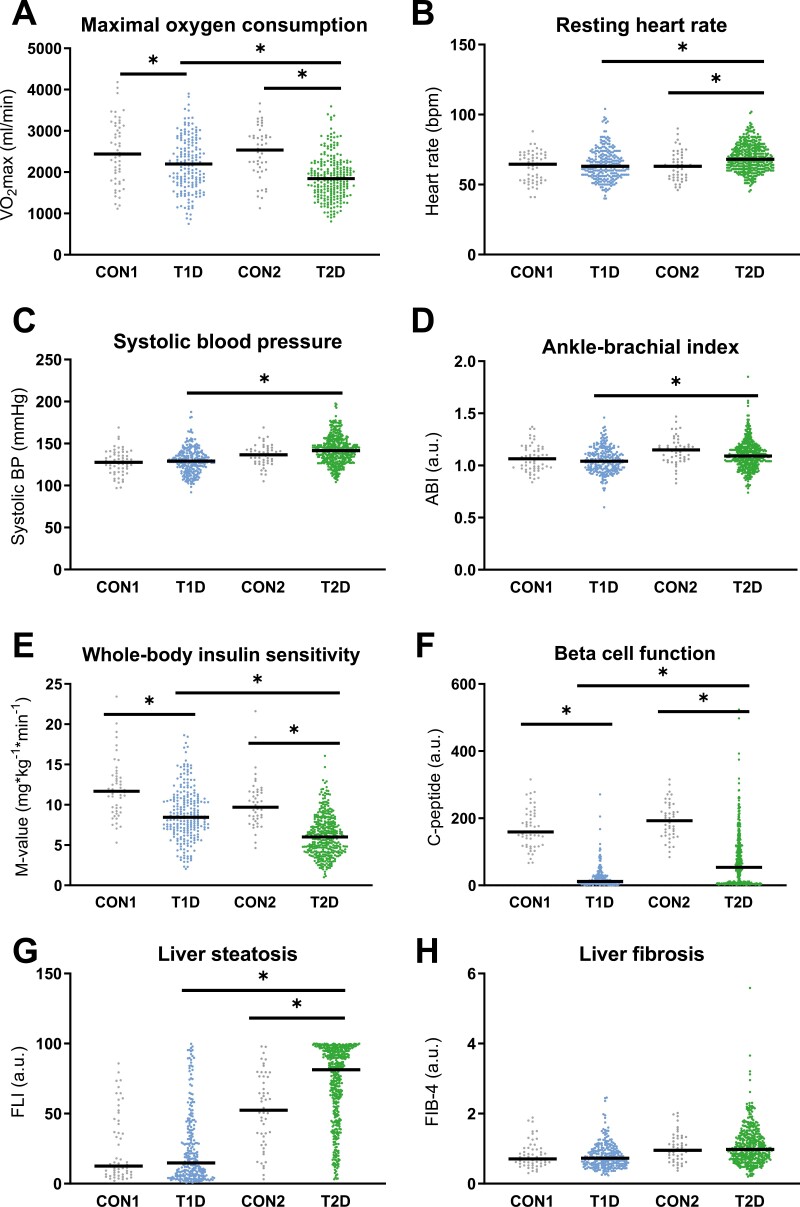
Caucasian participants of the prospective German Diabetes Study (GDS) with known diabetes duration <1 year (n = 398) or without diabetes, but of similar age, body mass index (BMI) and sex distribution (n = 109), underwent measurements of flow-mediated dilation (FMD) and nitroglycerin-mediated dilatation (NMD). Whole-body insulin sensitivity (M-value) was assessed by hyperinsulinemic-euglycemic clamps and physical fitness (VO2max) by spiroergometry. A subset of individuals with type 1 or type 2 diabetes (n = 108) was re-evaluated after 5 years.
At baseline, neither FMD nor NMD differed between people with diabetes and the matched glucose-tolerant groups. At the 5-year follow-up, decline in FMD (-13.9%, P = .013) of persons with type 2 diabetes was independent of age, sex, and BMI, but associated with baseline adipose tissue insulin resistance and indices of liver fibrosis. The M-value decreased in both type 1 and type 2 diabetes groups by 24% and 15% (both P < .001, respectively) over 5 years. Higher HbA1c, lower M-value, and lower VO2max at baseline was associated with lower FMD in both type 1 and type 2 diabetes.
Endothelial function decreases during the early course of type 2 diabetes. In addition to age and BMI, insulin sensitivity at diagnosis was the best predictor of progressive impairment in endothelial function in type 2 diabetes.
内皮功能障碍可能在心血管和代谢疾病的早期发展中发生;然而,它仍然经常被低估,而且研究很少区分糖尿病类型。我们检查了 1 型和 2 型糖尿病早期内皮功能及其决定因素。
参加前瞻性德国糖尿病研究(GDS)的白种人参与者,已知糖尿病病程<1 年(n=398)或无糖尿病,但年龄、体重指数(BMI)和性别分布相似(n=109),接受血流介导的扩张(FMD)和硝酸甘油介导的扩张(NMD)测量。全身胰岛素敏感性(M 值)通过高胰岛素-正常血糖钳夹评估,身体适应性(VO2max)通过呼吸功测量评估。1 型或 2 型糖尿病患者的亚组(n=108)在 5 年后重新评估。
在基线时,糖尿病患者和匹配的葡萄糖耐受人群之间的 FMD 或 NMD 没有差异。在 5 年的随访中,2 型糖尿病患者的 FMD 下降(-13.9%,P=0.013)与年龄、性别和 BMI 无关,但与基线脂肪组织胰岛素抵抗和肝纤维化指数相关。1 型和 2 型糖尿病组的 M 值在 5 年内分别下降了 24%和 15%(均 P<0.001)。较高的 HbA1c、较低的 M 值和较低的 VO2max 与 1 型和 2 型糖尿病患者的 FMD 降低相关。
在 2 型糖尿病的早期阶段,内皮功能下降。除年龄和 BMI 外,诊断时的胰岛素敏感性是 2 型糖尿病内皮功能进行性损害的最佳预测指标。