Anderson Nathaniel W, Markowitz Anna J, Eisenberg Daniel, Halfon Neal, Moore Kristin Anderson, Zimmerman Frederick J
Department of Health Policy and Management, UCLA, Los Angeles, CA USA.
Department of Education, UCLA, Los Angeles, CA USA.
Child Indic Res. 2022;15(6):2015-2042. doi: 10.1007/s12187-022-09962-0. Epub 2022 Aug 6.
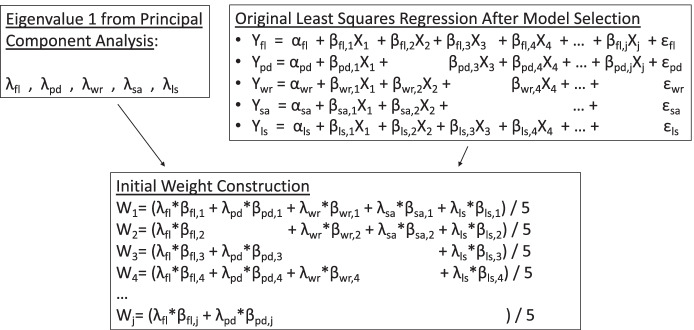
The well-being of children and adolescents is emerging as an area of interest for population health measurement. Previous approaches assessing national and state trends in well-being have relied on composite indices. However, these methodologies suffer from several weaknesses. This paper develops an improved index for the United States that is measurable with existing population-data resources. It derives the appropriate weights for items in this index using a longitudinal panel of 2,942 children in the Panel Study of Income Dynamics. Candidate component measures are selected for the index based on their demonstrated association with several subjective scales assessed during young adulthood. The final index demonstrates that a broad range of measures indicate higher levels of population-level well-being. The predictive validity of the index for outcomes during young adulthood is also assessed: a one-standard-deviation increase in the index score is associated with a 7.9-percentage-point decrease [95% CI: 5.9 - 9.8] in ever reporting fair or poor health, a 6.3-percentage-point decrease [95% CI: 4.6 - 8.0] in ever reporting depression, and a 17.2% [95% CI: 13.7% - 20.5%] increase in peak earnings. These values for predictive validity are slightly higher than those of existing methodologies. We also find that incorporating contextual indicators from childhood and adolescence does not substantively improve predictive validity. Policy-makers and government agencies interested in population-level well-being of children and adolescents can continue to use existing indices as reasonable proxies, but should also commit to upgrading data systems to make them more child-centric in the future.
The online version contains supplementary material available at 10.1007/s12187-022-09962-0.
儿童和青少年的福祉正成为人口健康测量领域的一个关注焦点。以往评估国家和州层面福祉趋势的方法依赖于综合指数。然而,这些方法存在若干缺陷。本文为美国开发了一种改进的指数,该指数可利用现有的人口数据资源进行测量。它使用收入动态面板研究中2942名儿童的纵向面板数据得出该指数项目的适当权重。基于其与年轻成年期评估的几个主观量表的已证明关联,为该指数选择候选组成指标。最终指数表明,广泛的指标显示出更高水平的人口层面福祉。还评估了该指数对年轻成年期结果的预测效度:指数得分每增加一个标准差,报告健康状况为一般或较差的比例下降7.9个百分点[95%置信区间:5.9 - 9.8],报告有抑郁症状的比例下降6.3个百分点[95%置信区间:4.6 - 8.0],最高收入增加17.2%[95%置信区间:13.7% - 20.5%]。这些预测效度值略高于现有方法。我们还发现,纳入童年和青少年时期的背景指标并不能实质性提高预测效度。对儿童和青少年人口层面福祉感兴趣的政策制定者和政府机构可以继续将现有指数用作合理的替代指标,但也应致力于升级数据系统,使其在未来更以儿童为中心。
在线版本包含可在10.1007/s12187-022-09962-0获取的补充材料。