Nugraha Jusak, Permatasari Cynthia Ayu, Fitriah Munawaroh, Tambunan Betty Agustina, Fuadi Muhamad Robi'ul
Department of Clinical Pathology, Faculty of Medicine, Airlangga University, Dr. Soetomo Hospital, Surabaya, Indonesia.
Clinical Pathology Specialization Program, Faculty of Medicine Airlangga University, Surabaya, Indonesia.
J Public Health Res. 2022 Aug 9;11(3):22799036221104173. doi: 10.1177/22799036221104173. eCollection 2022 Jul.
COVID-19 pandemic causes severe acute respiratory syndrome and requires rapid action. The development of effective safe vaccines become a global priority for achieving herd immunity. Vaccination is expected to form specific antibodies against the SARS-CoV-2 spike protein which can neutralize the virus, preventing the virus from binding with ACE 2 receptors.
Evaluating and to know if there any differences of kinetics antibody levels from recipient's anti-IgG S-RBD and NAb with complete second dose CoronaVac Vaccine, to determine the antibody response in preventing SARS-CoV-2.
A prospective-cohort study using observational analytics was conducted from January-April 2021 at Dr. Soetomo Hospital, Surabaya. A total of 50 subjects are healthcare workers who received two doses of CoronaVac. The IgG S-RBD and NAb levels were measured on Maglumi 800 device (SNIBE, China). Differences in IgG S-RBD and NAb levels before vaccination and after second dose CoronaVac vaccination on 14th day, on 28th day, ware tested using Friedman and Wilcoxon tests.
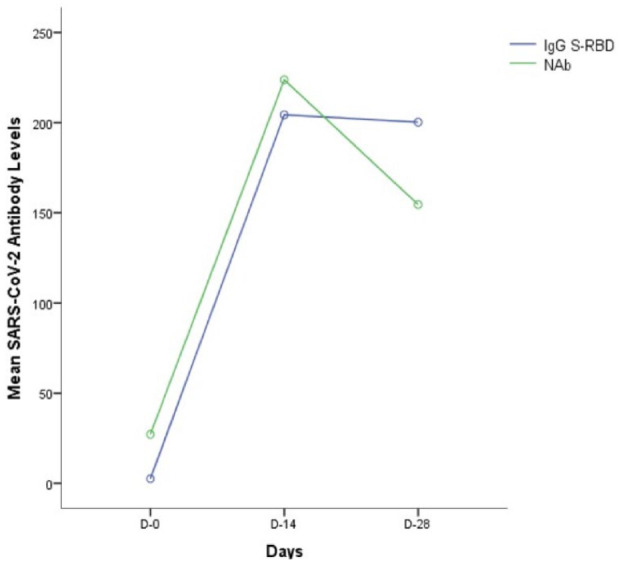
Mean values of IgG S-RBD and NAb have fluctuated. There was a significant difference between IgG S-RBD and NAb levels on day-0 (0.090 vs 18.630; < 0.001) and day-28 (141.266 vs 116.640; = 0.037). The median value showed the IgG S-RBD level on day-28 was much better than NAb value (141,266 v 116,640).
CoronaVac will form persistent antibodies. Despite antibody development, the acquired humoral immunity decreased at 28 days after full CoronaVac immunization. Kinetics of antibody NAb decreased more rapidly than IgG S-RBD.
新型冠状病毒肺炎疫情引发严重急性呼吸综合征,需要迅速采取行动。研发有效安全的疫苗成为实现群体免疫的全球优先事项。接种疫苗有望形成针对严重急性呼吸综合征冠状病毒2刺突蛋白的特异性抗体,该抗体可中和病毒,防止病毒与血管紧张素转换酶2受体结合。
评估并了解接种两剂科兴新冠疫苗后,受种者抗IgG S-RBD和中和抗体的动力学抗体水平是否存在差异,以确定抗体在预防严重急性呼吸综合征冠状病毒2方面的反应。
2021年1月至4月在泗水苏托莫博士医院进行了一项采用观察性分析的前瞻性队列研究。共有50名受试者为接种了两剂科兴新冠疫苗的医护人员。使用迈瑞800设备(中国深圳新产业生物医学工程股份有限公司)检测IgG S-RBD和中和抗体水平。采用弗里德曼检验和威尔科克森检验对接种疫苗前以及接种第二剂科兴新冠疫苗后第14天和第28天的IgG S-RBD和中和抗体水平差异进行检测。
IgG S-RBD和中和抗体的平均值有所波动。第0天(0.090对18.630;<0.001)和第28天(141.266对116.640;=0.037)的IgG S-RBD和中和抗体水平存在显著差异。中位数显示,第28天的IgG S-RBD水平远高于中和抗体水平(141,266对116,640)。
科兴新冠疫苗可形成持久抗体。尽管产生了抗体,但在完成科兴新冠疫苗全程免疫后28天,获得的体液免疫有所下降。中和抗体的动力学下降速度比IgG S-RBD更快。