De Ri, Zhang Ke-Xiang, Wang Fang, Zhou Yu-Tong, Sun Yu, Chen Dong-Mei, Zhu Ru-Nan, Guo Qi, Liu Shuang, Qu Dong, Qian Yuan, Zhao Lin-Qing
Laboratory of Virology, Beijing Key Laboratory of Etiology of Viral Diseases in Children, Capital Institute of Pediatrics, Beijing, China.
Graduate School of Peking Union Medical College, Beijing, China.
Front Microbiol. 2022 Jul 29;13:932858. doi: 10.3389/fmicb.2022.932858. eCollection 2022.
Human bocavirus 1 (HBoV1), first discovered in 2005, was positive in symptomatic and healthy children and co-detected with other respiratory viruses. It is a long journey to decisively demonstrate the unique viral pathogenic function of acute respiratory tract infection (ARTI) in pediatric patients.
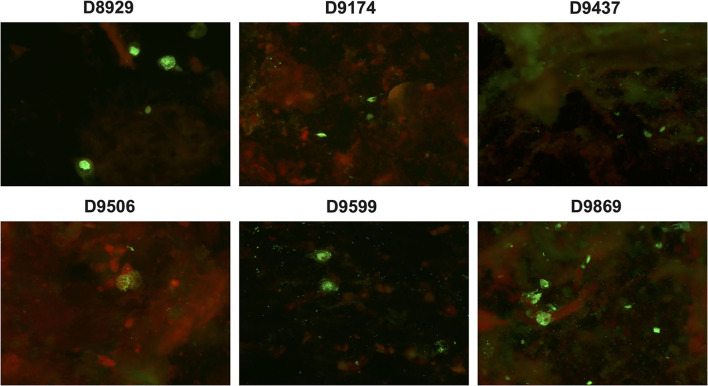
Respiratory specimens collected from pediatric patients with ARTI from January 2017 to December 2021 were screened by a capillary electrophoresis-based multiplex PCR (CEMP) assay, then genotyped by PCR and sequencing for HBoV1. For the antigen test, a part of HBoV1 DNA positive nasopharyngeal aspirates (NPAs) was used as an antigen, while a rabbit anti-HBoV1 DR2 specific to HBoV1 was used as an antibody in the indirect-immunofluorescence assay (IFA). Finally, the levels of IgG specific to HBoV1 in acute and convalescent sera selected retrospectively from only HBoV1 DNA-positive patients were evaluated by IFA.
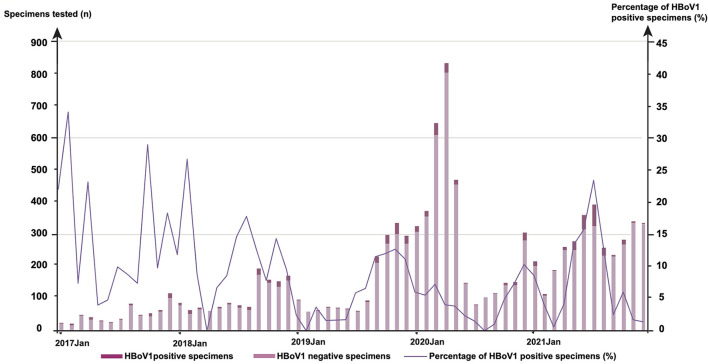
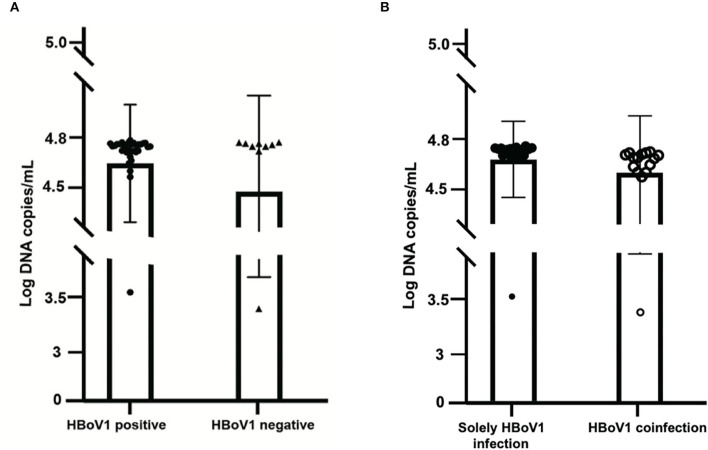
Among 9,899 specimens, 681 were positive for HBoV1 DNA (6.88%, 681/9899), which included 336 positives only for HBoV1 (49.34%, 336/681) and 345 (50.66%, 345/681) positives also for other pathogens. In the antigen test, there were 37 among 47 NPAs determined as HBoV1 antigen-positive (78.72%, 37/47), including 18 (48.65%, 18/37) positives solely for HBoV1 DNA. Among 4 pediatric patients with both acute and convalescent sera, there was one positive for HBoV1 antigen (D8873) and 2 lack the antigen results (D1474 and D10792), which showed seroconversion with a ≥ 4-fold increase in IgG levels.
The combination results of nucleic acid, antigen, and serology tests answered that HBoV1 is a genuine pathogen for ARTI in pediatric patients.
人博卡病毒1型(HBoV1)于2005年首次发现,在有症状和健康的儿童中呈阳性,并与其他呼吸道病毒共同检测到。要明确证明其在儿科患者急性呼吸道感染(ARTI)中独特的病毒致病作用,还有很长的路要走。
对2017年1月至2021年12月从患有ARTI的儿科患者中收集的呼吸道标本进行基于毛细管电泳的多重PCR(CEMP)检测筛选,然后通过PCR和测序对HBoV1进行基因分型。对于抗原检测,将一部分HBoV1 DNA阳性的鼻咽抽吸物(NPA)用作抗原,而将针对HBoV1的兔抗HBoV1 DR2用作间接免疫荧光检测(IFA)中的抗体。最后,通过IFA评估仅从HBoV1 DNA阳性患者中回顾性选择的急性期和恢复期血清中HBoV1特异性IgG的水平。
在9899份标本中,681份HBoV1 DNA呈阳性(6.88%,681/9899),其中仅HBoV1阳性336份(49.34%,336/681),同时感染其他病原体的阳性345份(50.66%,345/681)。在抗原检测中,47份NPA中有37份被确定为HBoV1抗原阳性(78.72%,37/47),其中仅HBoV1 DNA阳性18份(48.65%,18/37)。在4例同时有急性期和恢复期血清的儿科患者中,1例HBoV1抗原阳性(D8873),2例缺乏抗原检测结果(D1474和D10792),其IgG水平呈≥4倍升高的血清学转换。
核酸、抗原和血清学检测的综合结果表明,HBoV1是儿科患者ARTI的真正病原体。