Vlaeminck Jelle, Lin Qiang, Xavier Basil Britto, De Backer Sarah, Berkell Matilda, De Greve Henri, Hernalsteens Jean-Pierre, Kumar-Singh Samir, Goossens Herman, Malhotra-Kumar Surbhi
Laboratory of Medical Microbiology, Vaccine and Infectious Disease Institute, University of Antwerp, Antwerp, Belgium.
Molecular Pathology Group, Laboratory of Cell Biology & Histology, University of Antwerp, Antwerp, Belgium.
Front Microbiol. 2022 Jul 28;13:882346. doi: 10.3389/fmicb.2022.882346. eCollection 2022.
Methicillin-resistant (MRSA), a leading cause of chronic infections, forms prolific biofilms which afford an escape route from antibiotic treatment and host immunity. However, MRSA clones are genetically diverse, and mechanisms underlying biofilm formation remain under-studied. Such studies form the basis for developing targeted therapeutics. Here, we studied the temporal changes in the biofilm transcriptome of three pandemic MRSA clones: USA300, HEMRSA-15, and ST239.
Biofilm formation was assessed using a static model with one representative strain per clone. Total RNA was extracted from biofilm and planktonic cultures after 24, 48, and 72 h of growth, followed by rRNA depletion and sequencing (Illumina Inc., San Diego, CA, United States, NextSeq500, v2, 1 × 75 bp). Differentially expressed gene (DEG) analysis between phenotypes and among early (24 h), intermediate (48 h), and late (72 h) stages of biofilms was performed together with co-expression network construction and compared between clones. To understand the influence of SCC and ACME on biofilm formation, isogenic mutants containing deletions of the entire elements or of single genes therein were constructed in USA300.
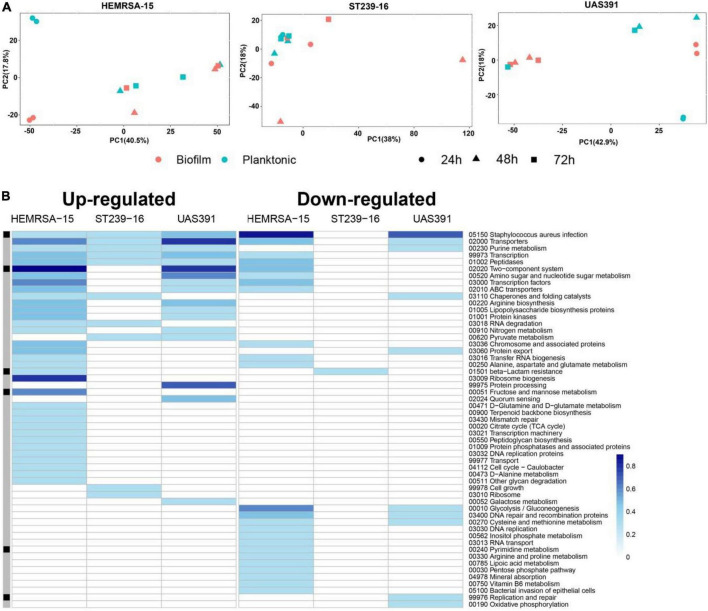
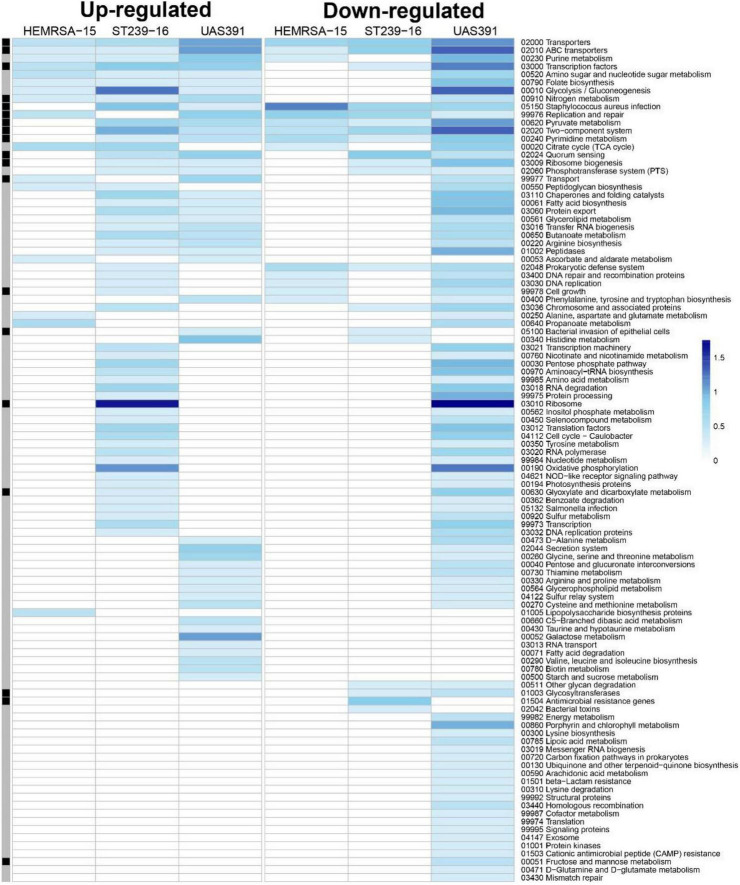
Genes involved in primarily core genome-encoded KEGG pathways (transporters and others) were upregulated in 24-h biofilm culture compared to 24-h planktonic culture. However, the number of affected pathways in the ST239 24 h biofilm ( = 11) was remarkably lower than that in USA300/EMRSA-15 biofilms (USA300: = 27, HEMRSA-15: = 58). The gene, which encodes clumping factor A, was the single common DEG identified across the three clones in 24-h biofilm culture (2.2- to 2.66-fold). In intermediate (48 h) and late (72 h) stages of biofilms, decreased expression of central metabolic and fermentative pathways (glycolysis/gluconeogenesis, fatty acid biosynthesis), indicating a shift to anaerobic conditions, was already evident in USA300 and HEMRSA-15 in 48-h biofilm cultures; ST239 showed a similar profile at 72 h. Last, SCC+ACME deletion and disruption negatively affected USA300 biofilm formation.
Our data show striking differences in gene expression during biofilm formation by three of the most important pandemic MRSA clones, USA300, HEMRSA-15, and ST239. The gene was the only significantly upregulated gene across all three strains in 24-h biofilm cultures and exemplifies an important target to disrupt early biofilms. Furthermore, our data indicate a critical role for arginine catabolism pathways in early biofilm formation.
耐甲氧西林金黄色葡萄球菌(MRSA)是慢性感染的主要病因,可形成大量生物膜,这为其逃避抗生素治疗和宿主免疫提供了途径。然而,MRSA克隆在基因上具有多样性,生物膜形成的潜在机制仍研究不足。此类研究是开发靶向治疗药物的基础。在此,我们研究了三种大流行MRSA克隆株(USA300、HEMRSA - 15和ST239)生物膜转录组的时间变化。
使用静态模型评估生物膜形成,每个克隆株选取一个代表性菌株。在生长24、48和72小时后,从生物膜和浮游培养物中提取总RNA,随后进行rRNA去除和测序(美国加利福尼亚州圣地亚哥的Illumina公司,NextSeq500,v2,1×75 bp)。对表型之间以及生物膜早期(24小时)、中期(48小时)和晚期(72小时)阶段进行差异表达基因(DEG)分析,并构建共表达网络,同时在克隆株之间进行比较。为了解葡萄球菌盒式染色体(SCC)和附属基因调控模块(ACME)对生物膜形成的影响,在美国300株中构建了缺失整个元件或其中单个基因的同基因突变体。
与24小时浮游培养相比,主要参与核心基因组编码的KEGG通路(转运蛋白等)的基因在24小时生物膜培养中上调。然而,ST239 24小时生物膜中受影响的通路数量(= 11)明显低于USA300/EMRSA - 15生物膜(USA300:= 27;HEMRSA - 15:= 58)。编码聚集因子A的clfA基因是在24小时生物膜培养中在三个克隆株中均鉴定出的唯一共同差异表达基因(2.2至2.66倍)。在生物膜的中期(48小时)和晚期(72小时)阶段,中心代谢和发酵途径(糖酵解/糖异生、脂肪酸生物合成)的表达降低,表明向厌氧条件转变,这在USA300和HEMRSA - 15的48小时生物膜培养中已很明显;ST239在72小时时表现出类似特征。最后,SCC + ACME缺失和clfA破坏对USA300生物膜形成产生负面影响。
我们的数据显示,三种最重要的大流行MRSA克隆株(USA300、HEMRSA - 15和ST239)在生物膜形成过程中的基因表达存在显著差异。clfA基因是24小时生物膜培养中所有三个菌株中唯一显著上调的基因,是破坏早期生物膜的重要靶点。此外,我们的数据表明精氨酸分解代谢途径在早期生物膜形成中起关键作用。