Hospital Universitari Vall d'Hebron, Barcelona, Spain.
Health Services Research Group, Institut de Recerca Vall d'Hebron, Barcelona, Spain.
F1000Res. 2021 Nov 24;10:1197. doi: 10.12688/f1000research.73988.1. eCollection 2021.
Hospitals have constituted the limiting resource of the healthcare systems for the management of the COVID-19 pandemic. As the pandemic progressed, knowledge of the disease improved, and healthcare systems were expected to be more adapted to provide a more efficient response. The objective of this research was to compare the flow of COVID-19 patients in emergency rooms and hospital wards, between the pandemic's first and second waves at the University Hospital of Vall d'Hebron (Barcelona, Spain), and to compare the profiles, severity and mortality of COVID-19 patients between the two waves.
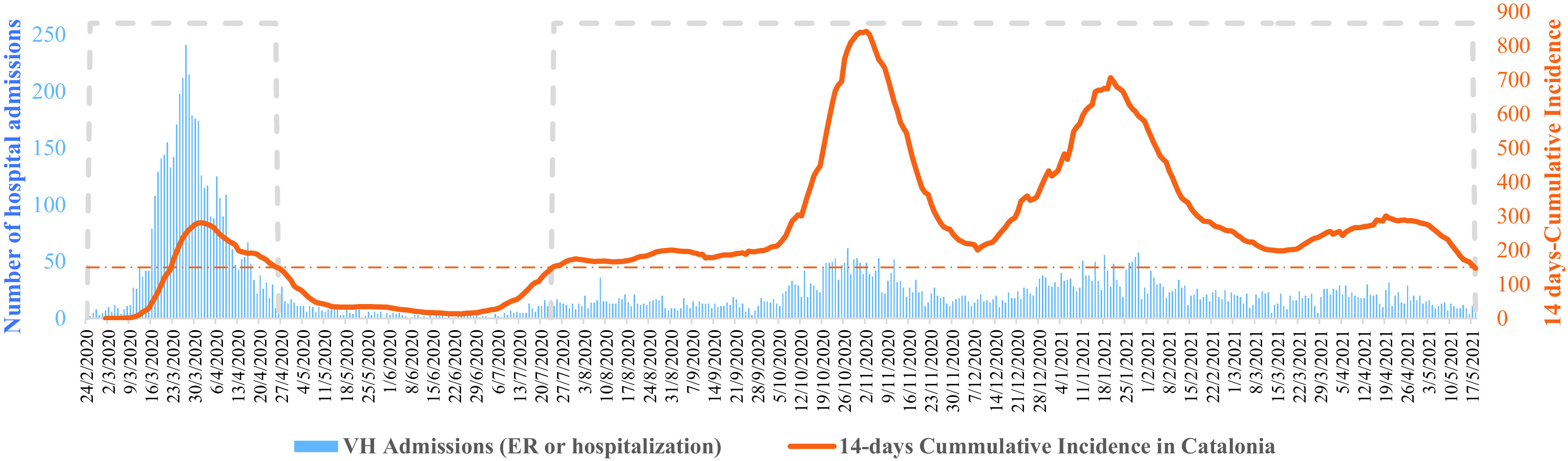
A retrospective observational analysis of COVID-19 patients attending the hospital from February 24 to April 26, 2020 (first wave) and from July 24, 2020, to May 18, 2021 (second wave) was carried out. We analysed the data of the electronic medical records on patient demographics, comorbidity, severity, and mortality.
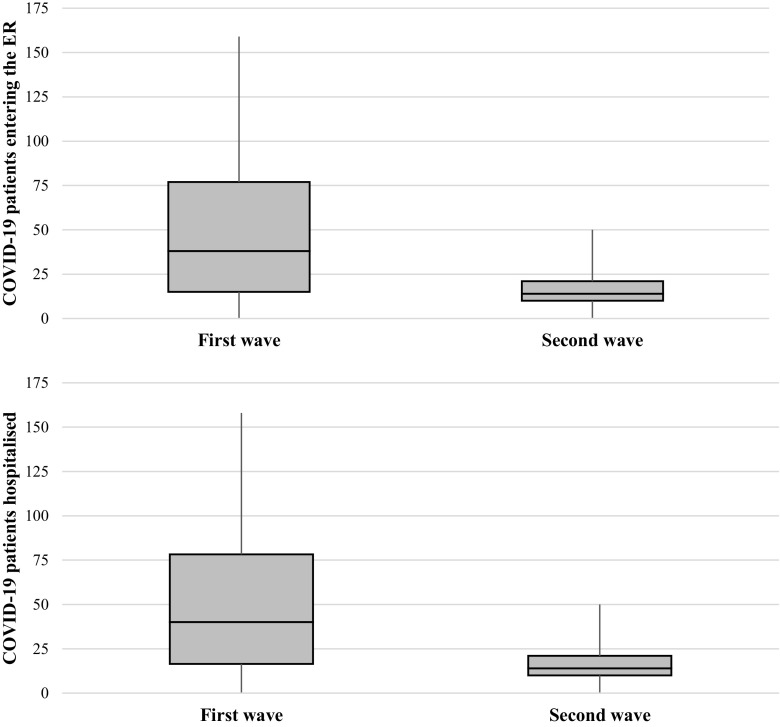
The daily number of COVID-19 patients entering the emergency rooms (ER) dropped by 65% during the second wave compared to the first wave. During the second wave, patients entering the ER were significantly younger (61 against 63 years old p<0.001) and less severely affected (39% against 48% with a triage level of resuscitation or emergency; p<0.001). ER mortality declined during the second wave (1% against 2%; p<0.000). The daily number of hospitalised COVID-19 patients dropped by 75% during the second wave. Those hospitalised during the second wave were more severely affected (20% against 10%; p<0.001) and were referred to the intensive care unit (ICU) more frequently (21% against 15%; p<0.001). Inpatient mortality showed no significant difference between the two waves.
Changes in the flow, severity and mortality of COVID-19 patients entering this tertiary hospital during the two waves may reflect a better adaptation of the health care system and the improvement of knowledge on the disease.
在应对 COVID-19 大流行期间,医院已经成为医疗体系的资源限制因素。随着大流行的发展,人们对疾病的认识不断提高,医疗体系也应该更加适应,以提供更有效的应对。本研究的目的是比较 COVID-19 患者在西班牙巴塞罗那 Vall d'Hebron 大学医院急诊室和病房中的流动情况,比较两次大流行期间 COVID-19 患者的特征、严重程度和死亡率。
对 2020 年 2 月 24 日至 4 月 26 日(第一波)和 2020 年 7 月 24 日至 2021 年 5 月 18 日(第二波)期间来院的 COVID-19 患者进行回顾性观察性分析。我们分析了电子病历中患者人口统计学、合并症、严重程度和死亡率的数据。
与第一波相比,第二波进入急诊室的 COVID-19 患者数量每日减少了 65%。在第二波中,进入急诊室的患者年龄明显更小(61 岁对 63 岁;p<0.001),病情也明显较轻(39%对 48%需要进行复苏或紧急分诊;p<0.001)。第二波急诊死亡率下降(1%对 2%;p<0.000)。第二波住院 COVID-19 患者数量每日减少了 75%。第二波住院患者病情更严重(20%对 10%;p<0.001),更频繁地转至重症监护病房(ICU)(21%对 15%;p<0.001)。两次大流行期间住院死亡率无显著差异。
在两次大流行期间,进入这家三级医院的 COVID-19 患者的流动、严重程度和死亡率的变化可能反映了医疗保健系统的更好适应和对疾病认识的提高。